 Milton Cooper
Sean Hibbeler’s documentary revisits the allegation that jet trails conceal a secret spraying program. America’s documented experiments with the weather raise a different question about public oversight.
In parts of the American West, efforts to coax more snow from winter clouds are a matter of public record. Cloud seeding has been used for decades, typically by introducing tiny particles of silver iodide into suitable clouds. How much extra snow does it produce? The U.S. Government Accountability Office found that even in documented operations, it can be difficult to tell how much precipitation the clouds would have produced on their own.
That uncertainty is worth keeping in mind when approaching Climate Trails, Sean Hibbeler’s 2025 documentary listed on Amazon’s Prime Video. Its synopsis promises to expose hidden agendas in the skies and features a person it describes as a military whistleblower, along with a doctor, a biologist and environmental activists. The allegation at the center of the film is that familiar white trails behind jets may be evidence of covert spraying.
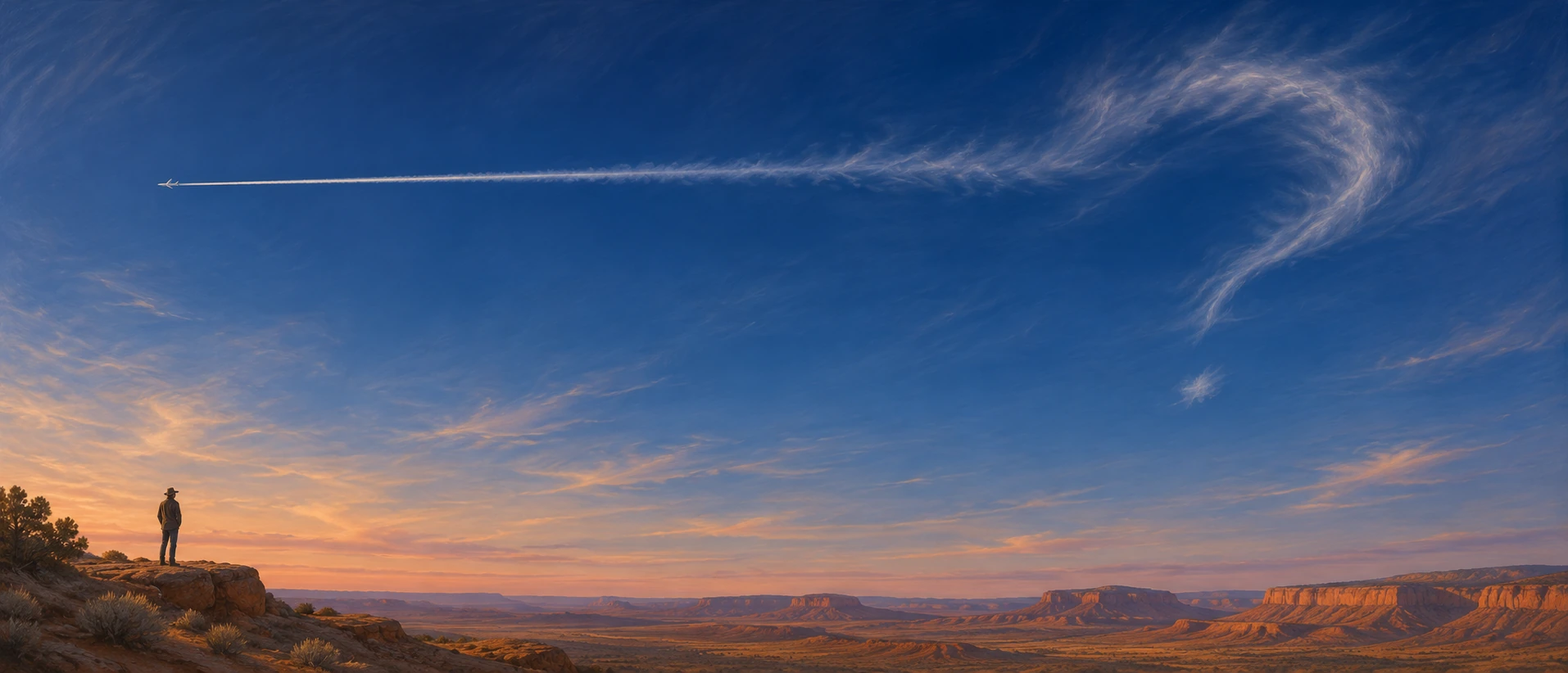
The trails themselves are well understood. When hot, moist jet exhaust meets sufficiently cold air, ice crystals form. In dry air they disappear quickly. In humid air they can persist and spread, long after the aircraft is out of sight. Those lingering clouds have environmental consequences of their own. Research suggests they contribute to warming, although the size of that effect remains uncertain.
In 2016, researchers asked 77 atmospheric chemists and geochemists whether they had encountered evidence of a secret, large-scale spraying program. Seventy-six said they had found none. The study reported that established atmospheric processes could explain the kinds of evidence commonly cited in support of the claim. A photograph can show how long a trail hangs over a neighborhood. Establishing what was released would require measurements that identify the material and trace it to the aircraft.
The tougher public question concerns proposals to intervene deliberately on a much larger scale. One form of solar geoengineering would introduce reflective particles into the stratosphere in an effort to cool the planet temporarily. The United Nations Environment Programme has warned of major gaps in knowledge about the consequences and called for greater transparency and wider public discussion. A state may decide to fund cloud seeding for its own watershed. Who could make an equivalent decision about an intervention whose effects might reach well beyond the country that authorized it?
That is where Climate Trails opens onto a debate worth having. If a government or private company proposes an experiment with effects beyond its borders, the people who might live with the consequences should know who approved it, what will be measured and who has the authority to stop it.


 Carlos Mundy


 Giovanni R. Ruffini Professor of History Fairfield University, USA



 Thubten Namdrol
 Charles Markeaton-Mundy
 Victoria Katumaru