
 Lavinia Ellington-Wentworth
From the waterways of Argentina to the cultural ferment of Madrid, Kico Camacho has spent a lifetime exploring the elusive territory between matter and emptiness, nature and abstraction, engineering and intuition. In his paintings and sculptures, water, light, colour and space become the elements of an artistic language that ultimately asks us not merely to look, but to enter.
There are artists whose work is immediately recognisable because they repeat a particular form, palette or visual formula. Kico Camacho belongs to a rather different category. What gives coherence to his work is not so much a recognisable object as a persistent question: what happens when art ceases to be something we simply look at and becomes a space — physical, emotional and imaginary — into which we are invited to enter?
It is a question Camacho has pursued across painting, sculpture, design and monumental intervention for decades. The scale has changed, as have the materials. At times the work has occupied a canvas; elsewhere it has escaped the wall altogether, becoming a thicket of sculptural lines, an architectural intervention or an imagined oasis large enough for the spectator to walk inside. Yet behind these apparently disparate manifestations lies a remarkably consistent investigation into space, nature, perception and, perhaps above all, water.
Water is not incidental to Camacho’s art. It is both memory and metaphor, landscape and philosophical proposition.
To understand why, one must return to Argentina.
Between the engineer and the artist
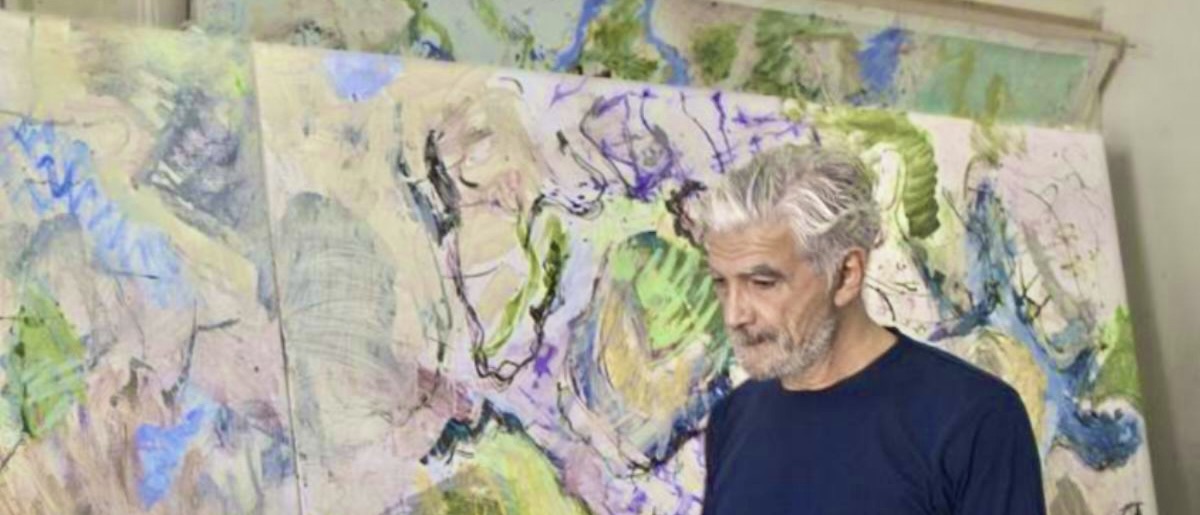
Kico Camacho was born in Buenos Aires in 1948. His formation was unusual and helps explain the curious equilibrium between freedom and structure that continues to characterise his work. He studied fine arts at the Escuela Nacional Manuel Belgrano whilst simultaneously working as a mechanical engineer, developing automotive prototypes for Ford in Buenos Aires. Flecha
It is a fascinating dual education. On one side stood the precision of engineering: structure, materials, forces, dimensions and the practical necessity of making an idea physically possible. On the other stood art: intuition, imagination and the possibility of creating something for which there need be no utilitarian explanation.
Rather than choosing between the two, Camacho appears to have absorbed both.
One can still detect the engineer beneath the artist, particularly in the sculptural work. However spontaneous a Camacho sculpture may initially appear, it possesses an underlying structural intelligence. Planes overlap. Forms counterbalance one another. Materials occupy space whilst deliberately preserving voids. Perspective changes according to where the spectator stands.
But there is equally something that engineering alone could never provide: unpredictability.
Camacho’s career has consequently unfolded in the territory between the calculated and the intuitive, the material and the immaterial, the planned and the unforeseen. His longstanding interest has been in understanding space not merely as an abstract concept but as a place capable of embracing both matter and emptiness. Flecha
This tension would eventually become fundamental to his art.
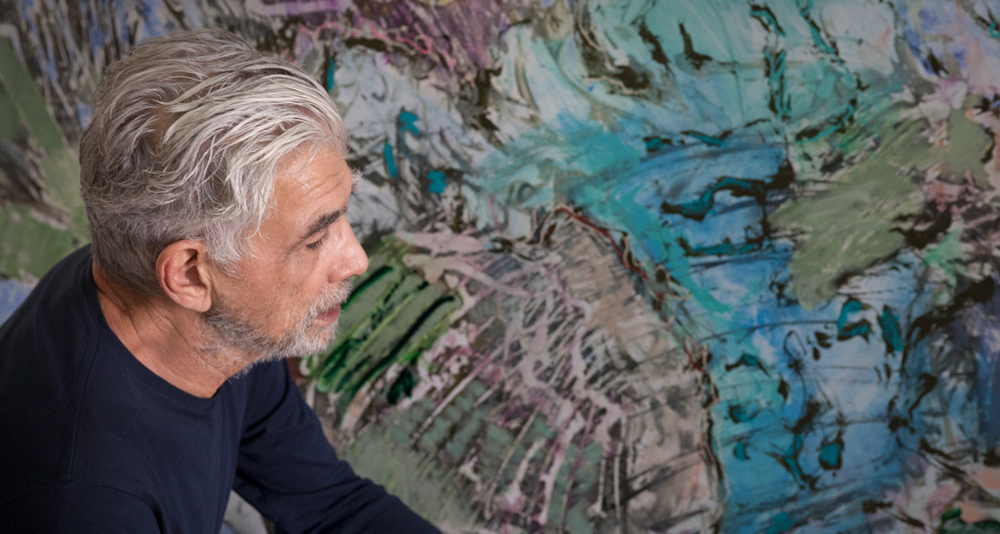
His life, meanwhile, was becoming as geographically fluid as the work itself. He travelled between Latin America, the United States and Europe, encountering New York during the cultural intensity of the 1970s before spending an extended period in Italy and considering Rome as a permanent home. Spain changed those plans.
During a visit he encountered the master printmaker and artist Don Herbert, who introduced him to Madrid’s artistic world, and the Basque painter Bonifacio, who became a close friend and with whom Camacho would later share a studio. He settled in Madrid in the early 1980s, precisely as Spain was undergoing one of the most exhilarating cultural transformations in its modern history. Flecha
The country was emerging from dictatorship, old conventions were being challenged and La Movida was transforming Madrid into a laboratory of music, art, fashion, cinema and cultural experimentation.
Camacho had arrived at exactly the right moment.
His first solo exhibition in Madrid took place in 1989. The influential New York dealer John Weber subsequently acquired one of his sculptures and encouraged him to return to New York, believing his work would find an audience there. Camacho chose instead to remain in Spain and participate in the artistic environment developing around him. Flecha
It was a consequential decision. Madrid became home, but Argentina never entirely disappeared.
The memory of water
Some of the most revealing clues to Camacho’s visual world lie thousands of miles from his Spanish studio, in the waterways of his youth.
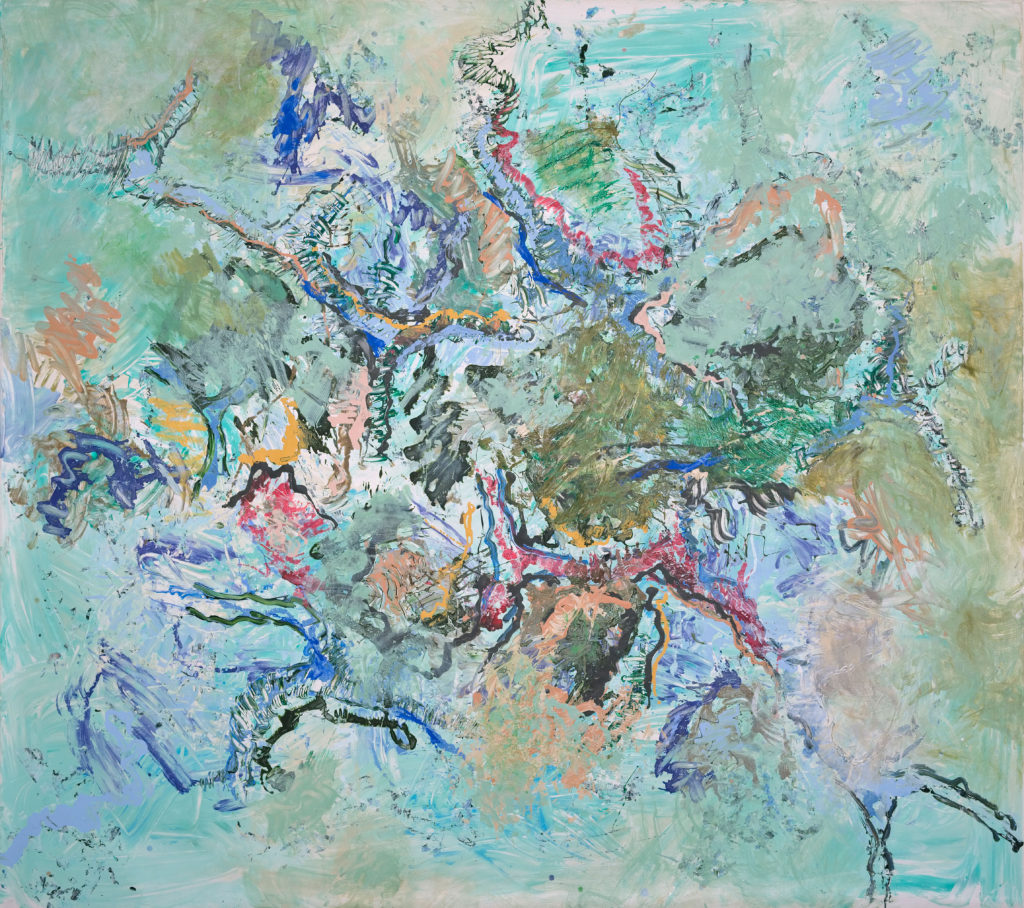
He spent considerable time around the Paraná Delta, rowing through its rivers and navigating a landscape in which water continually divides, reconnects and reshapes the land. Decades later, those memories remain embedded within his painting.
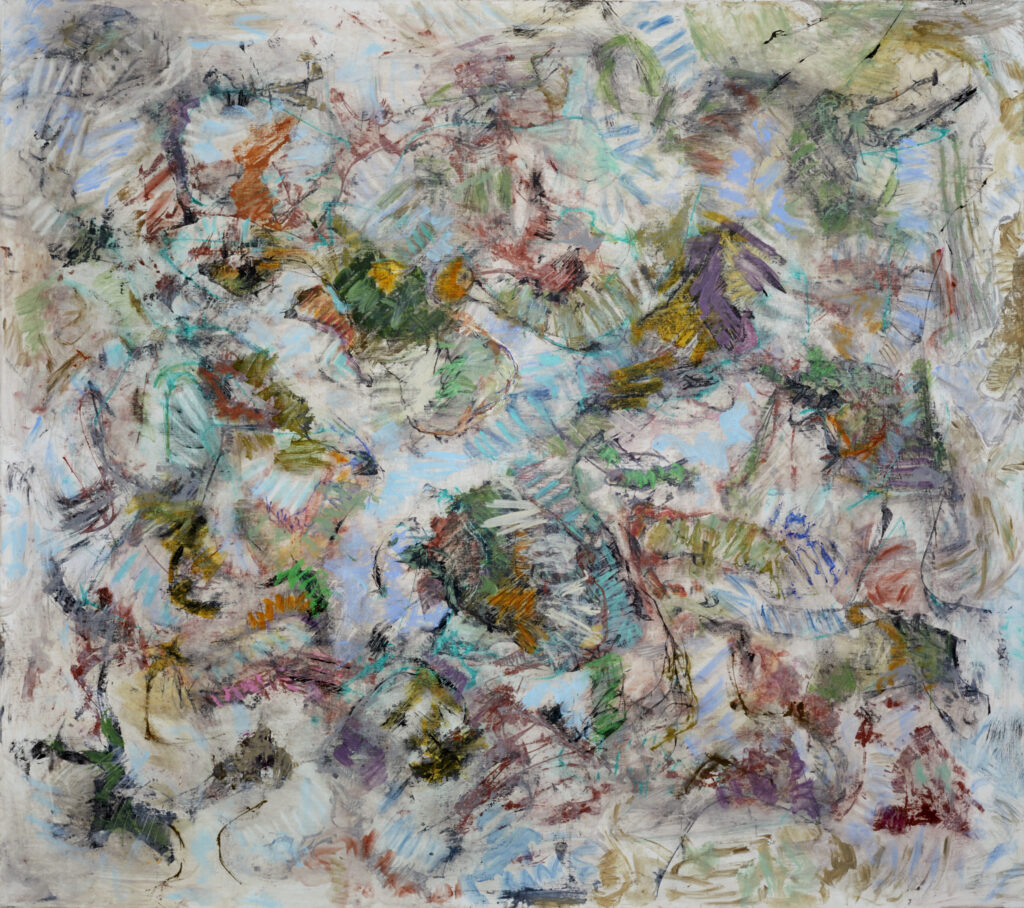
The Into the Delta exhibition in Dubai in 2021 brought together paintings from 2018 and 2019 inspired by precisely these recollections. Although resolutely abstract, the works can suggest aerial landscapes: rivers threading between expanses of land, islands appearing and disappearing, vegetation gathering along the banks. The exhibition explicitly connected the paintings to Camacho’s memories of navigating the seemingly infinite islands of the Argentine delta. Foundry Downtown Dubai
Yet to describe them simply as landscapes would miss the point.
Camacho is not painting topography. He is painting something closer to the memory of landscape.
The distinction matters.
Memory does not reproduce reality faithfully. It selects, distorts, magnifies and combines. A river remembered after half a century is no longer simply a river. It has accumulated childhood, distance, experience and loss. Geography has become interior landscape.
For Camacho, water therefore operates simultaneously at several levels. It is autobiographical, because it belongs to his childhood. It is formal, because rivers provide lines, boundaries, reflections and constantly changing perspectives. But it is also philosophical.
His artist’s statement makes this explicit. His concern for climate change and ecology has increasingly placed nature at the centre of his work, whilst his lifelong fascination with water has led him to regard it not merely as a natural resource but as a sacred gift. The Oasis Scuptures
Water, he argues, occupies a fundamental place in cultures, religions, mythology and poetry because it is inseparable from life itself. More provocatively, he describes it as a mirror of our collective soul: the health or deterioration of our rivers and water basins becomes a reflection of the condition of human consciousness. The Oasis Scuptures
That idea provides an important key to the work.
When Camacho paints water, he is not merely painting nature. He is asking us to look at ourselves.
Painting as territory
Camacho’s paintings can initially appear spontaneous: accumulations of colour, sweeping lines, overlapping shapes and apparently instinctive gestures. Look longer, however, and a peculiar spatial order begins to emerge.
One starts seeing coastlines.
Then islands.
Then tributaries.
Or perhaps they are none of these.
That ambiguity is essential.
The paintings occupy an uncertain territory between abstraction and landscape. The eye repeatedly attempts to impose geography upon them, whilst the work continually resists becoming entirely representational.
Seen from one perspective, the canvas may resemble an aerial view of a delta. From another, it becomes pure colour and gesture. The spectator oscillates between recognition and uncertainty.
This is precisely the territory Camacho seeks.
His visual language relies upon abstract elements, colour, form, perspective, symbolism, light and reflection to produce changing atmospheres. Crucially, however, he does not consider the spectator passive. The observer is invited mentally — and in some works physically — to enter the artwork, interpret it and in some sense complete it.
This makes the paintings less like pictures than territories.
One does not merely see them. One navigates them.
And once this principle is understood, Camacho’s movement from painting into sculpture becomes almost inevitable.
Drawing in space
In Camacho’s sculptural work, the lines that once inhabited the canvas appear to escape it.
His lattice sculptures are particularly revealing. Tangled linear forms overlap and penetrate one another, producing extraordinary three-dimensional drawings in which colour appears suspended in space.
There is something deliberately contradictory about them. They appear dense yet remain permeable; chaotic yet constructed; organic yet artificial.
They can suggest vegetation without actually representing plants. They evoke branches, reeds, vines and undergrowth, but equally handwriting, graffiti or an enlarged painter’s gesture.
The result is somewhere between sculpture and drawing.
Except that the drawing now possesses depth.
A conventional sculpture tends to assert its mass. Camacho frequently does the opposite. The empty spaces between his forms become as important as the forms themselves. Light passes through them. Shadows extend the sculpture beyond its physical limits. The surrounding architecture becomes part of the composition.
And as the spectator moves, the work changes.
What appeared dense from one angle may suddenly open. Two forms previously separated overlap. A colour disappears behind another plane. A shadow creates a second, temporary sculpture upon a wall.
The artwork therefore never quite exists as a single definitive image.
It unfolds through time.
This is why Camacho’s description as a creator of atmospheres is particularly appropriate. His work is concerned less with producing a fixed object than with establishing circumstances in which perception itself becomes unstable.
The artificial jungle
One of the most striking examples is the wall sculpture commissioned for a private residence in Madrid.
The photographs reproduced in The Oasis Sculptures presentation show an extraordinary intervention surrounding a small pool. The Oasis Scuptures
Here Camacho’s linear language becomes almost architectural.
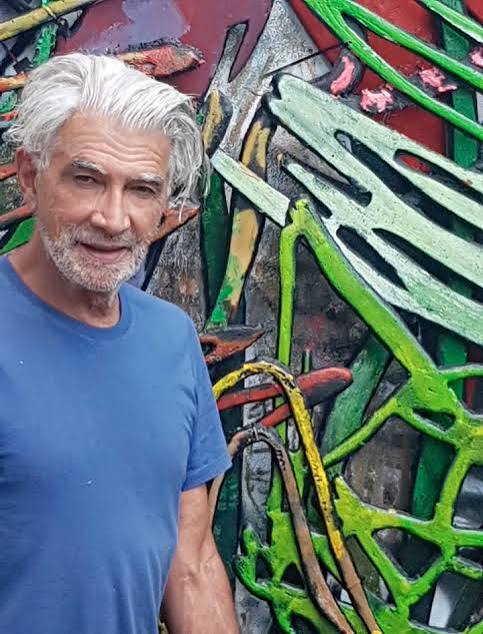
Layers of green, red, yellow and darker forms climb the walls like exuberant vegetation. Yet this is not botanical sculpture in any conventional sense. It is an invented ecosystem — somewhere between garden, drawing, sculpture and enclosure.
Water lies at its centre.
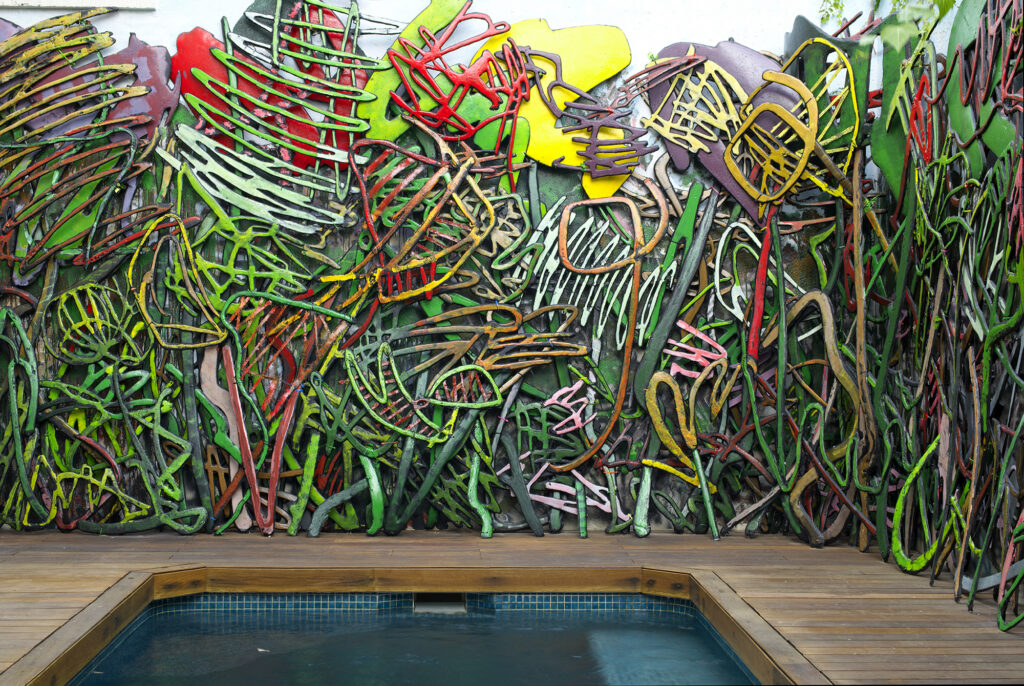
The relationship is important. The pool reflects the forms around it, multiplying them and destabilising the distinction between actual sculpture and reflected image. The surrounding vegetation of the residence further complicates matters: real plants encounter artificial ones; nature confronts its abstraction.
The effect is almost that of walking inside one of Camacho’s paintings.
And this is perhaps the decisive step in his artistic evolution.
The canvas has become a place.
The Oasis
That ambition reaches its most monumental expression in The Oasis Sculptural Project.
The proposal is conceived as a large environmental sculpture situated within the extreme landscape of the Arabian desert. Four entrances positioned according to the cardinal points lead visitors into an abstract garden in which vegetation, colour, water, labyrinthine structures, light and reflection combine to create continually changing atmospheres. The Oasis Scuptures
The symbolism is immediately powerful.
An oasis is one of humanity’s oldest images of salvation.
Within the desert it represents water, shade, vegetation, life and survival. It is simultaneously geographical reality and metaphor: refuge in the midst of hostility.
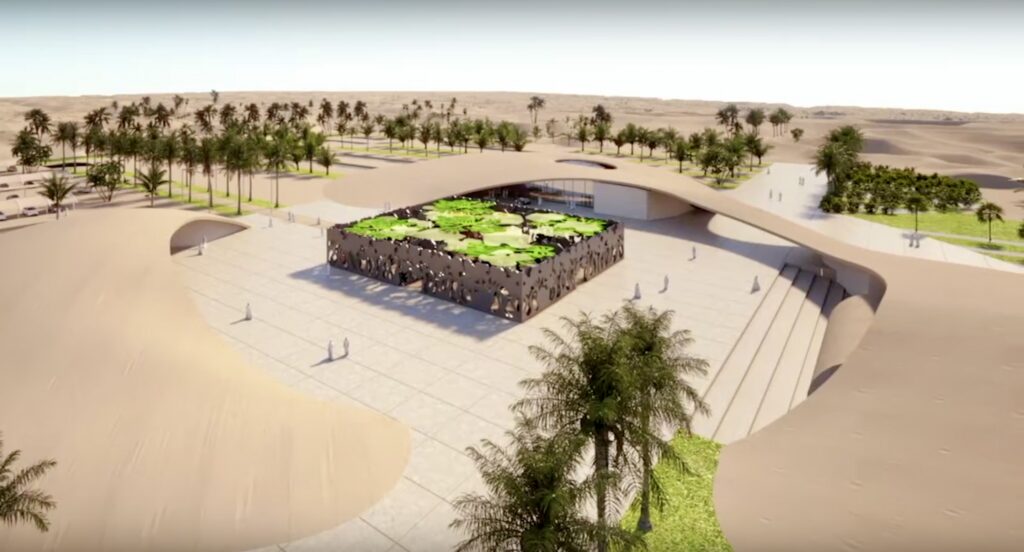
Camacho takes this ancient idea and transforms it into a contemporary environmental artwork.
The project is explicitly conceived as a call to preserve the oasis of the Arab desert — one of the world’s most extreme environments — but its ambition extends beyond ecological advocacy. Camacho imagines the sculpture as a place of encounter: with other people, certainly, but also with oneself. The Oasis Scuptures
The four doors matter. Entering becomes part of the artwork.
So does the labyrinth.
And so does water.
The spectator crosses a threshold and leaves ordinary space behind. Inside, light changes during the day. Reflections shift. Water alters the apparent solidity of surrounding structures. Shadows appear and disappear.
No two visits need be quite identical.
The work is therefore neither sculpture in the traditional sense nor architecture in the conventional sense.
It is an experience constructed from sculpture.
Nature reconstructed
The accompanying Oasis 3D project reveals how sophisticated this vocabulary has become.
Camacho uses silhouettes and interposed planes alongside colour, perspective, light and reflection to generate what he calls kaleidoscopic spaces. The imagery evokes rivers surrounding islands from whose interiors another world seems to emerge. The Oasis Scuptures
Yet the apparent organic spontaneity conceals considerable technical complexity.
The proposed materials include steel, polyurethane, polyester reinforced with glass fibre, wood, carbon fibre and concrete. The Oasis Scuptures
Here, once again, the young engineer from Buenos Aires reappears.
These are not merely fantasies. Camacho thinks about how imagined environments can actually be constructed.
Perhaps that explains why his work moves so comfortably between intimate and monumental scale. The Oasis vocabulary can become a vast architectural environment, an outdoor sculpture, a lattice construction or a tabletop piece. The presentation’s smaller Oasis 3D sculptures demonstrate that the underlying language remains recognisable even when reduced to something that can sit upon a pedestal. The Oasis Scuptures
The scale changes.
The idea does not.
The spectator completes the work
There is another constant running through Camacho’s work that deserves particular attention: the spectator.
Much twentieth-century art gradually dismantled the notion that an artwork was simply an autonomous object to be contemplated from an appropriate distance. Camacho takes that proposition seriously.
He wants us involved.
Sometimes that involvement is physical. Monumental sculpture can be approached, circled or entered. Perspective alters according to one’s position. Reflections depend upon the observer’s relationship to water and light.
Elsewhere the participation is psychological.
Camacho deliberately leaves room for what he calls imaginative and infinite readings, inviting the observer to move beyond physical and mental limitations and establish a dialogue with the sensitive and subconscious dimensions of experience. The Oasis Scuptures
Consequently, there is no single prescribed interpretation.
One viewer sees vegetation.
Another sees a map.
Another sees chaos.
Another remembers a river.
All may be correct.
Because the final material in Camacho’s work is perhaps not steel, acrylic, water or concrete at all.
It is perception.
An artist between worlds
There is something particularly appropriate about the fact that Camacho’s career has unfolded across continents.
Argentina and Spain. Latin America and Europe. Buenos Aires, New York, Italy and Madrid. Engineering and fine art. Painting and sculpture. Nature and architecture. Matter and void.
His life itself has occupied intermediate territories.
So has his art.
The waterways of the Paraná Delta may appear geographically distant from a proposed oasis in the Arabian desert, yet conceptually they belong to the same world.
Both begin with water.
Both concern the relationship between life and landscape.
Both transform geography into memory and memory into abstraction.
And both ultimately return to the same question: what is our relationship with the natural world upon which our existence depends?
There is urgency in that question today that perhaps did not exist when Camacho began his career. Climate change, desertification, pressure upon freshwater resources and the degradation of natural habitats have transformed ecology from an environmental concern into one of the defining questions of our century.
Camacho’s work does not respond with slogans.
It offers something subtler.
It reminds us why nature matters emotionally before asking us to consider why it matters politically.
Water is beautiful before it becomes scarce.
An oasis is magical before it becomes endangered.
A river belongs to memory before it becomes a statistic.
That distinction gives the work much of its strength.
Beyond the object
It would therefore be misleading to define Kico Camacho simply as a painter or a sculptor.
He is both, certainly. But his more interesting achievement lies in the territory between the disciplines.
His paintings behave like landscapes. His sculptures behave like drawings. His monumental works approach architecture. Architecture becomes landscape. Landscape becomes abstraction. And throughout it all, water and light prevent anything from remaining entirely fixed.
The coherence of the work becomes clearer when seen across decades.
The engineer learnt to construct.
The painter learnt to surrender control.
The sculptor discovered the expressive possibilities of emptiness.
The traveller accumulated landscapes.
And the boy who once navigated the waterways of Argentina never entirely stopped looking at water.
Perhaps this is why Camacho’s work, despite its structural sophistication, never feels purely intellectual. Behind the steel, acrylic, carbon fibre and concrete lies something remarkably elemental: the human fascination with entering an unknown landscape and discovering what might exist beyond the next bend of the river.
His best work asks us to undertake precisely that journey.
Not towards a particular destination, but towards a different way of seeing.
And that may ultimately be Kico Camacho’s most compelling proposition: art need not represent the world. It can create a space in which we rediscover our place within it.


 Elga Wimmer
 Pablo H. Aznar
 Clifford Thurlow
 Antoinette Martin
 Romy Querol
 Merritt Becker
 Carlos Mundy

 Laura Mitchell
 Mayte Hidalgo