
 Mayte Hidalgo
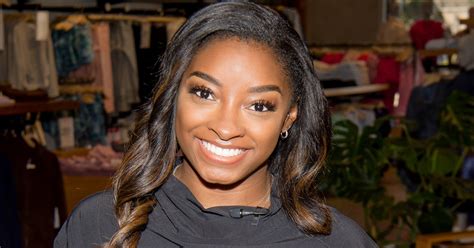
In the world of gymnastics, where precision, strength, courage, and artistry combine in a manner perhaps unmatched by any other sport, one name now stands above all others: Simone Biles.
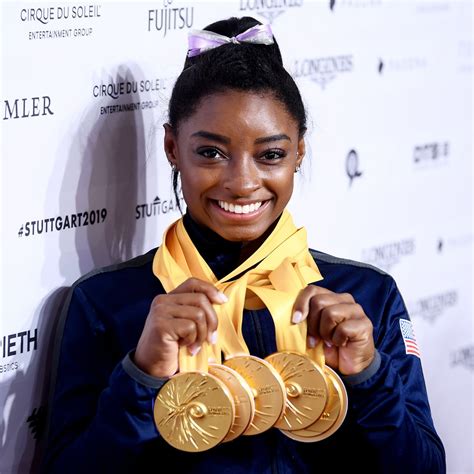
To describe Biles simply as an exceptional gymnast no longer does justice to what she has accomplished. She is the most decorated gymnast in history, male or female, with 41 medals across the Olympic Games and World Championships—11 Olympic medals and 30 World Championship medals. Seven of her Olympic medals are gold, while an extraordinary 23 of her World Championship medals are gold.
Yet statistics tell only part of the story.
Biles has transformed the technical limits of gymnastics, survived one of the greatest crises of her career on the world’s largest sporting stage, returned when many assumed she never would, and then, at the Paris Olympics in 2024, completed one of the most remarkable comebacks in modern sporting history.
Today, at 29, she finds herself contemplating one final question: Is there another chapter still to come?
Simone Arianne Biles was born on March 14, 1997, in Columbus, Ohio. Her early childhood was difficult, and she and her siblings entered foster care before Simone and her younger sister Adria were adopted by their maternal grandfather, Ron Biles, and his wife, Nellie.
Her introduction to gymnastics came almost accidentally. At the age of six, during a daycare field trip to a gymnastics center, the young Biles began imitating the gymnasts she saw around her. Coaches immediately recognized something unusual.
What followed would eventually change the sport.
By her teenage years, Biles was emerging as one of America’s most promising gymnasts. In 2013, at just 16, she won her first World all-around title. She also won gold on floor exercise, silver on vault, and bronze on balance beam.
It was the beginning of an era of dominance unprecedented in women’s gymnastics.
Three years later came Rio.
The 2016 Olympic Games transformed Biles from a gymnastics phenomenon into an international sporting superstar.
In Rio de Janeiro, she won four gold medals—in the team competition, individual all-around, vault, and floor exercise—along with bronze on balance beam. Her performances were extraordinary not simply because she won, but because of the margin between Biles and almost everyone competing against her.
She possessed a combination that gymnastics had rarely, if ever, seen in one athlete: enormous explosive power, extraordinary aerial awareness, precision, consistency and the ability to perform immensely difficult skills under intense pressure.
There was also something else.
Biles was changing the physical vocabulary of women’s gymnastics.
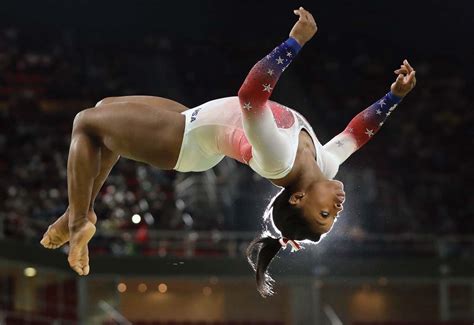
Today, five elements in the international Code of Points bear her name: two on vault, two on floor exercise, and one on balance beam. Among them is the celebrated Biles II vault, the Yurchenko double pike, one of the most technically demanding vaults ever performed by a woman.
Few athletes can say that their names have literally become part of the language of their sport.
Then came Tokyo.
The Tokyo Olympics, postponed from 2020 until 2021 because of the pandemic, were expected to be another coronation for Biles. Instead, they became perhaps the most important moment of her career for reasons having little to do with medals.
During the Games, Biles began suffering from what gymnasts call the “twisties”—a terrifying loss of spatial awareness in the air. For an ordinary person, the expression may sound almost trivial. For a gymnast attempting multiple twists and somersaults several feet above the ground, it can be extremely dangerous.
Biles withdrew from the team final and subsequently from several individual finals.
The decision generated enormous controversy.
Some criticized her. Others accused her of abandoning her team. But Biles insisted that continuing when she could no longer reliably determine her position in the air would have endangered her physically.
She eventually returned for the balance beam final and won bronze. The medal itself mattered less than what the episode represented.
One of the most successful athletes on Earth had publicly acknowledged that even champions have limits.
Her decision helped transform the international conversation surrounding mental health in elite sport. Athletes had long been expected to suppress fear, anxiety, exhaustion and psychological distress in pursuit of victory. Biles challenged that culture.
But the Tokyo story would acquire an entirely different meaning because it did not prove to be the end.
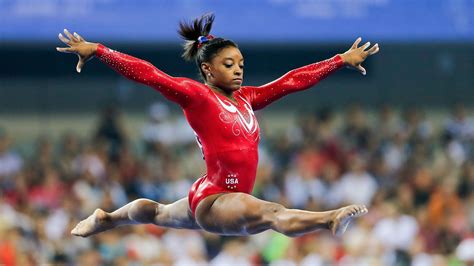
After taking two years away from competition, Biles returned to elite gymnastics in 2023.
And remarkably, she returned at the highest level.
At the 2023 World Championships in Antwerp, she won four gold medals—in the team competition, individual all-around, balance beam and floor exercise—as well as silver on vault. It was there that her Yurchenko double pike officially became the Biles II, the fifth element named after her in the international Code of Points.
The stage was now set for Paris.
If Rio had established Biles as a superstar, and Tokyo had revealed her vulnerability, the 2024 Paris Olympics completed the story of her return.
Biles herself described Paris as a “redemption tour.”
It proved to be precisely that.
Eight years after winning her first Olympic all-around title in Rio, Biles became Olympic all-around champion once again.
She led the United States to gold in the women’s team competition. She won gold in the individual all-around. She won gold on vault, performing the extraordinary Biles II. And she added a silver medal on floor exercise.
She finished Paris with three gold medals and one silver.
The results brought her career Olympic total to 11 medals: seven gold, two silver and two bronze.
Perhaps even more remarkable was her age.
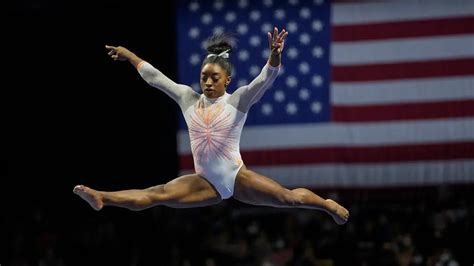
Women’s gymnastics was once a sport dominated by teenagers. Careers could be brutally short, with athletes considered veterans while still barely into their twenties. Biles won the Paris Olympic all-around title at 27.
She had not merely returned.
She had challenged one of gymnastics’ oldest assumptions about athletic longevity.
There was also an extraordinary moment at the conclusion of the floor competition.
Brazil’s Rebeca Andrade defeated Biles for gold, with Biles taking silver and American Jordan Chiles initially awarded bronze. On the podium, Biles and Chiles bowed toward Andrade in a spontaneous gesture of respect.
It was an image that travelled around the world.
For an athlete whose career had been defined by winning, Biles demonstrated that greatness can also be expressed in recognizing the greatness of a rival.
Her extraordinary Paris performance was recognized the following year when she was named the 2025 Laureus World Sportswoman of the Year.
It was the fourth time she had received the award, equalling Serena Williams’ record.
In February 2026, Laureus announced that Biles was joining the organization as an ambassador, giving her a new platform from which to support programs using sport to improve opportunities for young people, particularly girls and young women.
This transition from champion to mentor seems particularly appropriate because Biles’ influence has always extended far beyond medals.
She has been an outspoken advocate for mental health. She has challenged assumptions about what athletes owe spectators, federations and sponsors. She has demonstrated that protecting oneself does not necessarily mean surrendering ambition.
And she has been a powerful voice demanding accountability within gymnastics itself.
Biles was among the survivors of sexual abuse by former USA Gymnastics team doctor Larry Nassar. Rather than remaining silent, she used her stature to demand answers from the institutions responsible for protecting young athletes.
That advocacy forms an inseparable part of her legacy.
It would have been considerably easier for one of the sport’s greatest stars to collect her medals and avoid confronting the organization surrounding her. Instead, Biles repeatedly insisted that the failures that allowed the abuse to occur be examined and that future generations of gymnasts receive greater protection.
It is one of the reasons her importance cannot be measured solely by medal tables.
And yet those medal tables remain astonishing.
Biles has 30 World Championship medals, 23 of them gold, as well as her 11 Olympic medals. Her combined haul of 41 Olympic and World Championship medals makes her the most decorated gymnast in history.
There are also the five skills carrying her name.
Records can eventually be broken. Medal totals can eventually be surpassed.
But every time a future gymnast performs one of the elements named after Simone Biles, her contribution to the technical development of gymnastics will quite literally remain embedded within the sport.
And now comes the intriguing question of what happens next.
Biles has not competed since Paris 2024.
But importantly, she has not announced her retirement.
Throughout 2026, she has remained deliberately noncommittal about attempting a fourth Olympic Games. Earlier this year she described her chances of pursuing Los Angeles 2028 as roughly “50-50.”
And as recently as September 2026, the question remained unresolved.
Speaking to the Associated Press, Biles acknowledged that the possibility of competing in a home Olympics remains enormously attractive. Los Angeles would offer something she has never experienced: performing at an Olympic Games before an American home crowd. Several of her former teammates are also looking toward 2028.
But Biles would be 31 when the Los Angeles Games begin.
Her calculation is therefore very different from the one she faced before Rio, Tokyo or even Paris. She has spoken about the physical sacrifice another Olympic campaign would require, the time it would take away from her husband, NFL player Jonathan Owens, and their plans eventually to start a family.
There is another consideration.
She has nothing left to prove.
That may be the most important difference of all.
Biles could never perform another competitive routine and her position in gymnastics history would remain secure.
She has won Olympic all-around titles eight years apart. She has competed at three Olympic Games. She has won seven Olympic gold medals. She has amassed 30 World Championship medals. She has skills bearing her name across three apparatus. She disappeared from competition for two years and returned to become Olympic champion again.
She has also changed the conversation surrounding athletes and mental health, confronted institutional failures within her sport and demonstrated that longevity at the highest level of women’s gymnastics is possible.
Whether she returns for Los Angeles may therefore be less important than the fact that the decision belongs entirely to her.
And perhaps that is the most fitting conclusion to the Simone Biles story as it stands today.
For much of her life, the world has asked more of her.
More medals.
More difficulty.
More records.
Another Olympics.
Another comeback.
Another impossible skill.
But greatness cannot be measured simply by how long an athlete continues competing.
There comes a point when a champion has earned the right to decide that enough is enough—or, alternatively, to look once more at the greatest stage in sport and decide that there is still one final adventure worth pursuing.
If Simone Biles walks into the arena in Los Angeles in 2028, it would surely be one of the great sporting stories of the decade.
If she does not, nothing about her legacy diminishes.
The little girl who discovered gymnastics almost by accident has already changed the sport forever.
She expanded its technical possibilities. She redefined its standards of excellence. She challenged its culture. She survived its darkest institutional failures. She showed vulnerability without surrendering strength. And when many believed her career had effectively ended in Tokyo, she returned three years later and stood once again on top of the Olympic podium.
That may ultimately be Simone Biles’ greatest achievement.
Not that she never fell.
But that, each time the world believed it had discovered the limits of what Simone Biles could do, she found a way to rise beyond them.


 Carlos Mundy
 Dixon Acosta
 Elga Wimmer
 Metaphore Magazine
 Pablo H. Aznar



 Laura Mitchell
 Kamal Kumar