
 Charles Markeaton-Mundy
As conflict unsettles the Middle East, the UAE faces one of the most significant tests of its modern history. Yet beyond the immediate uncertainty lies a federation whose economic ambition, continuity of leadership, international outlook and remarkable capacity for reinvention continue to attract entrepreneurs, investors and families from across the world.
There are moments in the history of nations when their true character becomes apparent, not during periods of prosperity, but when the circumstances surrounding them turn unexpectedly hostile. The United Arab Emirates, a federation that has accomplished in little more than half a century what many countries have struggled to achieve over generations, now finds itself confronting precisely such a moment.
The conflict that has unsettled the Middle East during 2026 has inevitably cast a shadow over the Gulf. International aviation has suffered disruption, businesses have reconsidered travel arrangements, and some expatriate families have temporarily relocated, understandably concerned about the possibility of further escalation. For a country that has built much of its international reputation upon security, predictability and ease of movement, these developments cannot simply be dismissed.
Yet there is another, rather more interesting story unfolding beneath the headlines. The Emirates continues to attract international capital, entrepreneurs, professionals and families who regard the present difficulties not as a reason to abandon the country, but as an opportunity to consider its longer-term prospects. Although reliable figures do not yet establish how many newcomers have arrived specifically during the conflict, the continued interest in establishing businesses and residences reflects the enduring attraction of the country’s economic model.
The distinction is important. Temporary departures prompted by an exceptional security situation do not necessarily represent a permanent loss of confidence, just as the arrival of new investors does not mean that the risks have disappeared. What matters is whether the underlying institutions, infrastructure and economic opportunities remain sufficiently compelling to encourage people to commit their futures to the country.
There are encouraging indications that they do. In July 2026, the International Monetary Fund described the UAE economy as having demonstrated remarkable resilience to the Middle Eastern conflict, supported by substantial financial buffers, policy intervention and the redirection of trade flows. The Fund nevertheless acknowledged that uncertainty had affected tourism, transport, trade and property activity.
This is perhaps the most persuasive argument in the Emirates’ favour: not that it is immune to international upheaval, but that it possesses considerable resources with which to confront it.
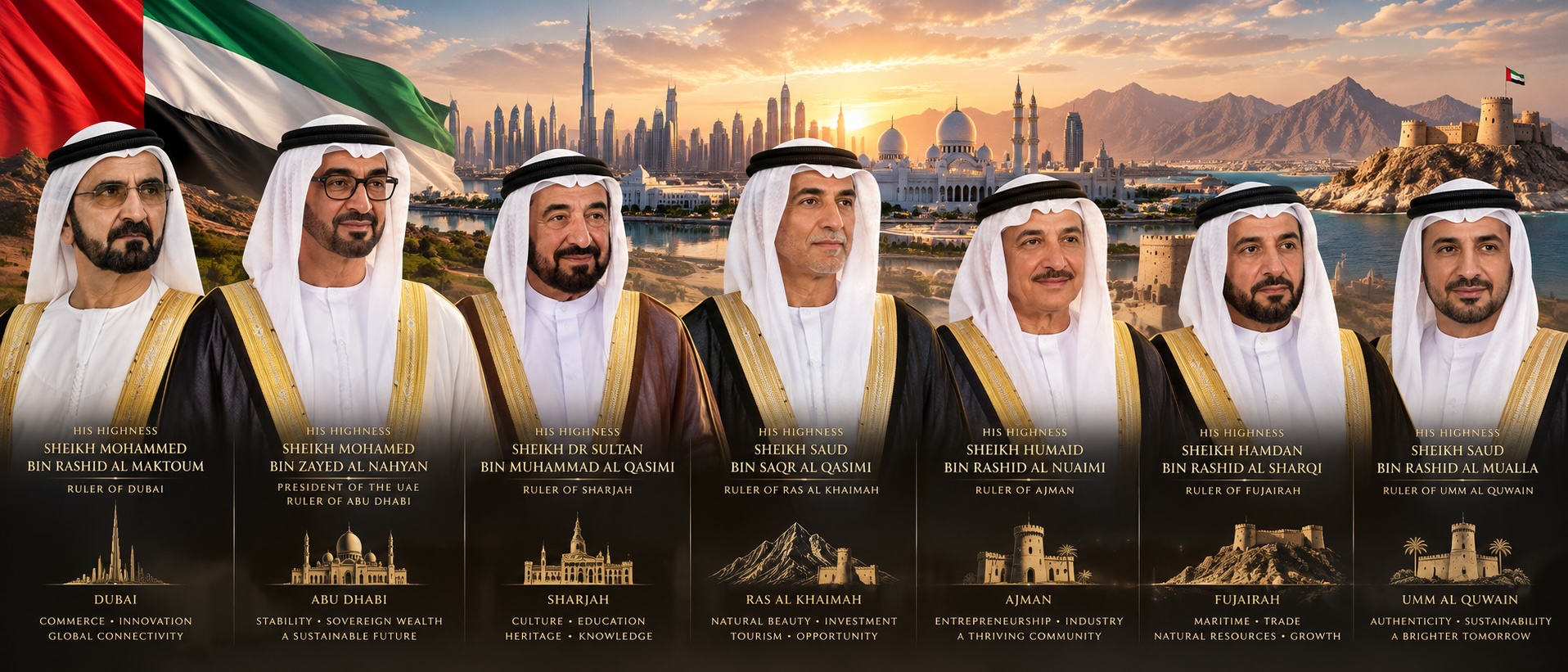
The Strength of Continuity: Seven Emirates, Seven Ruling Families, One Federation
To understand the UAE, one must first understand its political architecture. The federation was founded in 1971 under the leadership of Sheikh Zayed bin Sultan Al Nahyan, whose vision brought together emirates with distinct histories, ruling families and economic circumstances. Ras Al Khaimah joined in 1972, completing the federation of seven.
Unlike political systems in which successive governments may radically alter economic priorities, the Emirates has developed a model of hereditary leadership in which long-term national projects can be pursued over decades. The ruling families have provided a continuity of direction that many investors regard as an important element of the country’s institutional appeal.
Under President Sheikh Mohamed bin Zayed Al Nahyan, the federation continues to place considerable emphasis upon economic diversification, international partnerships, technological development and national infrastructure. In Dubai, Sheikh Mohammed bin Rashid Al Maktoum has overseen the emirate’s transformation into an international centre of commerce, aviation, tourism and finance.
Such continuity has practical consequences. Airports, ports, financial districts, universities and entire urban developments require planning horizons far longer than a single electoral cycle. The UAE’s political arrangements have facilitated sustained investment in projects whose benefits often emerge only after many years.
This does not mean that hereditary government is without limitations, nor that stability can be taken for granted. Political participation is restricted compared with parliamentary democracies, and questions concerning freedom of expression and civil liberties remain legitimate considerations for those contemplating residence or investment. Nevertheless, the consistency of economic policy, the availability of substantial sovereign resources and the capacity to implement long-term development plans have become distinctive characteristics of the Emirati model.
The federation’s greatest achievement may be that its seven constituent emirates have retained their individual identities whilst participating in a broader national enterprise. Abu Dhabi provides immense financial and energy resources; Dubai contributes commercial dynamism and international connectivity; Sharjah offers industrial depth and cultural distinction; Ras Al Khaimah brings manufacturing, natural beauty and an increasingly ambitious tourism sector. The remaining emirates add further dimensions to a surprisingly diversified national economy.
Far from being seven interchangeable territories, they are seven complementary centres of opportunity.
Dubai: The City That Refused to Accept Its Geographical Limitations

Dubai’s transformation is one of the most extraordinary urban and commercial stories of the modern age. A trading settlement on the Arabian Gulf, with relatively modest petroleum resources compared with Abu Dhabi, has become an international metropolis whose name is recognised almost everywhere.
Its success was neither accidental nor exclusively dependent upon oil. It was the result of an ambitious commercial philosophy: create the infrastructure, attract international enterprise, facilitate trade and allow the city to become indispensable to the movement of people, goods and capital.
The development of Jebel Ali Port, the expansion of Emirates Airline, the establishment of the Dubai International Financial Centre, and the creation of internationally recognised free zones have transformed the emirate into a commercial bridge between Europe, Asia and Africa.
Today, Dubai is much more than an attractive destination for wealthy expatriates. It is a headquarters location for multinational companies, a centre for financial services, logistics and technology, and a market in which entrepreneurs from very different backgrounds can establish enterprises with remarkable speed.
Its economic performance during the crisis deserves particular attention. Official figures released in July showed Dubai’s economy expanding by 2.4 per cent in the first quarter of 2026, with wholesale and retail trade remaining a major contributor and construction recording substantial growth. These figures do not eliminate the difficulties facing individual sectors, but they demonstrate that economic activity continued despite regional uncertainty.
Dubai’s appeal also lies in the quality of everyday life. Its international schools, hospitals, restaurants, cultural attractions, residential developments and sporting facilities offer a level of convenience that appeals to families as much as to business executives. English is widely spoken, and the city’s extraordinarily international population has created an environment in which newcomers can often establish professional and social relationships quickly.
The Dubai Economic Agenda, known as D33, reflects an ambition to place the emirate among the world’s leading urban economies. Such a goal requires far more than skyscrapers or luxury hotels. It requires financial sophistication, regulatory credibility, innovation, productivity and the capacity to attract exceptional talent.
For companies considering an international headquarters, Dubai offers a combination of geographical accessibility, commercial infrastructure and relative tax competitiveness that remains difficult to replicate. Its immediate challenge is to preserve the confidence upon which that position depends, particularly in aviation, property and tourism.
Yet the city has repeatedly demonstrated a capacity to reinvent itself, from its origins as a trading port to its emergence as an international financial and technological centre. That history gives substance to the argument that Dubai possesses the foundations for another period of expansion when regional conditions permit.
Abu Dhabi: Sovereign Wealth, Strategic Patience and the Architecture of the Future

If Dubai represents the entrepreneurial energy of the Emirates, Abu Dhabi represents its financial depth and strategic patience.
As the federal capital and the largest emirate, Abu Dhabi occupies a distinctive position within the UAE. Its substantial hydrocarbon resources have enabled successive generations of leadership to accumulate considerable sovereign wealth and invest it across international markets, whilst simultaneously developing domestic industries that extend well beyond petroleum.
Institutions such as the Abu Dhabi Investment Authority, Mubadala and ADQ have given the emirate a formidable presence in global finance and investment. Their importance is not merely the scale of their assets, but their capacity to support economic diversification, infrastructure and strategic industries over extended periods.
Under Sheikh Mohamed bin Zayed Al Nahyan, Abu Dhabi has continued to develop its ambitions in artificial intelligence, advanced manufacturing, renewable energy, aerospace, healthcare and scientific research.
The emirate’s commitment to culture and education is equally significant. The Louvre Abu Dhabi, the development of Saadiyat Island’s cultural district and the presence of international academic institutions reflect a determination to build a society whose appeal extends beyond commercial opportunity.
For international investors, Abu Dhabi offers a different proposition from Dubai. It is particularly attractive to enterprises seeking institutional partnerships, access to substantial capital, involvement in major industrial projects or a presence in sectors supported by national development strategies.
Its sovereign financial resources also provide an important degree of protection during periods of international instability. They cannot eliminate the effects of war or disruption to trade, but they can support economic intervention and investment when private-sector confidence becomes more cautious.
In an increasingly uncertain world, that capacity for patient capital may prove one of Abu Dhabi’s most valuable competitive advantages.
Sharjah: The Intellectual, Cultural and Industrial Heart of the Federation

Sharjah is sometimes overshadowed internationally by its more conspicuous neighbours, yet it offers one of the most interesting economic and cultural environments in the federation.
Under the leadership of Sheikh Sultan bin Muhammad Al Qasimi, the emirate has cultivated a reputation for education, literature, heritage preservation and cultural development. Its museums, universities, publishing initiatives and architectural conservation projects have created an identity quite distinct from Dubai’s commercial exuberance.
This cultural commitment has been accompanied by substantial industrial activity. Sharjah possesses an established manufacturing sector, important logistics facilities and access to maritime routes through its ports on both the Arabian Gulf and the Gulf of Oman.
Its industrial areas and free zones provide opportunities for companies involved in manufacturing, distribution, engineering, technology and international trade. For businesses whose priorities include production facilities, warehousing or competitive operating costs, Sharjah merits serious consideration.
The emirate also offers residential advantages to families seeking a somewhat more traditional atmosphere, with access to educational institutions and cultural amenities whilst remaining within reach of Dubai’s commercial opportunities.
Sharjah’s importance lies precisely in the fact that it has not attempted to become another Dubai. It has followed a distinctive development strategy, demonstrating that economic progress need not require every city to adopt the same character.
In a federation built upon complementary strengths, this diversity is an advantage rather than a weakness.
Ras Al Khaimah: The Emerging Frontier of Opportunity

Among the Emirates attracting increasing international attention, Ras Al Khaimah deserves a particularly prominent place.
Situated in the northern part of the federation, with a landscape encompassing mountains, desert and coastline, Ras Al Khaimah possesses natural advantages that distinguish it from the more densely urbanised centres of Dubai and Abu Dhabi.
Under Sheikh Saud bin Saqr Al Qasimi, the emirate has pursued a development strategy combining manufacturing, tourism, logistics, property investment and international business services.
The Ras Al Khaimah Economic Zone, widely known as RAKEZ, has helped position the emirate as a practical destination for small and medium-sized enterprises, industrial businesses and international entrepreneurs seeking a commercially accessible base in the Gulf.
Its manufacturing credentials are already well established, whilst its hospitality sector has entered an ambitious new phase. Luxury resorts, residential developments and the Wynn Al Marjan Island project have attracted international interest, opening the possibility of a substantially expanded tourism economy.
For families, Ras Al Khaimah offers an appealing alternative to the pace of Dubai, with more immediate access to mountains, beaches and outdoor recreation. For companies, its attraction includes industrial infrastructure and potentially lower operating costs, depending upon the nature of the enterprise.
It would be premature to assume that every announced development will achieve its projected commercial success. Nevertheless, the scale of investment and the emirate’s increasingly international profile indicate that Ras Al Khaimah is becoming a more significant participant in the UAE’s wider economic transformation.
It may prove especially attractive to investors who prefer to establish a presence in an emerging market rather than compete exclusively within an already mature commercial centre.
A Society Where Tolerance Has Become an Economic Advantage

One of the UAE’s most remarkable achievements is the development of a society in which people of different nationalities, religions and cultural traditions live and work alongside one another.
More than 200 nationalities are represented in the country, creating an extraordinary mixture of languages, customs and professional experience. Muslims, Christians, Hindus, Sikhs, Buddhists and Jews have established communities, with recognised places of worship reflecting the federation’s commitment to religious coexistence.
For a Muslim-majority nation in a region frequently associated with religious and political tensions, this has considerable significance.
The historic visit of Pope Francis to Abu Dhabi in 2019, the establishment of the Abrahamic Family House, and the development of Hindu temples and Christian churches illustrate a willingness to accommodate religious diversity whilst maintaining the country’s Islamic identity.
The Abrahamic Family House is particularly symbolic. Bringing a mosque, a church and a synagogue together within one architectural complex, it embodies the conviction that different religious traditions need not exist in permanent opposition.
The UAE has also made tolerance an explicit component of national policy, establishing a ministerial portfolio dedicated to tolerance and coexistence and introducing legislation intended to combat religious hatred and discrimination.
Naturally, tolerance in the Emirates operates within a legal and cultural framework that differs from those of Western liberal democracies. Religious practice is protected subject to public-order provisions, and the country’s laws impose restrictions upon certain forms of expression. Prospective residents should understand these distinctions rather than assume that every freedom enjoyed in their country of origin applies in precisely the same manner.
Nevertheless, the practical experience of millions of expatriates demonstrates that a deeply international society can flourish within the traditions of the Arabian Peninsula.
This multicultural character is also an economic asset. A company establishing itself in Dubai or Abu Dhabi gains access not merely to a local workforce, but to an international community with commercial connections extending across continents.
The Emirates has made diversity part of its competitive advantage, attracting people who might otherwise have chosen London, Singapore, Hong Kong, Zurich or New York.
Why International Capital Continues to Look Towards the Emirates
The economic case for the UAE is supported by figures that extend beyond the promotional language so often associated with international investment destinations.
According to figures published by the UAE Ministry of Investment in July 2026, the country attracted a record US$48.3 billion in foreign direct investment during 2025, an increase of 6 per cent over the previous year. The UAE ranked ninth globally for foreign direct investment inflows, whilst recording 1,562 announced greenfield investment projects.
$48.3bn
6% annual increase
Global FDI destination
9th
2025 international ranking
Announced greenfield projects
1,562
During 2025
Annual FDI ambition
$65bn
National target for 2031
Source: UAE Ministry of Investment, July 2026. These are 2025 investment results and future targets, not measurements of new investment since the conflict began.
These figures are especially significant because foreign direct investment represents a commitment to economic activity rather than merely the movement of speculative capital. Manufacturing plants, research facilities, logistics operations and corporate headquarters involve investments that may take years to generate their full returns.
The UAE’s investment strategy is also evolving. Artificial intelligence, advanced communications, manufacturing and digital infrastructure are increasingly important alongside established strengths in finance, tourism and property.
For investors assessing the country’s prospects beyond the present crisis, this diversification is essential. An economy supported by numerous productive sectors is better positioned to absorb shocks than one dependent upon a single commodity or industry.
The immediate consequences of regional conflict remain serious, particularly for aviation, tourism and international trade. Yet the country’s substantial existing investment base provides a foundation from which recovery and renewed expansion can develop.
The Attraction of a More Competitive Tax and Business Environment
For entrepreneurs and international companies, taxation is undoubtedly one of the principal attractions of establishing a presence in the Emirates.
The UAE does not generally levy personal income tax on employment salaries, whilst its standard federal corporate tax framework provides a zero per cent rate on taxable profits up to AED 375,000 and a 9 per cent rate above that threshold. The standard value-added tax rate is 5 per cent. Certain qualifying free-zone income may benefit from favourable treatment, whilst large multinational groups can be subject to additional minimum-tax rules.
Compared with many European jurisdictions, where income taxation, employer contributions and other fiscal obligations can represent a substantial proportion of earnings and business expenditure, this framework can be attractive.
Yet the advantages of the UAE should not be reduced to a simple comparison of tax rates.
The ability to establish businesses with full foreign ownership in many activities, access modern banking and communications infrastructure, operate through specialised economic zones and recruit internationally all contribute to its commercial appeal.
The country has also developed several residency arrangements intended to attract investors, entrepreneurs and skilled professionals, including longer-term Golden Visa options for qualifying applicants.
Such opportunities are particularly relevant to internationally mobile business owners, technology entrepreneurs, consultants, financial professionals and families seeking to establish a base from which to manage interests across several countries.
Relocation must, of course, be undertaken with proper legal and fiscal advice. A residence permit does not automatically eliminate tax obligations in another jurisdiction, and company incorporation does not by itself establish genuine tax residence. The distinction between mainland and free-zone businesses, licensing requirements, banking compliance and the substance of commercial activities must all be considered.
Nevertheless, for those who can establish genuine personal and commercial ties to the UAE, its regulatory and fiscal framework offers substantial opportunities.
Why the Present Crisis Could Strengthen the UAE’s Economic Foundations
The suggestion that a nation might emerge stronger from a regional conflict requires careful consideration. War is destructive, creates genuine human suffering and can undermine economic confidence for years. There is nothing inherently beneficial about such upheaval.
Yet history offers numerous examples of countries and commercial centres that have responded to adversity by strengthening institutions, diversifying supply chains and accelerating investment in strategic infrastructure.
The UAE possesses several characteristics that could support such a response.
Its substantial financial reserves provide resources for intervention and investment. Its diversified economy reduces dependence upon individual sectors. Its extensive international partnerships allow businesses to reach markets far beyond the Gulf. Its political institutions are organised around long-term development programmes, whilst its seven emirates offer a range of complementary commercial environments.
There is also the question of experience. The federation has previously navigated financial crises, fluctuations in energy prices, the global pandemic and periods of regional political instability. Each episode has placed different demands upon its institutions and businesses.
The present crisis may encourage further investment in supply-chain security, aviation resilience, energy infrastructure, food security, cybersecurity and strategic logistics. These are areas in which the UAE already possesses considerable expertise or has made substantial commitments.
The country’s location will continue to present both opportunities and vulnerabilities. Its position between major international markets is an advantage in normal circumstances, but regional instability can disrupt precisely the trade and transport networks upon which its prosperity depends.
The long-term opportunity therefore lies not in pretending that geographical risk has disappeared, but in developing systems capable of managing it more effectively.
Should the Emirates succeed in reinforcing confidence whilst maintaining its economic openness, the experience of 2026 could ultimately become an important chapter in the federation’s institutional and commercial development.
The Future Belongs to Nations That Welcome Enterprise
Perhaps the most compelling aspect of the UAE’s economic philosophy is its willingness to welcome people who wish to build something.
For generations, ambitious individuals from Europe, Asia, Africa and the Americas have travelled abroad in search of opportunities that were unavailable, or insufficiently accessible, in their countries of origin. The Emirates has positioned itself as one of the destinations for this international movement of talent and enterprise.
A young entrepreneur may establish a technology company in Dubai; an industrial group may develop manufacturing operations in Sharjah; a family office may choose Abu Dhabi for its financial and institutional environment; whilst a hospitality investor may discover opportunities in Ras Al Khaimah.
These choices reflect different priorities, but they share a common underlying attraction: the possibility of participating in a country whose development strategy places considerable emphasis upon investment, infrastructure and international commerce.
The UAE’s challenge will be to ensure that this promise remains accessible not only to exceptionally wealthy individuals and multinational corporations, but also to smaller businesses, skilled professionals and families whose contributions are equally important to a flourishing society.
Housing affordability, educational costs, regulatory compliance and competition for skilled employment all require attention. Sustained prosperity depends upon maintaining an environment in which a broad range of people can establish stable and productive lives.
The federation’s future will be determined not merely by the volume of capital it attracts, but by its capacity to transform that capital into productive enterprises, knowledge, innovation and enduring economic value.
A New Chapter in the History of the Gulf

When Sheikh Zayed and the founding rulers established the United Arab Emirates in 1971, few outside the region could have imagined the transformation that would follow. What began as a federation of relatively small territories has developed into a country whose influence in international commerce, aviation, finance, energy and diplomacy extends far beyond its geographical dimensions.
Its achievements have not eliminated the challenges inherent in its location, nor can accumulated wealth guarantee immunity from international conflict. The events of 2026 have demonstrated that even the most sophisticated commercial centres remain vulnerable to developments beyond their borders.
Nevertheless, the UAE enters this difficult period with advantages that many economies would envy: substantial sovereign resources, established infrastructure, international commercial networks, a diversified business environment and a tradition of long-term strategic planning.
Its ruling families have been central to that development, providing continuity across generations whilst overseeing the transformation of their respective emirates. The durability of the federation will continue to depend upon the quality of its institutions, the effectiveness of its economic policies and its ability to respond to changing circumstances.
For international investors and families considering their future, the UAE remains a destination worthy of serious attention. Those prepared to evaluate its opportunities carefully, understand its laws and acknowledge the present security environment may find a compelling combination of commercial possibilities and quality of life.
The most important question is not whether the Emirates can escape the consequences of regional conflict. It cannot. The question is whether the foundations established over the past half-century will enable it to preserve confidence, attract new enterprise and resume its development with renewed strength.
There are substantial reasons to believe that those foundations remain intact.
The UAE’s greatest asset is not simply the wealth beneath its soil, the brilliance of its architecture or the scale of its investment. It is the ambition to create a country to which people from across the world wish to come, in which they can build businesses, raise families and imagine a future.
And if that ambition can be sustained through the present crisis, the United Arab Emirates will have demonstrated something more enduring than prosperity in favourable circumstances: the capacity to preserve its place among the world’s important economic centres even when the international environment becomes profoundly uncertain.


 Carlos Mundy
 Giovanni R. Ruffini Professor of History Fairfield University, USA


 Metaphore Magazine


 Laura Mitchell
 Mayte Hidalgo