

 Charles Markeaton-Mundy
Re-elected in 2026 with a commanding mandate, Tibet’s political leader has combined quiet diplomacy, democratic legitimacy and an unyielding defence of Tibetan identity at one of the most consequential moments in the nation’s modern history
I have had the privilege of meeting Penpa Tsering twice. The first occasion was when he was in opposition; the second, some years later, when he had become Sikyong — the democratically elected political leader of the Tibetan people and head of the Central Tibetan Administration. The contrast in circumstances was considerable; the man himself was remarkably unchanged.
What struck me on both occasions was his combination of intelligence, affability and determination. There is nothing theatrical about Penpa Tsering. He does not possess the manner of a politician perpetually conscious of his own importance. His authority is quieter than that. He listens, he understands the realities confronting his people, and he possesses that increasingly uncommon political quality: the ability to distinguish between what one might wish to achieve and what, in the circumstances of the real world, might actually be achieved.

That quality has become still more important since he first assumed office in May 2021. Five years later, the Tibetan people delivered their own judgement upon his stewardship. In February 2026, Penpa Tsering secured 61.025 per cent of the vote in the preliminary election — sufficient under Tibetan electoral rules to win outright without the need for a second ballot. On 27 May, in Dharamshala and in the presence of His Holiness the 14th Dalai Lama, he was sworn in for a second five-year term as Sikyong.
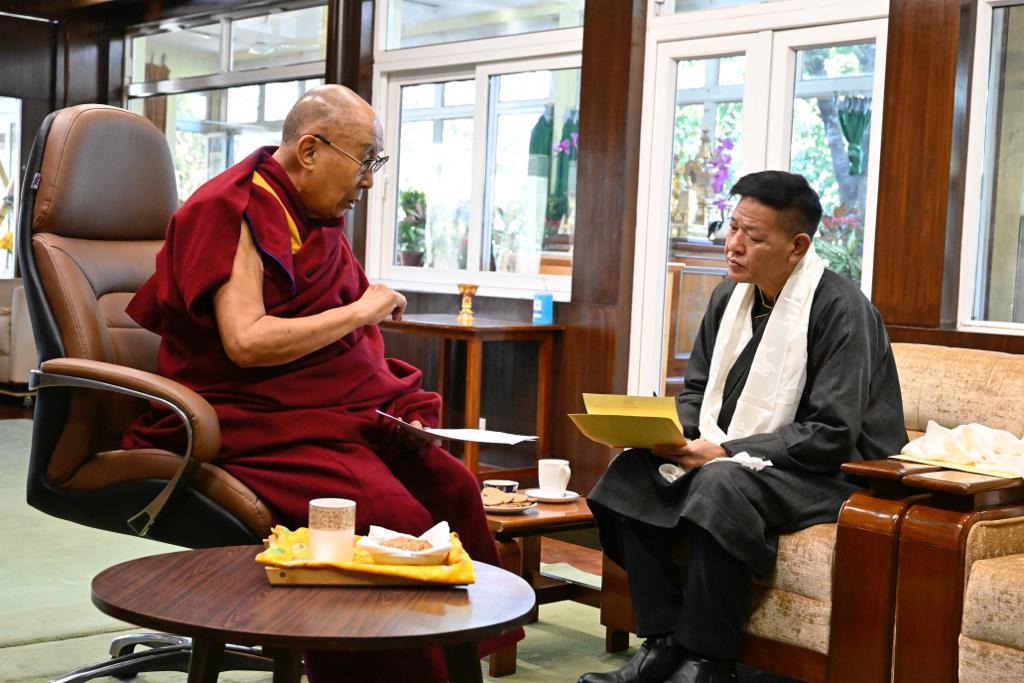
That result matters far beyond the fortunes of one politician. For a people dispossessed of their homeland and dispersed across continents, the continuing vitality of Tibetan democracy is itself a political achievement. The Tibetan institutions in exile have survived not by coercion but by consent, and the peaceful re-election of their political leader stands in striking contrast to the authoritarian system under which Tibet itself is governed.
Penpa Tsering was born in 1967 in Bylakuppe, in southern India, one of the oldest and most important Tibetan settlements established following the exodus from Tibet. His generation inherited the consequences of 1959 without having personally known the old Tibet. His family, like thousands of others, had been uprooted from their homeland. Exile was therefore not an abstraction but the condition into which he was born.
He attended the Central School for Tibetans in Bylakuppe before studying at Madras Christian College in Chennai. His education, combined with the intensely communal life of the Tibetan settlements, prepared him for a career that would increasingly be devoted to public service.
He entered the Tibetan Parliament-in-Exile in 1996 and eventually became its Speaker in 2008, serving until 2016. Those years gave him an intimate understanding not only of Tibetan politics but also of its divisions, sensitivities and limitations. They also established him as one of the most formidable advocates of the Middle Way Approach championed by His Holiness the Dalai Lama.
The Middle Way is frequently misunderstood outside the Tibetan world. It does not presently demand Tibetan independence. Rather, it seeks genuine autonomy for the Tibetan people within the constitutional framework of the People’s Republic of China, with meaningful protection for Tibetan language, religion, culture, education and the environment. It is an attempt to reconcile historical grievance with political reality through dialogue rather than violence.
Penpa Tsering has remained remarkably consistent in defending that position, even as the prospects for formal negotiations with Beijing have remained bleak. Perhaps one of the more important, if necessarily discreet, developments of his first administration was the restoration of informal communication with the Chinese side. In July 2025 he publicly confirmed that back-channel exchanges were continuing, while refusing to manufacture optimism where little was justified. It was a revealing example of his political temperament: keep the door open, continue talking, but harbour no illusions.
Upon beginning his second term in May 2026, he again reaffirmed that the Central Tibetan Administration remained firmly committed to the Middle Way Policy and to seeking a settlement through non-violence, dialogue and mutual benefit. The channel of communication with Beijing, however tenuous, would remain open.
This persistence should not be mistaken for weakness. Quite the contrary. One of Penpa Tsering’s accomplishments has been to make the Tibetan argument more politically sophisticated. Tibet cannot rely upon sentiment alone. Sympathy for the Dalai Lama remains enormous, but sympathy is not foreign policy. Governments act according to interests, strategic considerations and changing geopolitical circumstances. Penpa Tsering understands this perfectly well.
Consequently, his diplomacy has increasingly presented Tibet not merely as a question of historical injustice or human rights, but as an issue touching upon Asian security, the environment, water, relations with China and the preservation of a civilisation.
This has taken him repeatedly to the United States, Europe and elsewhere, meeting legislators, diplomats, academics, think tanks and Tibetan communities. In Washington in early 2026, for example, he met Senator Jeff Merkley and engaged with the US-China Economic and Security Review Commission, while also addressing the International Religious Freedom Summit and participating in a discussion at the Atlantic Council. His purpose was not simply to ask the world to remember Tibet, but to place Tibet within the larger strategic conversation about China and the future of Asia.
That effort builds upon one of the most significant international developments of recent years: the strengthening of bipartisan American support for Tibet. The Promoting a Resolution to the Tibet-China Dispute Act — commonly known as the Resolve Tibet Act — represented an important reaffirmation in Washington that the Tibet-China dispute remains unresolved and that meaningful dialogue should resume. The legislation enjoyed conspicuous bipartisan backing, something increasingly rare in contemporary American politics.
There have also been less glamorous but equally important diplomatic battles. When American funding cuts threatened Tibetan programmes and the international broadcasting services upon which many Tibetans depend for uncensored information, Penpa Tsering took the argument directly to Washington. He warned that weakening Radio Free Asia and Voice of America risked creating an information vacuum precisely where Beijing exercises extraordinarily tight control over information. He also welcomed the partial restoration of American assistance to Tibetan communities.
This is perhaps where his effectiveness is most evident. He has understood that the Tibetan cause must operate simultaneously on several levels. There is the great political question of Tibet’s future; there is the diplomatic struggle to prevent that question disappearing from the international agenda; and there is the everyday responsibility of governing a dispersed community that must educate its children, care for its elderly, preserve its institutions and prepare another generation to assume responsibility.
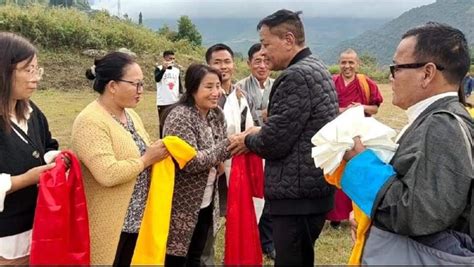
His administration has therefore placed considerable emphasis upon education and youth. Tibetan schools are not merely educational establishments in the conventional sense; they are among the principal means by which a civilisation in exile transmits its language, memory and values. In 2026 Penpa Tsering continued personally to visit Tibetan schools and settlements, urging younger Tibetans to pursue academic excellence whilst remaining rooted in their language and culture. During visits to Ladakh, Bir and Chauntra, he stressed education, leadership, environmental responsibility and community participation as essential to the survival of the Tibetan cause.
He has also been prepared to confront uncomfortable demographic realities. In September 2026 he drew attention to declining enrolment in Tibetan schools and the falling birth rate within the exile community. These are not headline-grabbing subjects, but they are precisely the sort of long-term questions that responsible leadership cannot afford to ignore. A nation in exile survives not only through declarations and diplomacy, but through families, schools, language and institutions.
His administration’s responsibilities extend still further. During the 2026 budget deliberations, attention was given to youth skills and entrepreneurship, elderly care, mental-health awareness, cooperation between Tibetan clinics and local hospitals, the growing burden of diabetes and hypertension, cybersecurity and the development of a larger generation of Tibetan IT professionals. These may seem prosaic beside the enormous question of Tibet itself, but they illustrate something important: the Central Tibetan Administration is not merely an advocacy organisation. It governs a living community.
Cultural preservation has likewise remained central. In April 2026 Penpa Tsering inaugurated new student and staff accommodation at the Tibetan Institute of Performing Arts, one of the institutions through which Tibet’s extraordinary artistic traditions have been preserved in exile.
But the challenge facing him has become more acute. What is at stake today is not simply political control over territory. It is the survival of Tibetan identity itself.
Beijing’s policies of assimilation — or Sinicisation — increasingly touch education, language, religion and cultural expression. Chinese-language education and the system of boarding schools have become particular sources of concern among Tibetan organisations and international human-rights advocates. Penpa Tsering has therefore made the preservation of Tibetan national identity one of the defining themes of his leadership.
In September 2026 he formally proclaimed an annual Tibetan National Identity Preservation Week, intended to mobilise Tibetan families, schools, associations and supporters around the world in defence of Tibetan language, religion, culture, values and heritage. The initiative was presented as a response to increasingly systematic assimilation policies, including China’s new Law on Promoting Ethnic Unity and Progress.
It is an intelligent response because cultural survival cannot ultimately be delegated to governments. A language survives because parents speak it to their children. A culture survives because it is practised. A religion survives because it is believed and transmitted. A historical identity survives because successive generations understand where they came from.
Penpa Tsering appears acutely conscious that China possesses resources incomparably greater than those available to the Tibetan exile administration. His answer is not to pretend otherwise, but to concentrate upon the assets China cannot easily manufacture: legitimacy, memory, culture, faith and the extraordinary international moral authority accumulated by the Tibetan cause over more than six decades.
Nowhere is this more important than in the question that inevitably hangs over Tibet’s future: the eventual succession of His Holiness the Dalai Lama.
In July 2025, on the eve of his ninetieth birthday, His Holiness confirmed that the institution of the Dalai Lama would continue and made clear that responsibility for identifying his reincarnation rests with the Gaden Phodrang Trust, in consultation with the appropriate Tibetan Buddhist authorities — not with the Chinese state. Beijing maintains that it has authority over the succession process. The result is likely to become one of the great religious and geopolitical confrontations of the coming years.
Penpa Tsering’s role in preparing Tibetans and the international community for that moment is therefore of enormous importance. The issue is not merely theological. At stake is the question of whether an officially atheist Communist state can claim the right to determine the reincarnation of one of Buddhism’s most revered spiritual leaders.
His administration has been unequivocal. The future Dalai Lama cannot be selected for the political convenience of Beijing.
At the same time, Penpa Tsering has been careful to maintain the distinction between the spiritual authority of His Holiness and the democratic political institutions of the Tibetan people. This, in many respects, is one of the Dalai Lama’s greatest legacies. By devolving political authority to elected leadership, His Holiness helped ensure that the Tibetan political movement need not depend upon one individual, however extraordinary that individual might be.
The re-election of Penpa Tsering in 2026 demonstrates that this democratic transition has taken root.
There is another dimension to Tibet which the Sikyong has worked hard to bring to international attention: the Tibetan Plateau itself.
Often described as the world’s “Third Pole” because of its immense reserves of ice and snow, Tibet is the source of some of Asia’s greatest river systems. What happens to its glaciers, rivers and ecosystems therefore concerns not merely Tibetans but hundreds of millions of people downstream. Penpa Tsering has repeatedly connected the environmental future of the plateau with the geopolitical future of Asia, arguing that ecological degradation, large-scale infrastructure development and the management of Tibetan water resources cannot be treated as matters of purely domestic Chinese concern. His engagement with young Tibetans has similarly stressed the strategic and environmental significance of the plateau.
There is a certain irony here. Tibet may have lost much of its political power, yet geographically it remains of immense strategic importance. Its altitude, water, borders, natural resources and position between the great civilisations of South and East Asia ensure that Tibet cannot simply be erased from the geopolitical map, however determined Beijing may be to remove it from diplomatic discussion.

This is why Penpa Tsering’s approach is ultimately one of endurance.
He knows that there may be no dramatic diplomatic breakthrough tomorrow. He knows that Beijing possesses enormous economic and political power. He knows that governments which express sympathy for Tibet must simultaneously manage their own relationships with China. He knows, too, that the Tibetan diaspora itself is changing as younger generations move across India, Europe, North America and Australasia.
Yet his answer is neither despair nor empty rhetoric. It is institution-building, education, diplomacy, cultural preservation and patience.
That is leadership of a rather particular kind.
The Tibetans have endured for more than six decades without surrendering either their identity or their political aspirations. They have created democratic institutions in exile. They have maintained schools, monasteries, cultural institutions and settlements. They have carried their language and religion across the world. And, remarkably, they have done so whilst adhering overwhelmingly to the principle of non-violence.
Penpa Tsering is the product of that achievement, but he is now also one of its custodians.
When I first met him in opposition, he was a politician arguing for the future of Tibet. When I met him again as Sikyong, the burden of helping to secure that future rested, in considerable measure, upon his shoulders.
Today, following his emphatic re-election, that responsibility is greater still.
The next five years may prove among the most consequential in modern Tibetan history. The struggle to preserve Tibetan identity is intensifying. The question of the Dalai Lama’s eventual succession looms ever larger. China’s power is formidable, while the international order itself is becoming less predictable. At the same time, a younger and increasingly global Tibetan generation must decide how it will inherit a cause begun long before many of them were born.
Penpa Tsering’s task is to hold these different worlds together: the Tibet remembered by the generation of 1959; the Tibet that exists today under Chinese rule; the global Tibetan diaspora; and the Tibet that future generations still hope one day to inherit.
It is an unenviable responsibility.
Yet there is something deeply compelling about a political leader who continues to advocate dialogue with an adversary vastly more powerful than himself, whilst refusing to surrender the history, identity or dignity of his people. Penpa Tsering’s pragmatism does not derive from weakness. It derives from an understanding that Tibet’s greatest strength has always been its capacity to endure.
His second mandate is therefore more than an electoral victory. It is a declaration of continuity.
The Tibetan people remain. Their institutions remain. Their culture remains. Their cause remains.
And under Penpa Tsering, they have a Prime Minister determined to ensure that the world remembers not only what Tibet was, but what Tibet may yet become.


 Carlos Mundy

 Giovanni R. Ruffini Professor of History Fairfield University, USA



 Charles Markeaton-Mundy

 Gaspard de Montfort

 Milton Cooper
