
 Maricruz Sainz de Aja
How an unexpected detour led me into a centuries-old tradition in Asturias
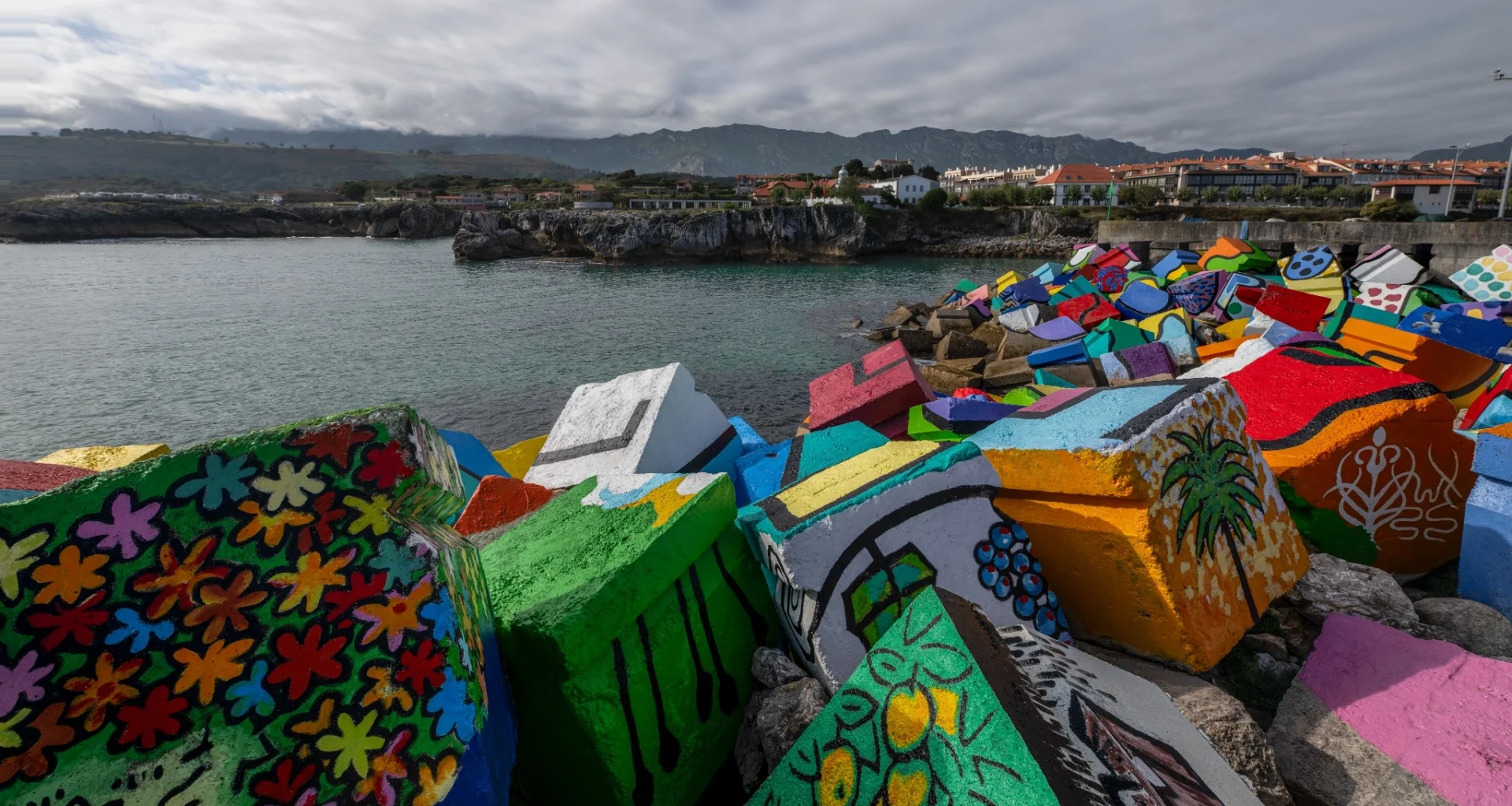
Llanes was never part of my plans. I had spent the night in Burgos and was heading for San Sebastián. I knew little about this small town on the Asturian coast, except for an image that had stayed with me: enormous concrete blocks, painted in brilliant colours, standing against the sea.
I decided to see them for myself.
I went straight to the harbour before even looking for a hotel. I climbed towards the sea and there they were, just as I remembered. I knew neither their name nor their history. All I knew was that colour, concrete, water and light had somehow drawn me to this place. I reached for my camera.
Only later did I learn their name: the Cubos de la Memoria, or Cubes of Memory, Agustín Ibarrola’s intervention on the concrete blocks of the harbour breakwater. The work brings together the artist’s memories, the history of art and the memory of the land itself. On 7 September, however, none of that meant anything to me yet. My instinct was to photograph what I saw. Understanding it would come later.
From the harbour I wandered into town. The stone streets, the architecture, the closeness of the mountains, and the Cantabrian Sea glimpsed between buildings were enough to make me want to stay. But every hotel seemed to be full. I had no idea why.
Eventually, a receptionist told me a room had just become available. When he realised I had arrived without the slightest idea of what was happening in Llanes, he could hardly believe it. The town was preparing for one of its most cherished celebrations: the feast of the Virgen de la Guía, Our Lady of the Guide. He spoke of her as though she were a member of his own family. She was believed to work miracles, he told me. He found me a small book about her history and encouraged me to visit the chapel, tell her what was troubling me, and ask for her guidance.
So I went.
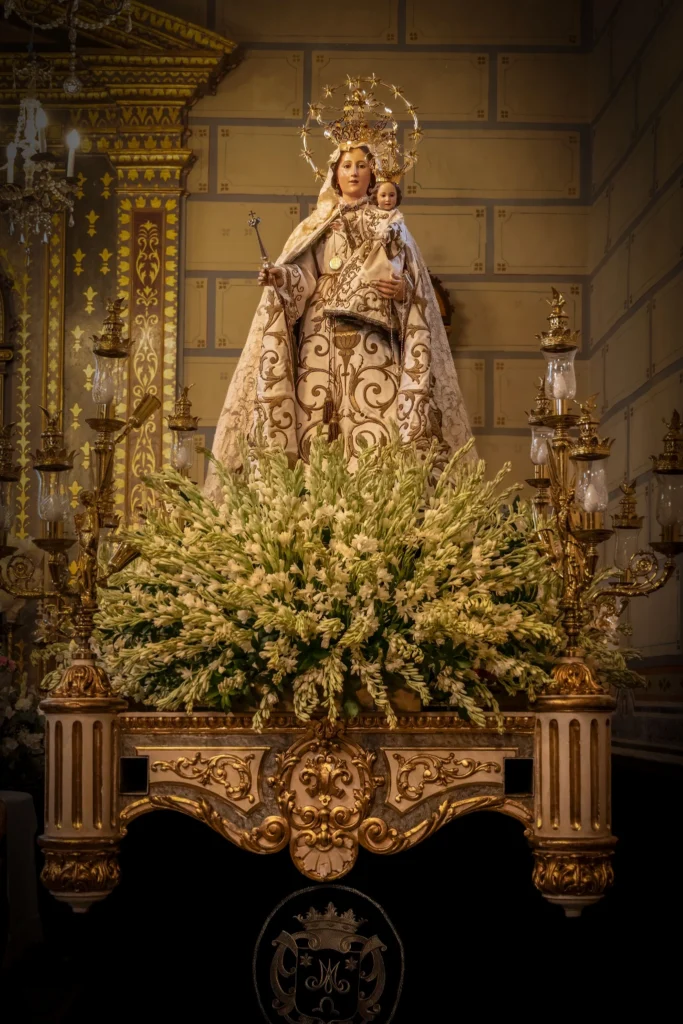
The chapel of the Virgen de la Guía stands on a hill overlooking Llanes and the sea. I would later learn that this devotion stretched back centuries. According to the chronology recorded by the Bando, the local festival association, Fernando de Salas petitioned Pope Leo X in 1515 for permission to establish the chapel. By 1632, a secular celebration in the Virgin’s honour was already recorded in the minutes of the Brotherhood of Seafarers of Saint Nicholas of Llanes.
I climbed to the chapel. Standing outside, I listened to the rosary and then to Mass. I found myself praying: “My Lady, you must have brought me here for a reason…” At the time, they were simply words spoken in prayer. Later, they would mean something else.
Those first hours brought unexpected encounters. Agustín and Susa began to give names and stories to everything I had been seeing: the Cubes, the indianos, the families, the traditions, and the particular way this town celebrates its festivals. The indianos were emigrants who had made their fortunes in the Americas and returned home.
That was when I met Mateo, a historian working on his thesis about the Virgen de la Guía. I had been trying to make sense of the celebration for a few hours; he had devoted years to studying it. His knowledge, though, went well beyond the archives. His family belonged to this tradition, and he had composed music for the festivities himself. Later I met his sister, who would take part first in a mantilla and then in traditional dress. Mateo led us to where the band was gathering. As the musicians struck up and began making their way through the streets towards the chapel, I followed with my camera. I did not yet understand much of what I was witnessing. I knew only that I wanted to keep looking.
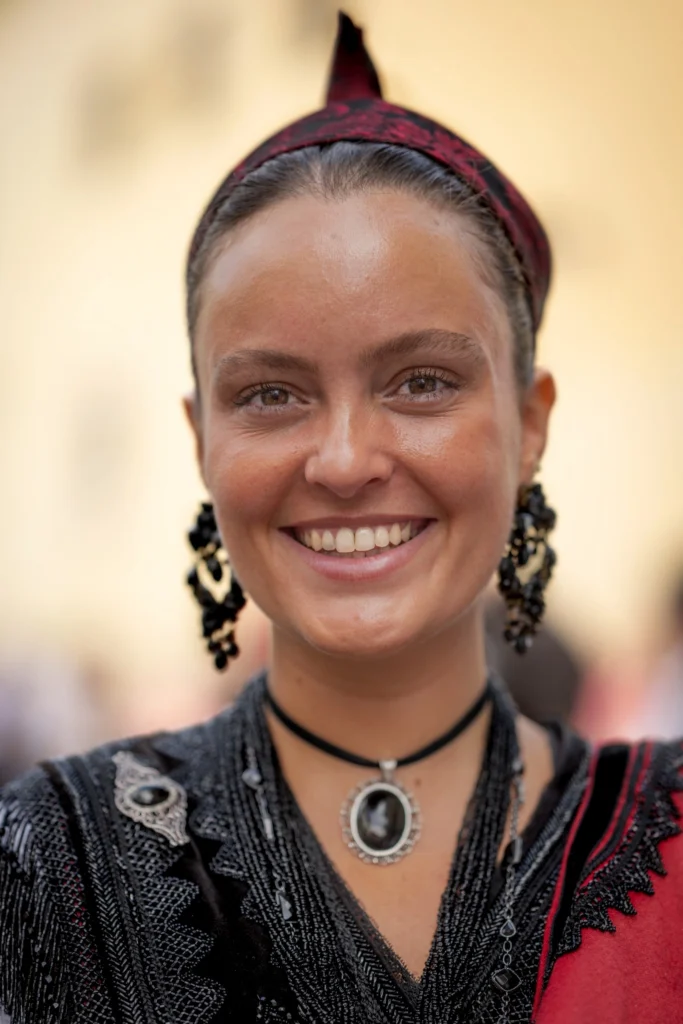
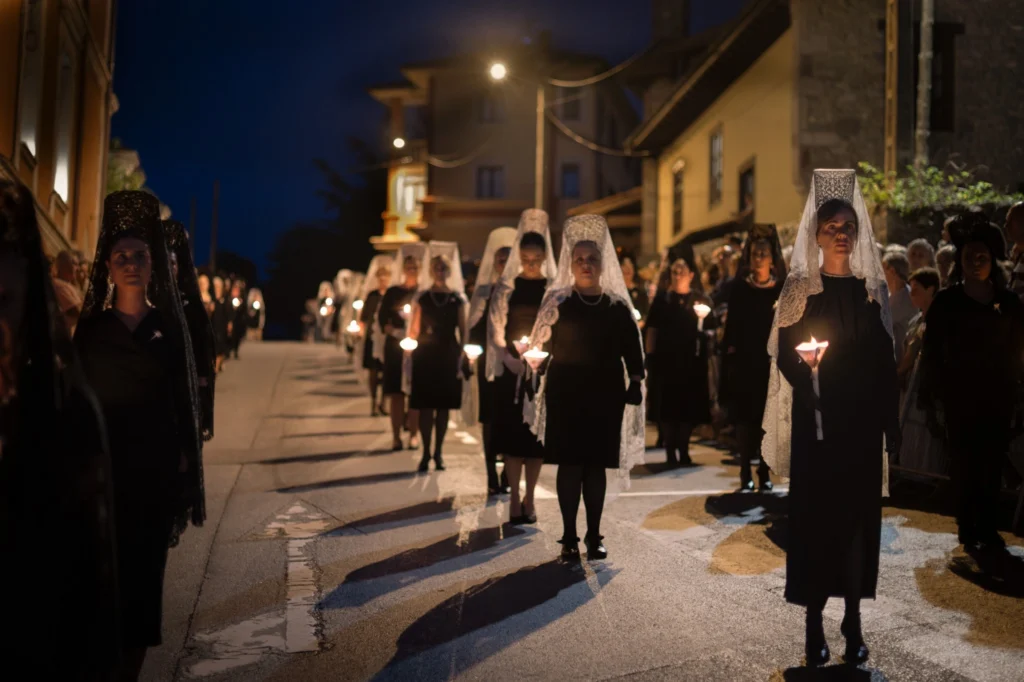
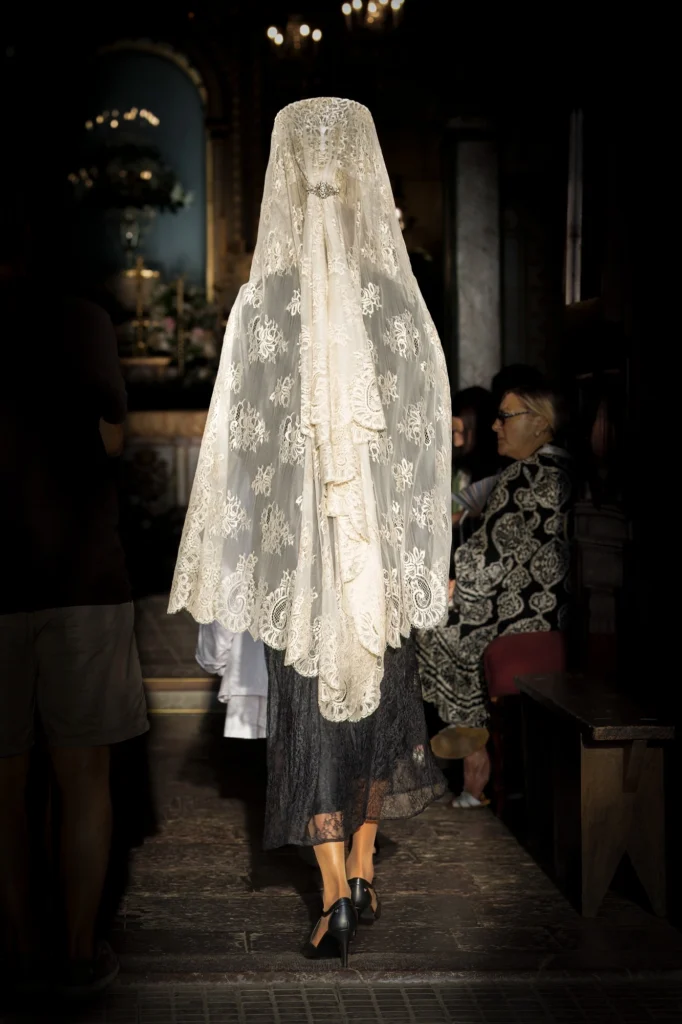
As the afternoon unfolded, the women began to appear: elegant, solemn figures in white and black mantillas, making their way one after another up to the chapel. The scene seemed ancient, although I would later learn that the ceremony as it exists today has a precise history. Until 1929, the main observances took place on 8 September. That year, a nighttime procession was introduced on the 7th to carry the statue from the small chapel to the Basilica of Santa María, which could accommodate the faithful for the solemn Mass the following day. The descent took place at dusk, after the novena, by candlelight.
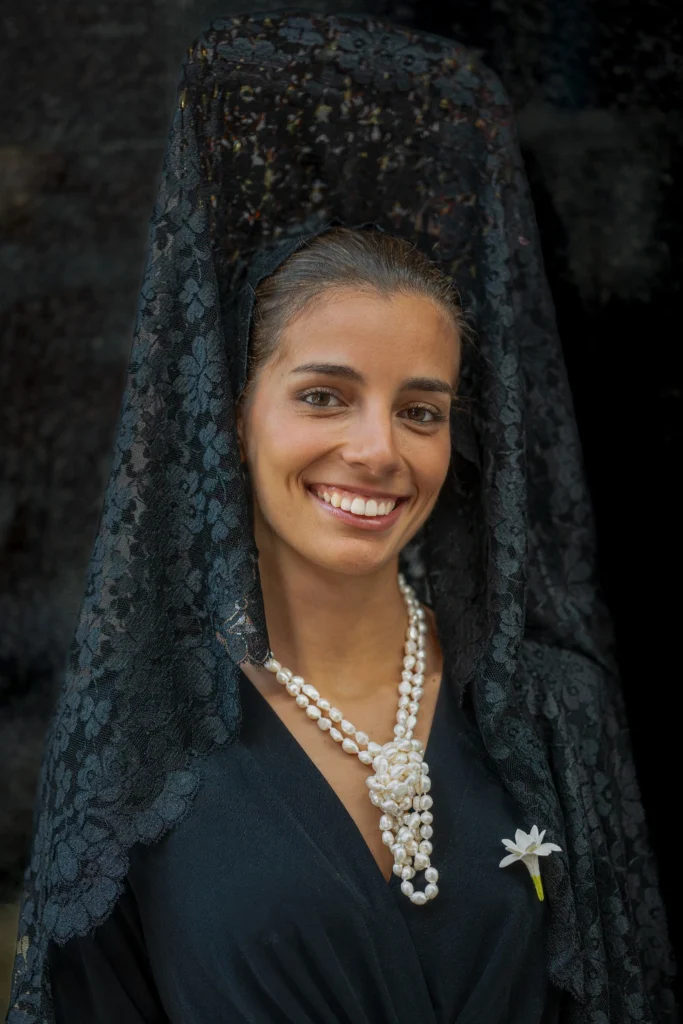
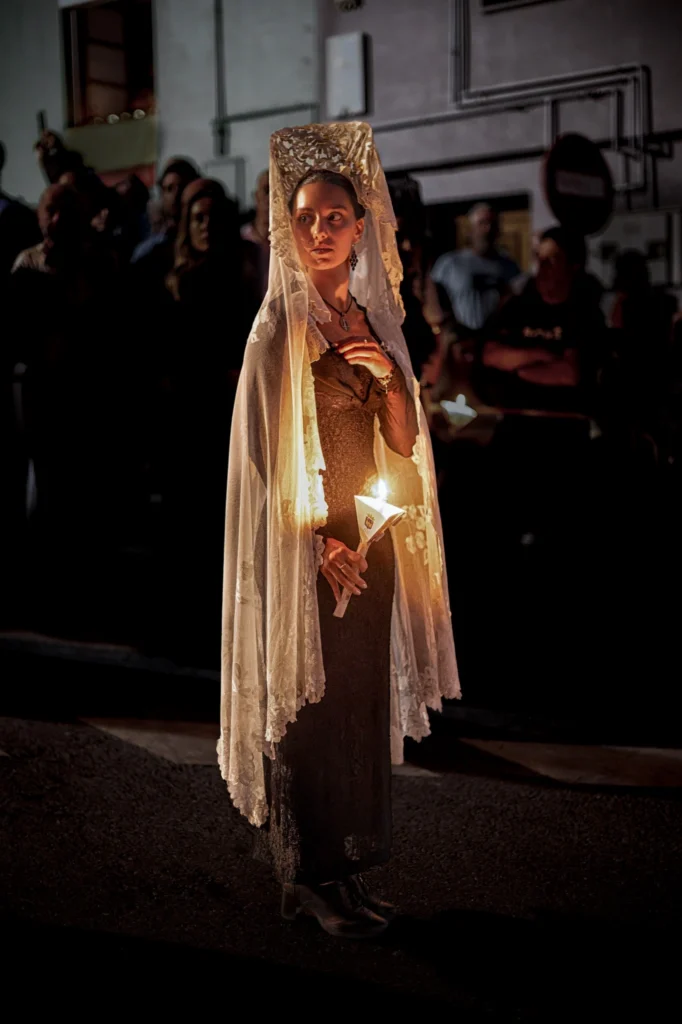
The mantillas came later. The Bando’s historical chronology records that in 1948 a group of devotees accompanied the Virgin wearing traditional Spanish mantillas. From the end of that decade onwards, their numbers grew, until the mantillas became one of the defining images of the procession. And there were the tuberoses, the flower of the Bando de la Virgen de la Guía: white and intensely fragrant, appearing alongside the mantillas, in the women’s hands and all around the Virgin.
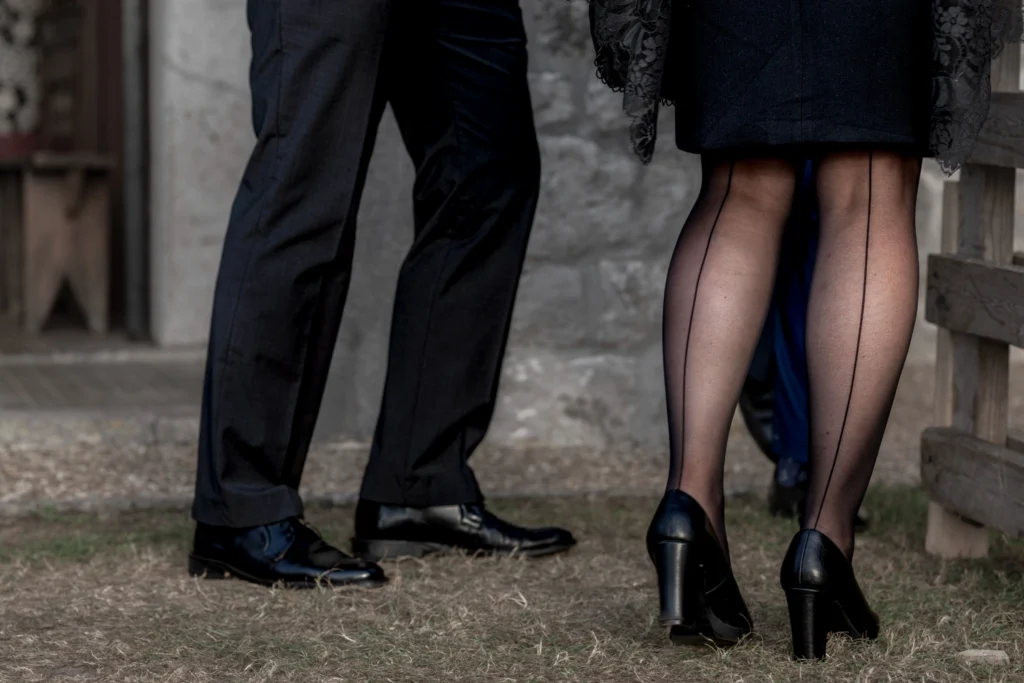
What had first captivated me visually was slowly revealing something far deeper.
Before the procession began, I was allowed inside the little chapel. It was still empty. There stood the Virgen de la Guía, surrounded by tuberoses and held in the quiet of the stone interior. For a few precious minutes I photographed her alone: no procession, no music, no crowd. Just the Virgin and the flowers.
Soon afterwards, the women began to arrive. I did not know whom to photograph; everything was happening at once. Young women and older women, black mantillas and white, candles, tuberoses, different faces united by the same tradition and by something difficult to capture in a photograph: the pride of carrying forward what they had inherited from those who came before them.
At nine o’clock, when the novena had ended, the nighttime procession began. The women emerged first. Long lines descended from the chapel amid mantillas, candles and tuberoses, in the hushed stillness of the Llanes night. Then the Virgin appeared, carried on the shoulders of her bearers, and the band began to play.
For a moment, I forgot I was there to photograph.
A cold sweat came over me. Then I remembered myself and ran. There was one place I wanted to be when the procession arrived: the harbour.
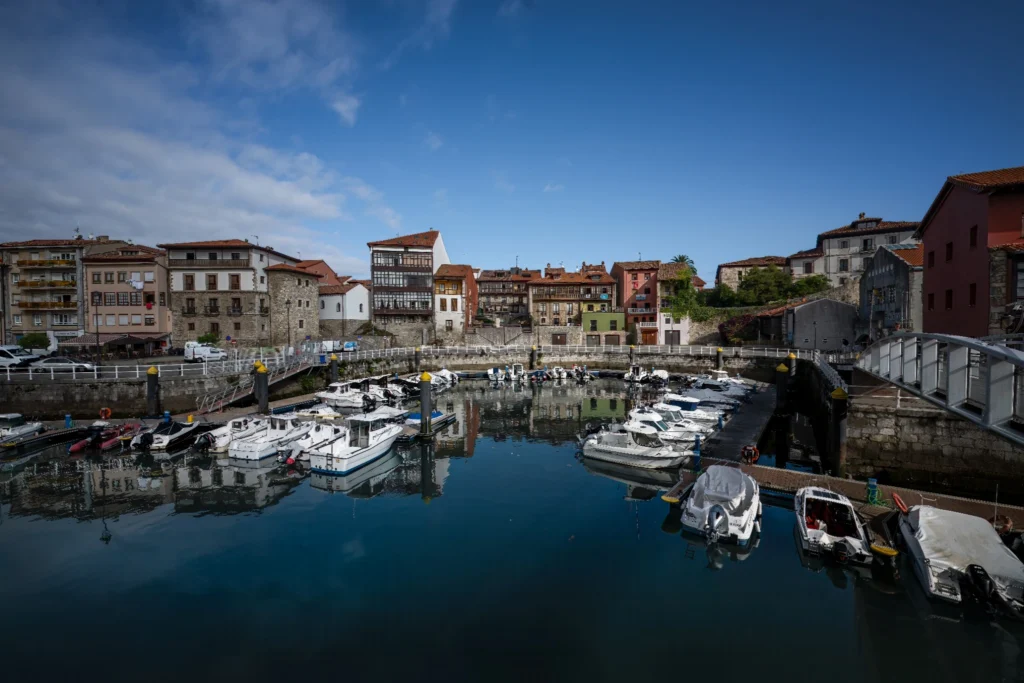
Almost the whole town of Llanes was waiting there. The procession stopped on the bridge, and the bearers turned the platform until the Virgin faced the estuary, looking out to sea. I did not yet understand the meaning of the gesture. Later I learned that it also speaks to those who are far away—to the people of Llanes who are absent, and to a history shaped by departures.
Then another part of Llanes began to make sense. Eastern Asturias experienced substantial emigration during the nineteenth century and the first half of the twentieth. Cuba was among the principal destinations, followed later by Mexico. Some emigrants returned wealthy and built the grand indiano houses that still shape the landscape; many others never returned. Yet family ties and emotional bonds with Mexico survived the ocean between them.
I am Mexican, the daughter of a Spanish father. Spain has never felt foreign to me; it is part of my own story. Perhaps that is why I was so moved to discover, in this corner of Asturias, how many stories had travelled in the opposite direction too: from Llanes to Mexico and, generation after generation, from Mexico back to Llanes.
Standing there by the water, I was no longer thinking about a historical connection. I was watching it unfold.
Then came the crackle of firecrackers and the fireworks. I crossed to the other side of the bridge because I needed some distance to take it all in: the Virgin, the harbour, the people, the Cantabrian Sea and the sky lighting up over Llanes.
8 September
The following morning I woke to music: bands playing, voices rising, people singing. From my balcony I could see the children performing the Danza de Arcos, the traditional Dance of the Arches. The previous evening had been all candlelight, mantillas, tuberoses and silence. Now Llanes had burst into colour.
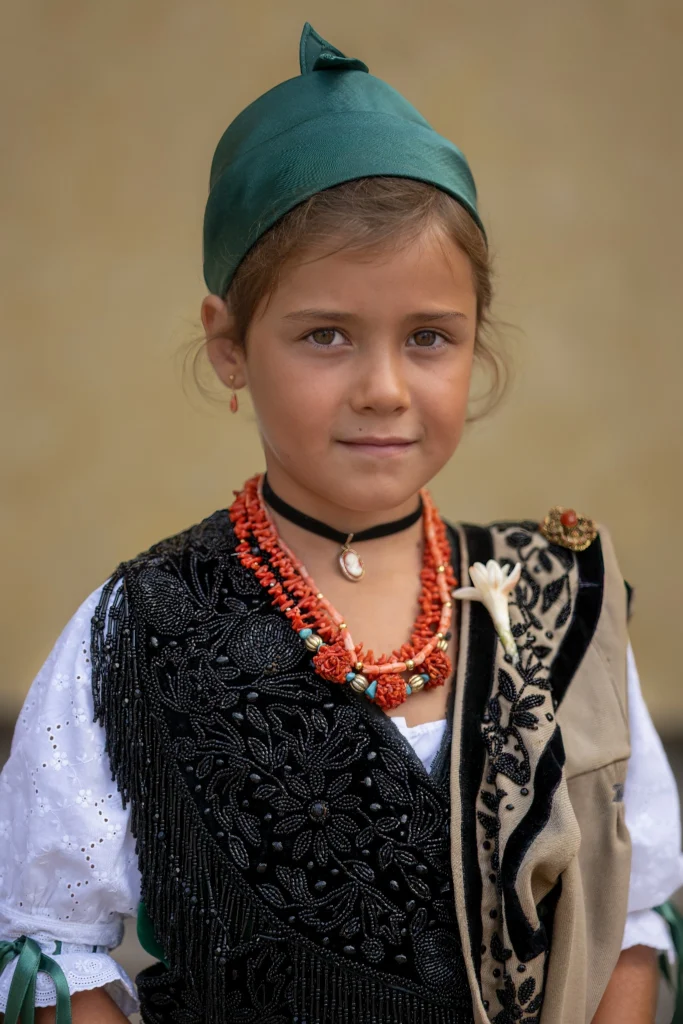
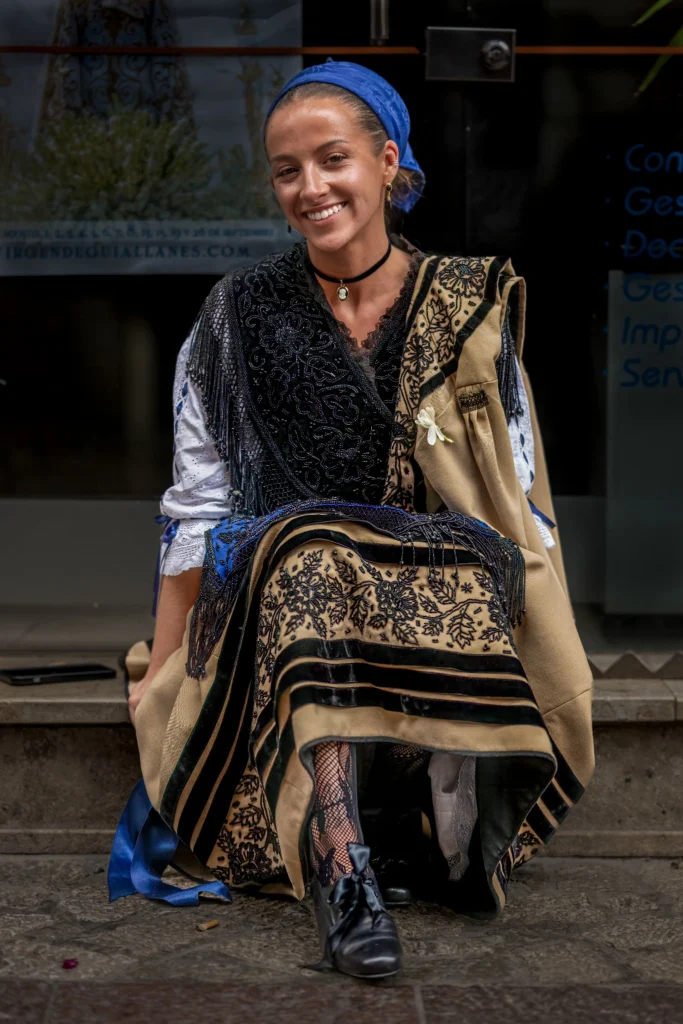
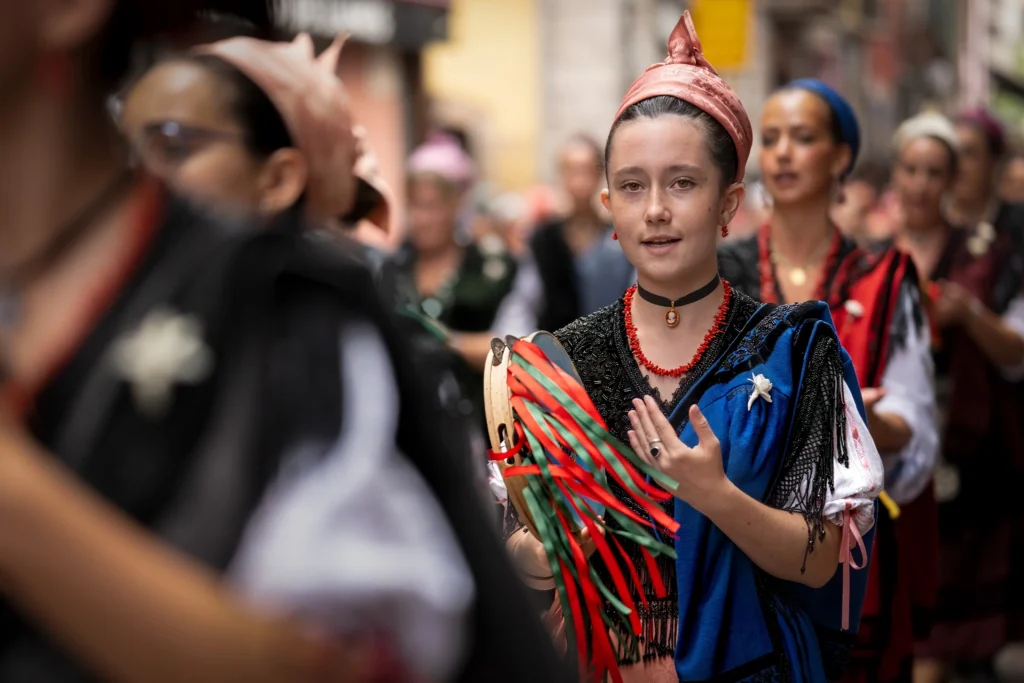
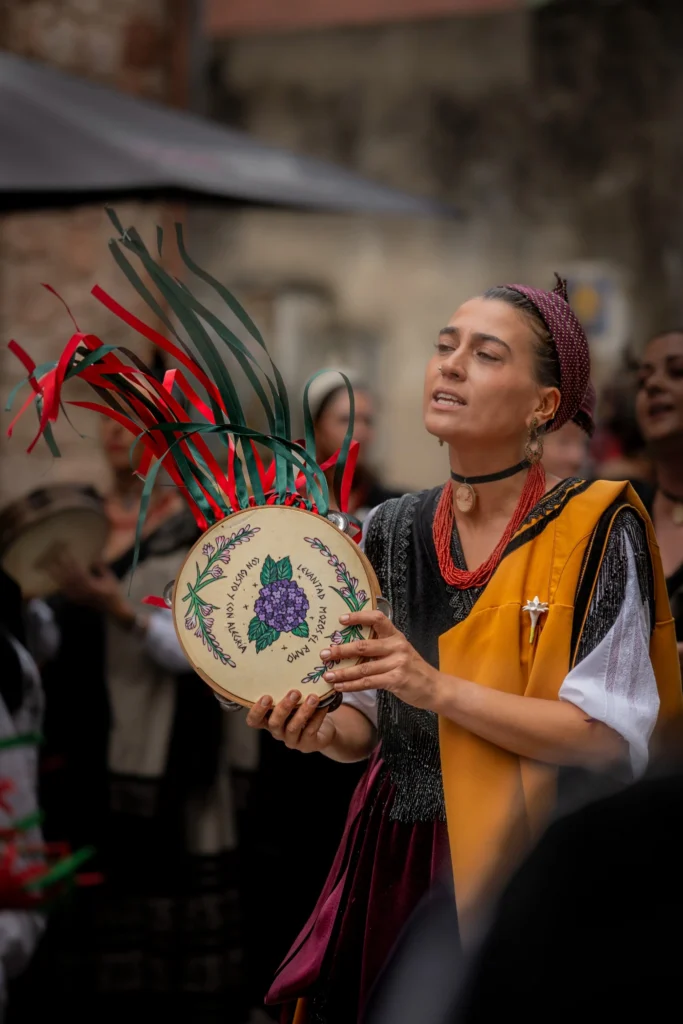
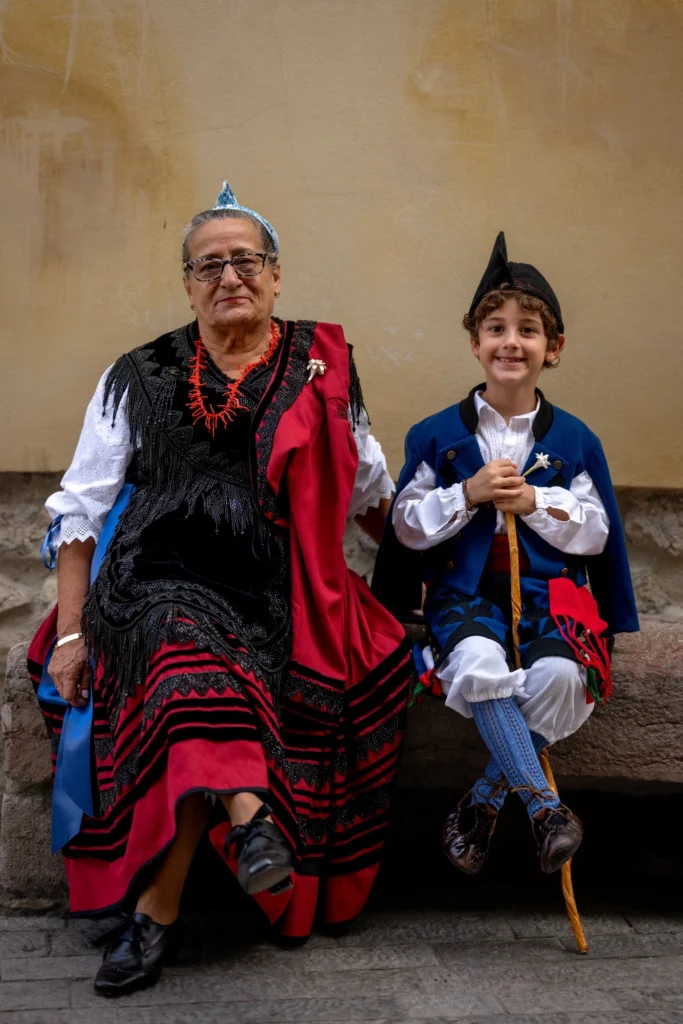
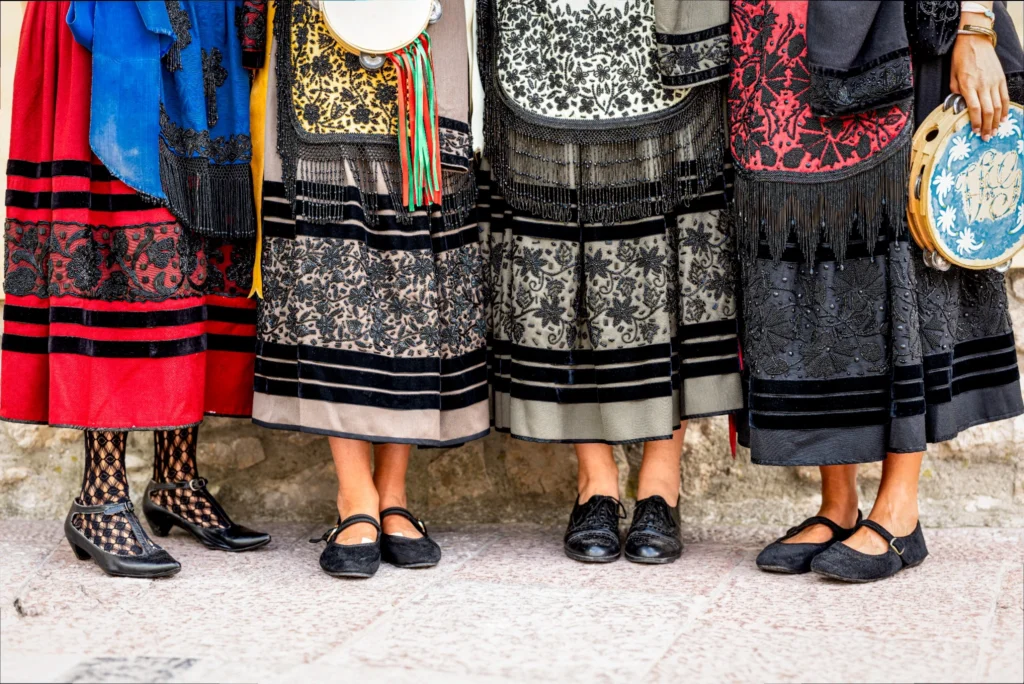
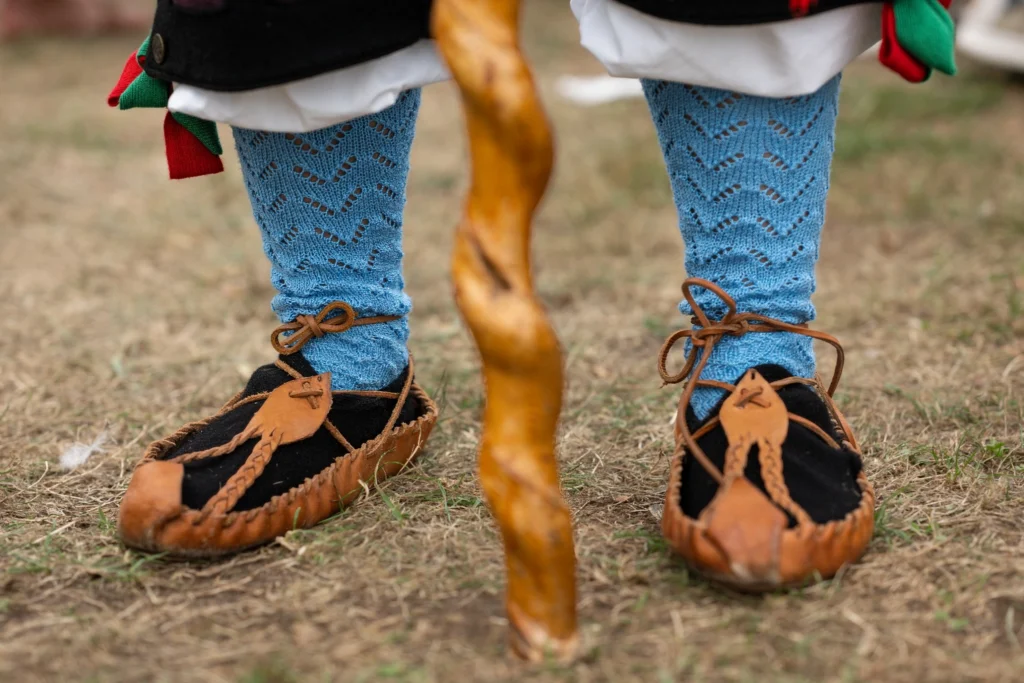
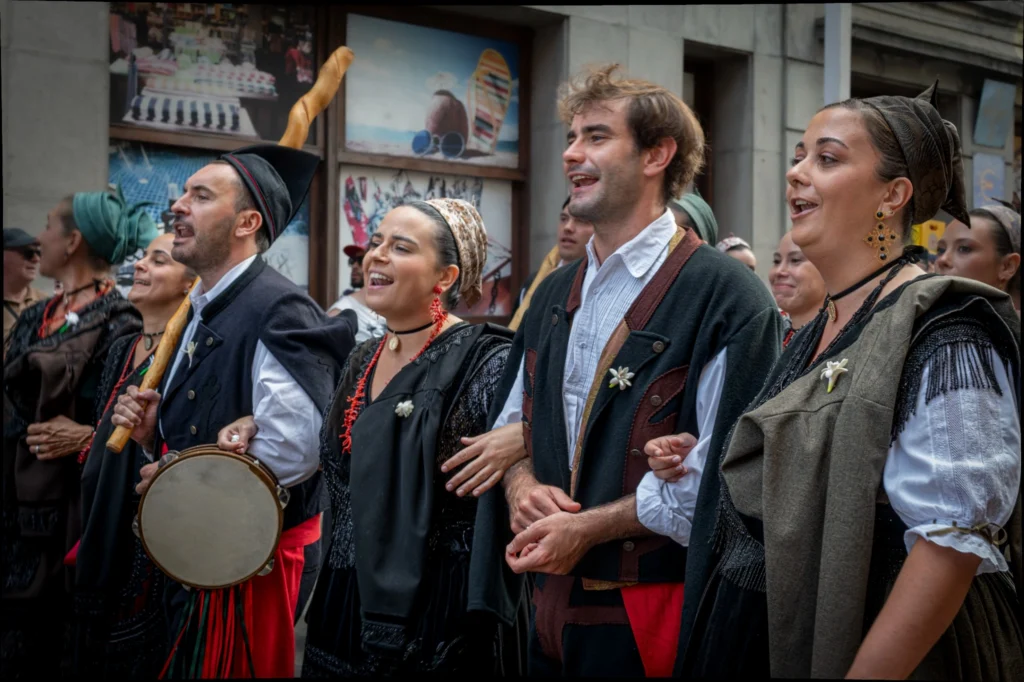
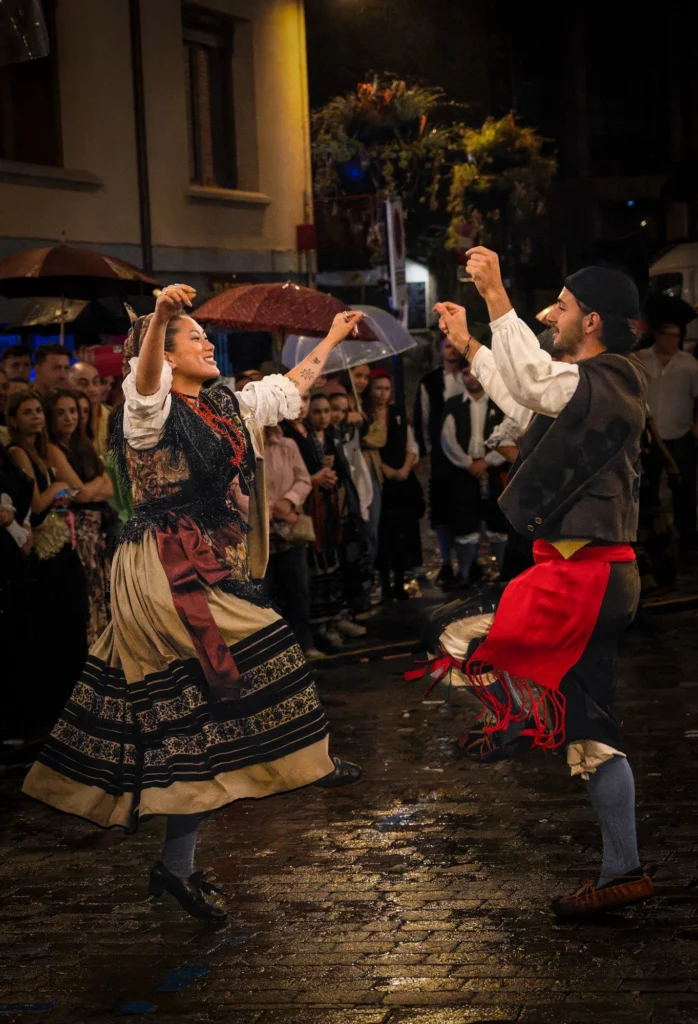
8 September is the great feast day of the Virgen de la Guía. The streets filled with women in the traditional dress of Llanes and men in the traditional porruano costume, with dresses, scarves, music and tuberoses; children, young people, grandparents, entire families. Nieves, María, Martha and Carmen were there. It seemed the whole town had come out into the streets.
As a documentary photographer, I hardly knew where to turn my lens.
The costumes, I realised, were not simply part of the spectacle. They carried memory. Generation after generation had preserved them and passed them down, along with the music, dances and gestures. Tradition survives not in the clothes themselves, but in the people who choose to wear them.
I kept moving through the crowds. With only one camera battery and barely a pause between photographs, I learnt to recharge whenever an opportunity presented itself—sometimes for little longer than the time it took to have a beer. I bumped into Agustín again and we had one together in the middle of the festivities. Then he drew my attention to something I had been walking over all along: poetry set into the streets.
The public art trail Contempo con poesía runs through the old town, its 95 metal plaques embedded in the pavement and inscribed with verses by Celso Amieva. I had walked across them without noticing. Once again, Llanes had a story to tell me that I had almost missed.
There were dances, processions, cider, music, heat and flowers. And we made our way back towards the chapel. This time we were not following the Virgin; we were going to wait for her. The statue that had descended solemnly into Llanes the night before was now returning to her sanctuary, accompanied by women in Llanes dress, men in porruano costume, musicians and the children performing the Danza de Arcos.
On reaching the Campo de la Guía, the dancers performed the traditional Danza de Arcos in honour of the Virgin. Then came the Reverencia, the Ofrecimiento de Ramos—the offering of floral arrangements—and regional dances, including the Pericote. The previous night I had photographed the quiet devotion of candles and mantillas; now there was movement, music and colour. It was the same faith expressed in two entirely different ways.
Among all those people, I continued looking for what interests me most when documenting a culture: its people. I photographed Martha and Ana. By then they were no longer simply two women I had met among hundreds of strangers; they had become my friends. I had arrived knowing no one, and now I was beginning to recognise faces, names and stories.
When the rain began, I retreated to recharge my battery. The town, of course, carried on without me. The festivities continued in the square below my room, and from upstairs I could hear the music and voices well into the night. The celebrations would not end until five in the morning.
I had come to Llanes in pursuit of an image of coloured concrete blocks whose meaning I did not know. They were called the Cubes of Memory.
Perhaps that was the only way this story could have begun.
In the space of two days, everything had become a story about memory: those who crossed the Cantabrian Sea for the Americas and those who came home; those who stayed in Mexico but never lost their ties to Asturias; a centuries-old devotion; women wearing their mantillas once more; children learning a dance; costumes handed from one generation to the next; poetry underfoot; and the stories a community chooses to keep alive.
There is also the kind of memory that photographers try to hold on to: the fleeting instant that vanishes almost as soon as we press the shutter.
I had arrived by chance. Or so I thought.
On my arrival, a surprised hotel receptionist had pointed me towards a small chapel and said, “Ask her to guide you.” And I had.
Then came Agustín, Susa, Mateo, Nieves, María, Martha, Carmen and Ana. The mantillas and the tuberoses. The music and the rain. Above all, there was an entire town that, for two days, welcomed me into its tradition.
I cannot explain why I arrived on that particular 7 September.
I arrived in Llanes knowing nothing of the Virgen de la Guía. I left with a small part of her story woven into my own.

 Lavinia Ellington-Wentworth
 Kamal Kumar

 Cristina Pedrazuela
 Fillipo degli Albizzi
 Basil St. Clair Fairfax
 Gaspard de Montfort