
 Romy Querol
Some artists become inseparable from the place where their visual language first took shape. Others begin in one city and eventually belong to many. Keith Haring’s work was born deeply connected to 1980s New York: the subway, the streets of Downtown, the clubs, the music, and that extraordinary generation in which art and life seemed to be happening at the same time. Yet the visual language he created there never belonged to New York alone.
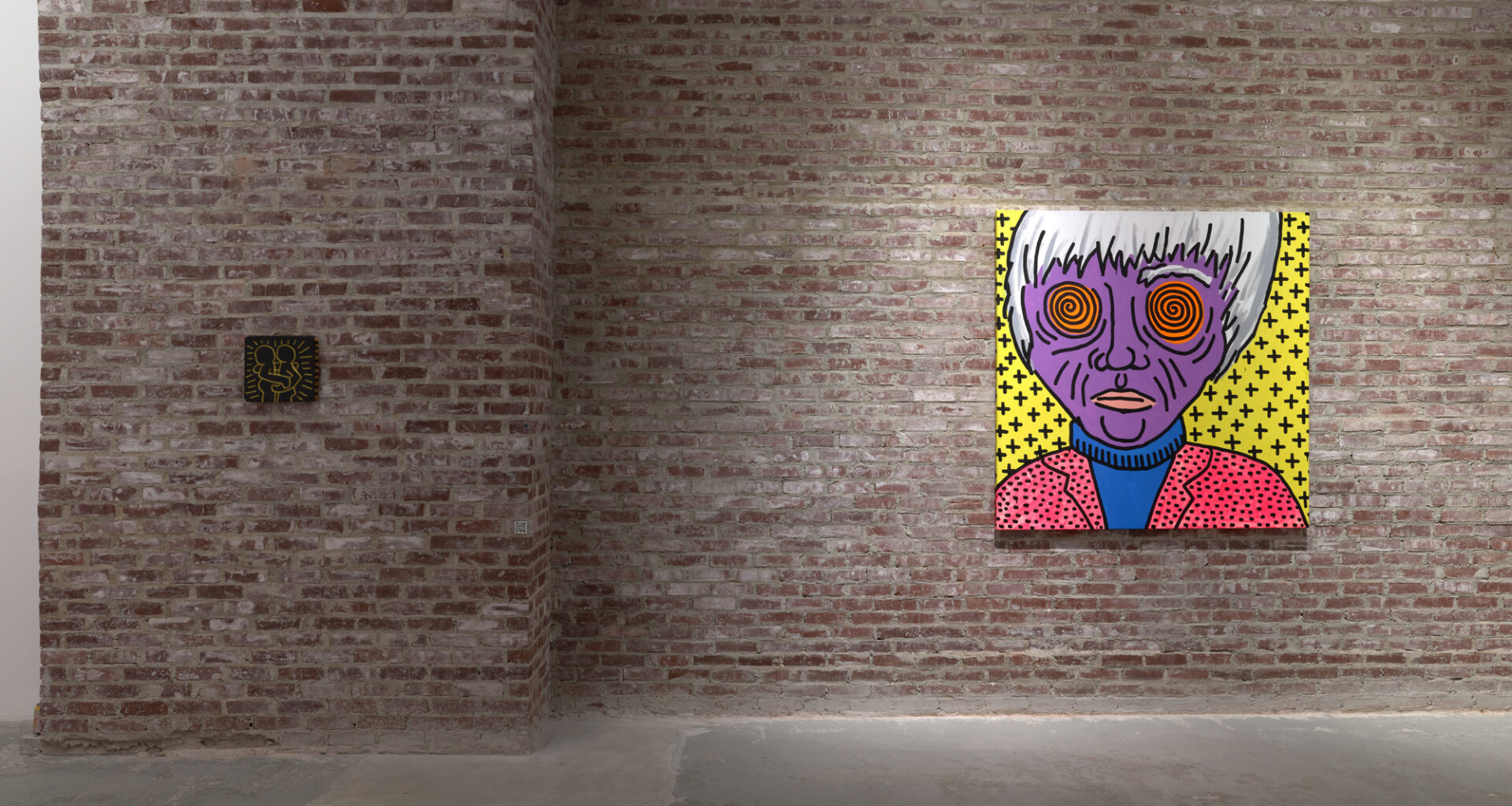
That is precisely what Keith Haring: A World in Motion is about. Spanning several floors of 60 White, a gallery in Tribeca, the exhibition traces the journey of a visual language born Downtown as it moves through Tokyo, Paris, Milan and San Francisco, encountering other cities, cultures and audiences along the way.
“Keith Haring’s work is rooted in New York, but it belongs to the world,” says Malca. And that is perhaps the best way to enter this exhibition. Haring achieved something extraordinarily difficult: he created an instantly recognizable vocabulary that needed no translation. His figures dance, run, collide and radiate energy; his dogs bark, and his Radiant Babies still seem to keep moving forty years later. Behind that apparent simplicity lay a perspective on power, sexuality, illness, racism, technology and collective responsibility.

Malca knows that universe well. He began collecting in the 1990s, drawn precisely to that New York generation — Haring, Jean-Michel Basquiat, Kenny Scharf, George Condo — before it became the chapter of art history we know today. “I wasn’t collecting because I believed these artists would become icons — I was collecting because they spoke to me,” he explains. For him, building an in-depth collection is something like writing an artist’s biography through their work.


Perhaps that is why one of the most fascinating moments in A World in Motion is not found before a perfectly illuminated work on a white wall.
You have to enter the night.
In 1986, Haring created five enormous panels for the DV8 club in San Francisco. They were installed above the bar of a venue that, for years, was one of the hubs of the city’s nightlife. There, the works were not contemplated from a distance: they lived alongside the music, the bodies, the drinks, the conversations and the black light. They were part of the life of the place.
Forty years later, Malca has decided to give them back something of that life.
At 60 White, the five panels reappear in an installation that evokes DV8, bringing back the black light and fluorescent glow. It does not attempt to turn a Tribeca gallery into a 1986 nightclub. What matters is something else: preserving not only the artwork, but also something of the experience for which it was created.

“The responsibility is to preserve not only the artwork but also its spirit,” Malca explains. He recalls how some visitors who were at the original DV8 have entered the installation and become emotional upon recognizing it: “I was there… I saw it back in ’86.”
Suddenly, those five panels cease to be simply five major Harings.
They have a night behind them again.
And perhaps this is precisely where the exhibition finds its most beautiful moment. Much of the art of that generation was born before anyone knew it would end up protected, catalogued and hanging in major institutions. It circulated through subway stations, walls, clubs, parties and streets. Haring understood very early on that public space could also be an artistic space. His celebrated chalk drawings on the black panels of the New York subway brought his images directly to thousands of people who might never have entered a gallery.
Malca shares something of that idea. In a recent interview, he put it very simply: “I always try to feel a work before understanding it.” He added that the artist begins the conversation, the work is the language, and we become its interlocutors. For him, what matters is not where we encounter a work, but what happens when we do.
A World in Motion allows precisely those encounters.
There is, for example, the drawing made in 1984 at the Alma-Marceau Métro station in Paris; Sister Cities — For Tokyo, from 1985; monumental works and pieces created at different moments and in different places that reveal just how deeply Haring absorbed the cities he passed through without ever abandoning a language of his own.
New York remained the starting point, but it was no longer a boundary.
Haring arrived in the city in 1978 to study at the School of Visual Arts and found a Downtown where disciplines mixed with a naturalness that is almost difficult to reconstruct today: painting, performance, graffiti, fashion and music shared artists, stages and nights. Haring moved through Club 57, the Mudd Club and Danceteria; his work lived alongside musicians, dancers and performers, and eventually left New York with the same ease with which it had previously left the galleries to take its place in the subway.
Malca recalls that when he discovered Haring and Basquiat, he did not think in terms of categories. He was not yet familiar with many of the hierarchies of the art world. For him, a subway station, a city wall, a club or a gallery were simply different settings in which creativity could appear. “For me, there were never any boundaries, simply because I didn’t know they existed.”
That sentence explains both Haring and this exhibition rather well.
Because A World in Motion does not try to confine Keith Haring to the 1980s. It does exactly the opposite: it sets him in motion again.
Between New York and Tokyo. Paris and Milan. San Francisco and Downtown. Between the museum and the street, painting and music, history and a night that happened forty years ago — a night that, under the black light of a room in Tribeca, for a few minutes, seems not to have ended at all.
Keith Haring: A World in Motion
60 White, Tribeca, New York
Curated by Carlo McCormick in collaboration with Lio Malca
On view through November 25, 2026.


 Elga Wimmer

 Pablo H. Aznar

 Clifford Thurlow


 Antoinette Martin

 Romy Querol
 Charles Markeaton-Mundy

 Gaspard de Montfort

 Milton Cooper
