
 Milton Cooper
Spain was once regarded as one of Europe’s great democratic success stories: a country which, after the death of Franco and under the decisive stewardship of King Juan Carlos I, accomplished an extraordinary transition from dictatorship to constitutional democracy.

It was not a perfect democracy. No democracy is.
Governments of both Left and Right were subsequently tarnished by corruption scandals, some of them extremely serious. The Partido Popular has its own uncomfortable history in this regard, just as the Socialist Party does. Corruption in Spain was neither invented by Pedro Sánchez nor confined to one side of politics.
But something different is happening now.
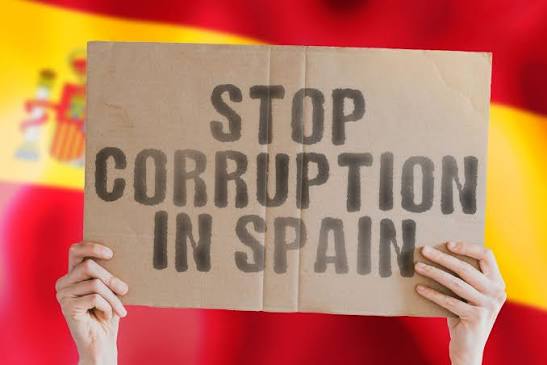
It is the sheer accumulation of cases surrounding the present Government, the Prime Minister’s former closest political associates, his party and even members of his immediate family that raises a more disturbing question: at what point does a succession of individual scandals become a crisis of political culture?
The developments of 2026 have made that question impossible to dismiss.
José Luis Ábalos was not some obscure provincial party functionary. He served as Minister of Transport under Pedro Sánchez and as Organisation Secretary of the PSOE, one of the most powerful positions within the governing party.
In June 2026, Spain’s Supreme Court sentenced Ábalos to 24 years and three months in prison for offences including bribery, embezzlement, influence-peddling and participation in a criminal organisation arising from the procurement of masks during the Covid pandemic. His former adviser Koldo García received 19 years and eight months. Businessman Víctor de Aldama was also convicted, receiving a substantially lighter sentence in recognition of his cooperation with the authorities.
These were not accusations shouted across the chamber of the Cortes.
They were findings of Spain’s Supreme Court.
The Court went further. In discussing the conduct before it, it warned that such behaviour undermined the country’s democratic architecture.
That observation deserves to be read carefully.
Because Ábalos had occupied the very heart of Sánchez’s political operation.
The scandal does not establish that Sánchez personally participated in Ábalos’s crimes. There is no judicial finding that he did. But political responsibility is not identical to criminal responsibility.
A Prime Minister chooses the people whom he trusts with great offices of state. He chooses the individuals entrusted with the organisation of his party. When one of the most powerful men in that structure is convicted of offences of such gravity, the public is entitled to ask how such behaviour was possible and how it went undetected for so long.
And Ábalos is hardly the end of the matter.
Santos Cerdán, another former PSOE Organisation Secretary and once one of Sánchez’s most trusted political lieutenants, has become embroiled in separate investigations concerning alleged corruption and alleged efforts to interfere with investigations damaging to the Socialist Party or Government.
Then there is the extraordinary Leire Díez affair.
Spain’s National Court is investigating allegations that a network sought information capable of discrediting police officers, prosecutors or others involved in corruption investigations affecting the PSOE and the Government. The investigation has examined alleged payments connected with the operation, and a Guardia Civil report has traced €43,225 received by Díez through intermediaries to PSOE funds.
These matters remain under judicial investigation, and those implicated are entitled to the presumption of innocence.
But politically the question is unavoidable.
How many investigations must converge upon the governing party before Europeans are permitted to ask whether something more serious than a collection of unfortunate coincidences is taking place?

There is more.
The Prime Minister’s wife, Begoña Gómez, has now been ordered to stand trial before a jury for alleged influence-peddling and misuse of public funds connected with her professional activities and the use of a Moncloa employee.
She denies wrongdoing. The public prosecutor has sought her acquittal, and Pedro Sánchez has repeatedly characterised the proceedings against his wife as politically motivated “lawfare”.
Those facts must be stated.
But another fact must also be stated: after an investigation lasting more than two years, an investigating judge has ordered the wife of Spain’s serving Prime Minister to face a jury.
That is an extraordinary situation for any European government.
Then there is David Sánchez, the Prime Minister’s brother.
Here the affair has progressed beyond investigation.
In July, the Provincial Court of Badajoz convicted David Sánchez of administrative prevarication in connection with his employment at the provincial authority and sentenced him to nine years’ disqualification from public employment or office.
The judgment is not yet final and has been appealed. He was acquitted of influence-peddling.
Again, precision matters.
But so does the remarkable political picture.
The Prime Minister’s former minister and former party Organisation Secretary has been sentenced to more than two decades in prison.
His brother has been convicted at first instance and disqualified from public employment for nine years.
His wife has been ordered to stand trial before a jury.
Another former PSOE Organisation Secretary has been drawn into major investigations.
A separate judicial inquiry is examining alleged attempts to obstruct or compromise investigations damaging to the PSOE.
And another investigation has examined the party’s system of cash payments.
One can examine each case separately—and legally one must.
Politically, however, Europeans are entitled to look at the whole picture.
There is another episode which should trouble anyone concerned with the integrity of Spanish institutions.
In November 2025, Spain’s Supreme Court convicted the country’s then Attorney General, Álvaro García Ortiz, of unlawfully disclosing confidential information. He was disqualified from office for two years, fined and subsequently left his post.
The Attorney General is not an ordinary political official. The office stands at the summit of Spain’s public prosecution service.
Once again, this does not prove personal wrongdoing by Pedro Sánchez.
But when the Attorney General appointed during a government’s tenure is convicted by the Supreme Court; when a former minister and senior party official is convicted of corruption offences; when the Prime Minister’s brother is convicted at first instance; and when his wife is ordered to stand trial, it becomes increasingly difficult to dismiss public concern as merely partisan hysteria.
And then came Ceuta.
The events of July 2026 moved the argument beyond corruption and into the realm of the state’s most elementary responsibility: control of its own borders.
In the space of an extraordinary few days, approximately 70,000 people entered Ceuta irregularly from Morocco.
Consider that figure.
Ceuta itself has a population of only about 80,000.
Spain suddenly found one of its sovereign territories—and therefore part of the external frontier of the European Union—confronted by a movement of people on a scale without modern precedent there.
People died. Spanish security forces were overwhelmed. The military was mobilised. Tens of thousands subsequently returned or were returned to Morocco, while thousands remained and the city struggled with the humanitarian and logistical consequences.
The Government insists that the extraordinary scale of the crossing could not reasonably have been predicted. Sánchez has said that intelligence and security reports noted increased attempts to enter Ceuta but did not forecast anything approaching an influx of 70,000 people.
He has also rejected suggestions that there is evidence demonstrating Moroccan state responsibility for deliberately orchestrating the episode.
Those assertions must be recorded.
But they do not remove the question of political responsibility.
A government exists, before almost anything else, to defend the territorial integrity of the nation and maintain control of its borders.
Ceuta is not some distant colonial possession for which Madrid has only theoretical responsibility.
Ceuta is Spain.
Its frontier with Morocco is also an external frontier of the European Union.
When that frontier was overwhelmed, the consequences were not confined to Spaniards.
Italy subsequently introduced temporary border checks on arrivals from Spain, citing security concerns following the Ceuta crisis. Spain responded with reciprocal controls. Italy has since extended its measures.
Thus, a failure of control on Europe’s southern frontier began to reverberate through Schengen itself.
This is why the Sánchez question can no longer be regarded simply as an internal Spanish political quarrel.
The European Union has spent years presenting itself as the guardian of democratic standards, judicial independence, transparency and the rule of law.
It publishes annual reports examining precisely these matters. It has confronted Member States when it believed their governments threatened institutional checks and balances.
That is entirely legitimate.
But principles acquire authority only when they are applied consistently.
The European Commission’s own 2026 Rule of Law Report continues to scrutinise Spain’s justice system, anti-corruption framework, media pluralism and institutional checks and balances.
Europe therefore cannot credibly argue that what happens inside Spanish institutions is of no concern to Brussels.
It is Europe’s concern because Spain is Europe.
There is a further irony.
Pedro Sánchez came to power in 2018 after a corruption scandal engulfed the Partido Popular government of Mariano Rajoy. Sánchez presented himself as the instrument of political regeneration.
Eight years later, the language of regeneration rings rather differently.
None of this permits us to dispense with the presumption of innocence.
Begoña Gómez has not been convicted. Santos Cerdán and others implicated in continuing investigations are entitled to defend themselves. David Sánchez’s conviction is under appeal. Pedro Sánchez himself has not been convicted of corruption, and no court has established that he personally participated in the crimes for which Ábalos and Koldo García were convicted.
Those distinctions are essential in a democracy.
But democracy requires something more than criminal liability.
It requires political accountability.
A Prime Minister need not personally receive an illegal payment before Parliament, the press or the electorate may legitimately question his judgment.
A head of government bears responsibility for the people he appoints, the administration he leads, the standards he sets and the political culture over which he presides.
That is the difference between a courtroom and a parliament.
The criminal court asks: Can this individual’s guilt be proved to the standard required by law?
A democracy asks a broader question: Has this Government retained the confidence necessary to govern?
Spain’s institutions are, in one important respect, demonstrating considerable resilience.
Judges continue to investigate.
The Guardia Civil continues to investigate.
Prosecutors continue to act.
Courts have been willing to convict extremely powerful individuals.
That is not evidence of a dead democracy. Quite the contrary: it is evidence that important parts of the Spanish constitutional system continue to function.
The danger lies elsewhere.
It lies in normalisation.

And it is here that anyone seeking to understand what is happening in Spain today should turn to one of the most important modern histories of the country: Sir Paul Preston’s A People Betrayed: A History of Corruption, Political Incompetence and Social Division in Modern Spain 1874–2018.
It should, in my view, be essential reading.
Preston’s great achievement is to demonstrate that corruption and political incompetence in Spain cannot honestly be reduced to one government, one party or even one political tradition. His canvas extends across more than a century, through monarchy, dictatorship, republic, civil war, Francoism, transition and modern democracy. Governments and political movements of very different colours appear in its pages.
That is precisely why the book matters to the present argument.
To recommend A People Betrayed is not to suggest that Pedro Sánchez is responsible for some uniquely Spanish political disease, nor that corruption began with the present Socialist Government. Such a proposition would be historically absurd.
Preston demonstrates something considerably more disturbing: how corruption, patronage, political incompetence and institutional weakness can recur across generations and political systems, and how their cumulative effect can poison the relationship between citizens and those who govern them.
The real subject of A People Betrayed is therefore larger than corruption itself.
It is trust.
A democracy can survive corrupt politicians. It can prosecute them, remove them and replace them. Indeed, Spain has repeatedly demonstrated that its courts are capable of doing precisely that.
What becomes more dangerous is the moment when corruption ceases to shock; when political scandal becomes part of the scenery; when citizens cease asking whether conduct is acceptable and begin merely asking whether anybody will actually be punished for it.
This is why Preston’s book is such important reading for anyone wishing to understand contemporary Spain. History does not repeat itself mechanically, and modern democratic Spain is emphatically not the Spain of Alfonso XIII, Primo de Rivera or Franco. But history can reveal habits of political culture, failures of accountability and institutional temptations which societies ignore at their peril.
Above all, Preston reminds us that corruption is not simply the theft or misuse of money.
Its greatest theft is public confidence.
Once citizens cease to believe that public office exists for public service rather than private advantage, partisan protection or political survival, something infinitely more valuable than money has been lost.
That lesson belongs neither to the Spanish Left nor to the Spanish Right.
It belongs to Spain.
And, indeed, to every democracy.
Democracies rarely collapse because citizens wake one morning to discover that everything has disappeared. Institutions are more often degraded gradually, as conduct that would once have produced resignation, disgrace or political consequences becomes merely another headline to be survived.
One scandal follows another.
Outrage becomes exhaustion.
Exhaustion becomes indifference.
And indifference is the soil in which impunity grows.
Spain deserves better.
It is a magnificent European nation whose modern democracy was built at considerable historical cost. Spaniards of different political persuasions should be able to disagree passionately without accepting corruption, patronage or abuse of institutions as the unavoidable price of government.
Nor should Europe confuse criticism of a particular Spanish government with criticism of Spain.
Quite the reverse.
To demand high standards from Spanish institutions is to believe that Spain is capable of meeting them.
France has recently demonstrated that former presidents are not beyond the reach of criminal justice. Spain’s own courts have demonstrated the same principle by prosecuting and convicting powerful political figures from different parties.
That is how democratic institutions are supposed to work.
But justice after the event cannot substitute indefinitely for responsibility while in office.
Europe must therefore confront an uncomfortable question.
How many scandals surrounding one administration are too many?
A former minister and PSOE Organisation Secretary convicted and sentenced to more than two decades in prison.
A former Attorney General convicted by the Supreme Court.
The Prime Minister’s brother convicted at first instance.
The Prime Minister’s wife ordered to face a jury.
Continuing investigations involving other former senior PSOE figures and alleged attempts to interfere with judicial and police investigations.
An unprecedented crisis at Ceuta in which approximately 70,000 people crossed irregularly into Spanish—and therefore European—territory.
Any one of these episodes would be politically serious.
Taken together, they present a question about standards of government which cannot indefinitely be answered by describing every criticism as partisan warfare.
Pedro Sánchez is entitled to every protection of Spanish law. So are his wife, his relatives, his colleagues and his opponents.
But Spain is entitled to something too.
It is entitled to expect the highest standards of accountability from those entrusted with government.
And Europe, if its declarations about accountability and the rule of law are to mean anything at all, must apply its scrutiny consistently, irrespective of the political family to which a government belongs.
The question is not whether Pedro Sánchez has personally been convicted of corruption.
He has not.
The question is one of political responsibility for the extraordinary accumulation of judicial, institutional and governmental crises surrounding his administration.
Paul Preston’s A People Betrayed leaves its reader with an uncomfortable understanding of why such questions matter. The ultimate danger of corruption is not simply that politicians betray laws or institutions. It is that, after sufficient repetition, the people themselves cease to be surprised by the betrayal.
That is the moment a democracy should fear most.


 Carlos Mundy

 Giovanni R. Ruffini Professor of History Fairfield University, USA


 Charles Markeaton-Mundy

 Gaspard de Montfort

 Milton Cooper
