 Victoria Katumaru
In the nineteenth century, as Europe proclaimed its cultural and scientific superiority, thousands of people from distant lands were exhibited before curious crowds in gardens, exhibitions and colonial spectacles. Behind the elaborate costumes, reconstructed villages and claims of ethnographic education lay a troubling chapter in the history of empire, racial prejudice and human dignity.


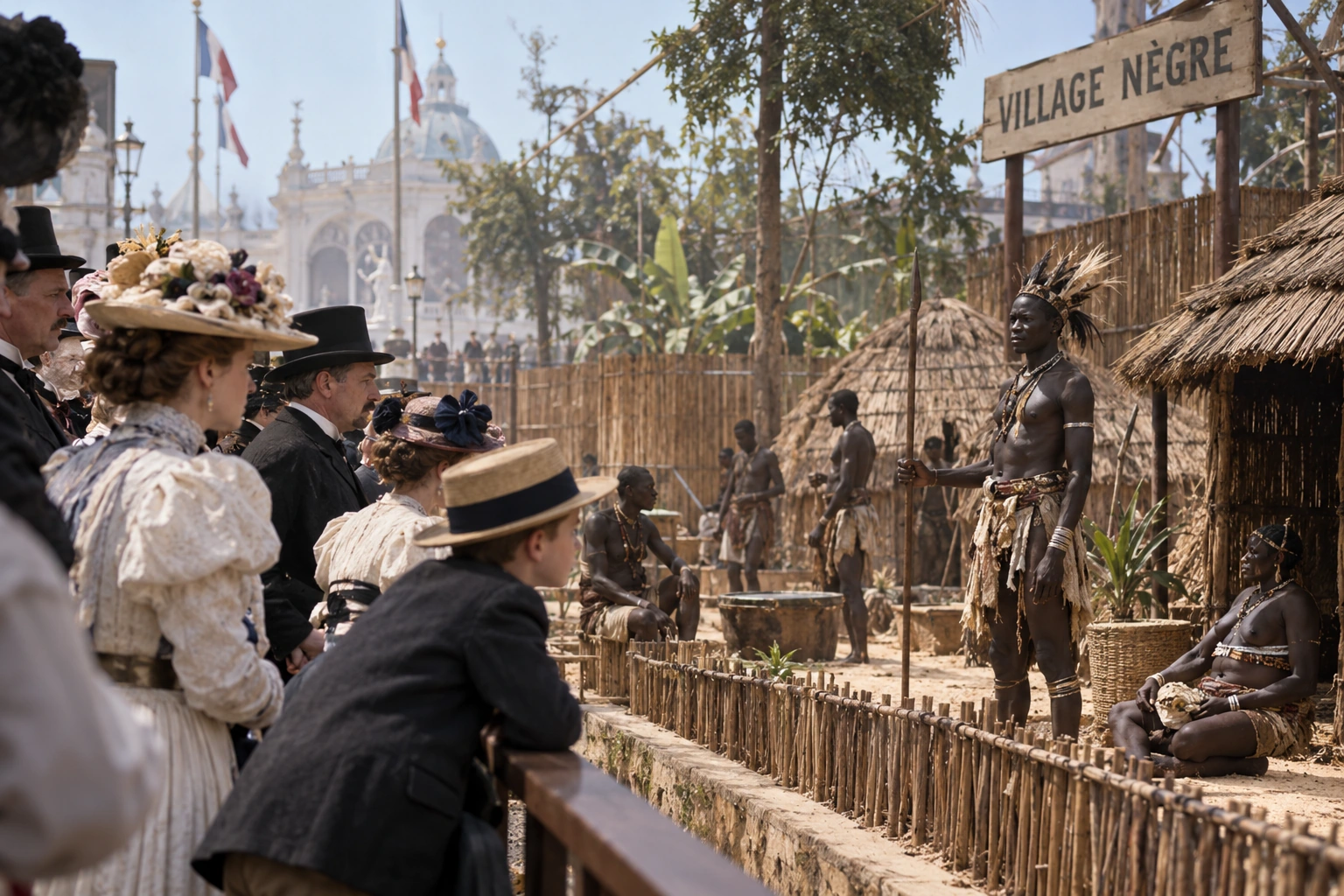
In the elegant gardens of nineteenth-century Paris, where fashionable ladies strolled beneath parasols and gentlemen discussed the latest achievements of science and civilisation, an extraordinary spectacle awaited those willing to pay the price of admission. Behind fences and within carefully constructed villages, men, women and children from distant continents were going about their daily lives under the fascinated gaze of European spectators. They cooked, worked, sang, performed traditional ceremonies and occasionally simply sat, enduring the curiosity of strangers who had come to observe them as representatives of supposedly primitive humanity.
They were not actors in the conventional sense, nor were they visiting dignitaries. They were the living exhibits of what historians have come to call human zoos.
The expression is a modern one, but the phenomenon was entirely real. Throughout the latter decades of the nineteenth century, human beings were displayed in zoological gardens, international exhibitions, travelling shows and reconstructed indigenous settlements across Europe and, eventually, North America. Presented as opportunities for scientific education, anthropological observation and cultural discovery, these spectacles frequently concealed a profoundly disturbing assumption: that certain peoples could legitimately be placed on display for the amusement and instruction of others.
What makes this episode particularly remarkable is not simply its cruelty, but the civilisation that permitted it to flourish.
This was the Europe of Victor Hugo and Charles Dickens, of Darwin and Pasteur, of great museums, universities, opera houses and parliamentary institutions. It was a continent increasingly confident in its intellectual achievements and moral authority. Yet, while Europeans congratulated themselves on their progress towards enlightenment, they were purchasing tickets to observe fellow human beings as curiosities.
The contradiction was as immense as the crowds these exhibitions attracted.
The origins of human exhibitions predated the nineteenth century. For centuries, European courts had displayed individuals brought from distant lands, sometimes as honoured guests, sometimes as servants, and occasionally as objects of curiosity. The expansion of European exploration and colonial commerce had introduced the public to peoples whose appearance, languages and customs were unfamiliar.
Yet the nineteenth century transformed an occasional curiosity into a commercial industry.
One of the earliest and most notorious examples was that of Sarah Baartman, a Khoikhoi woman from southern Africa who was brought to Britain in 1810 and exhibited under the degrading stage name of the Hottentot Venus.
Baartman was displayed before paying audiences in London and subsequently in France. Her physical appearance, particularly the proportions of her body, became the subject of intrusive public fascination and purported scientific examination.
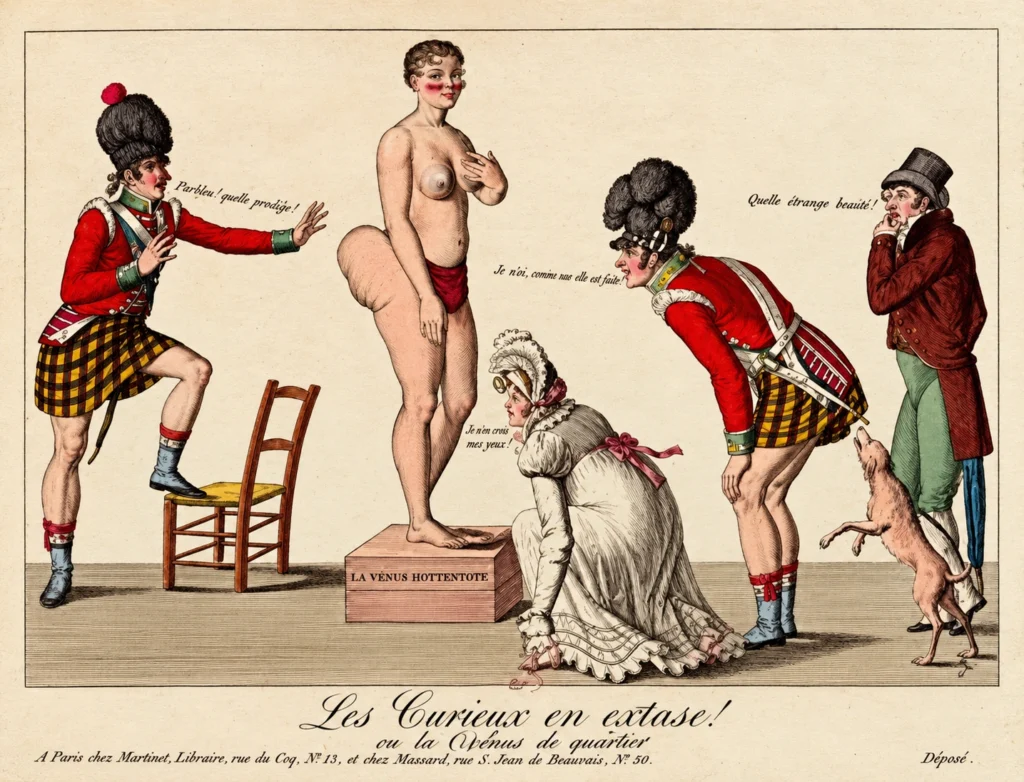
Following her death in Paris in 1815, the indignity continued. Her remains were subjected to anatomical study, and parts of her body were subsequently displayed in a French museum. Only in 2002 were her remains returned to South Africa for burial.
Her story illustrates an essential feature of the period: the transformation of human difference into a spectacle, frequently accompanied by the pretence of scientific legitimacy.
The nineteenth century was, after all, the great age of classification. European naturalists devoted themselves to identifying, cataloguing and organising the natural world. Plants, animals, minerals and fossils were arranged into elaborate systems intended to explain the diversity of creation.
Unfortunately, some scholars attempted to apply comparable methods to humanity itself.
Anthropologists measured skulls, compared physical characteristics and constructed racial hierarchies that purported to demonstrate the superiority of certain populations over others. These theories, subsequently discredited, provided intellectual justification for colonial domination and encouraged the belief that human societies could be ranked along a single ladder of civilisation.
It was within this intellectual climate that human exhibitions found their most receptive audience.
The German animal dealer Carl Hagenbeck played a particularly important role in transforming these spectacles into a flourishing commercial enterprise.
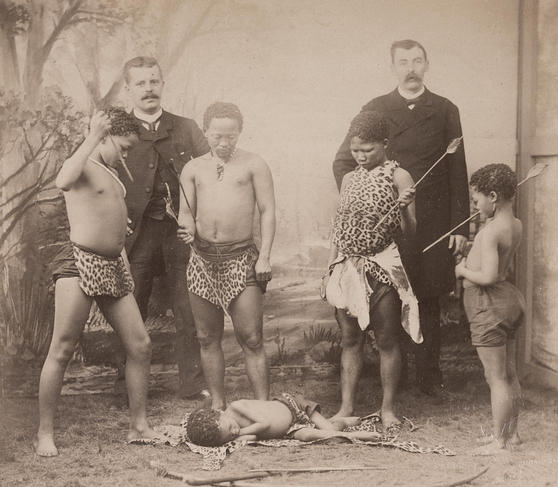
In 1874, Hagenbeck began organising an exhibition involving Sámi people from northern Scandinavia, accompanied by reindeer and traditional equipment. The presentation was designed to recreate an apparently authentic fragment of Arctic life for the benefit of German spectators.
Its success encouraged further ventures.
Soon, groups from Africa, the Arctic and other distant regions were being transported across Europe and exhibited in settings intended to reproduce their native environments. The formula was commercially irresistible: exotic animals, unfamiliar costumes, reconstructed dwellings and living representatives of cultures that most Europeans would never otherwise encounter.
The public was offered the illusion of travelling around the world without leaving its own city.
Hagenbeck’s exhibitions also revealed how easily the boundaries between scientific observation, theatrical entertainment and commercial exploitation could disappear. Not every participant had been abducted or compelled to take part. Some entered into agreements, received payment and regarded the journey as an opportunity for employment or travel. Others, however, were recruited through deception, coercion or outright kidnapping.
The experiences of those exhibited were therefore far from uniform, although the unequal balance of power between organisers and participants remained a defining characteristic of the enterprise.
Paris soon became one of the principal centres of this extraordinary industry.
From 1877 onwards, the Jardin d’Acclimatation, situated in the Bois de Boulogne, organised a succession of exhibitions featuring people from Africa, Asia, the Americas and the Arctic.
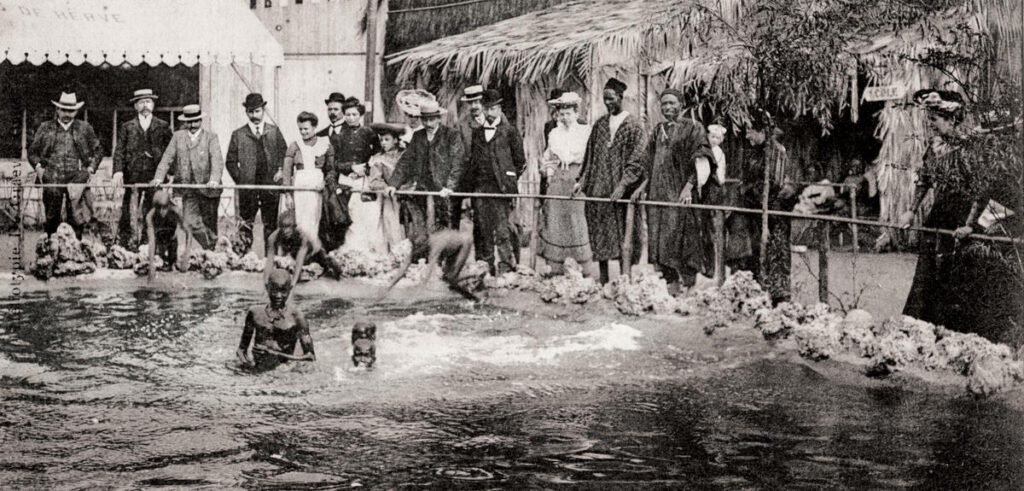
Originally conceived as a zoological and botanical institution, the Jardin discovered that human attractions could be remarkably profitable. Visitors flocked to observe Nubians, Ashanti, Sámi and other groups, frequently presented in artificial villages constructed to satisfy European expectations of exotic life.
The irony was that these displays often revealed considerably more about European prejudices than about the societies they purported to represent.
A village might be deliberately simplified, its inhabitants encouraged to wear traditional clothing regardless of their normal habits, or their daily routines transformed into performances. Complex cultures, possessing their own histories, political institutions, intellectual traditions and systems of belief, were reduced to picturesque tableaux.
The visitor departed believing he had acquired knowledge of a distant civilisation, when in reality he had often encountered little more than a carefully manufactured caricature.
The Jardin d’Acclimatation acknowledges today that approximately thirty such ethnographic exhibitions were organised between 1877 and 1931. Some participants suffered from illness and exposure to unfamiliar climatic conditions; others died.
The most revealing aspect of these exhibitions was perhaps the ease with which they became integrated into respectable society.
They were not necessarily hidden in disreputable entertainment districts. They took place in celebrated public gardens, international exhibitions and institutions associated with education and scientific advancement. Families attended. Newspapers advertised them. Photographers recorded them. Distinguished visitors passed through their reconstructed settlements.
Human exhibition had become a perfectly acceptable form of bourgeois entertainment.
The great international exhibitions of the nineteenth century provided an especially impressive stage for such displays.
At the Paris Exposition Universelle of 1889, organised to commemorate the centenary of the French Revolution, visitors marvelled at the newly constructed Eiffel Tower, the technological achievements of industrial Europe and the architectural splendours of the exhibition grounds.
Yet the same event also featured colonial displays and reconstructed settlements populated by people from territories under European influence.
The juxtaposition was striking.
On one side stood the Eiffel Tower, an audacious monument to engineering ingenuity and modern progress. On the other were living representatives of colonised societies, presented through displays that often emphasised their supposed distance from European modernity.
The intended message was difficult to misunderstand: Europe represented the future, while the colonised world was made to embody an earlier stage of human development.
Such exhibitions helped to popularise the ideology of empire. Colonial conquest could be presented not merely as territorial expansion or economic exploitation, but as a civilising enterprise undertaken for the supposed benefit of peoples considered less advanced.
The spectacle gave a visual form to that argument.
A European visitor did not need to read a political treatise defending colonialism. He could walk through a reconstructed village, observe its inhabitants and leave with the impression that the imperial hierarchy was both natural and necessary.
This was perhaps the most insidious achievement of the human zoo: it converted prejudice into something resembling personal experience.
The phenomenon was not confined to France and Germany.
In Belgium, the colonial ambitions of King Leopold II produced one of the most notorious examples of the genre.
The Brussels International Exposition of 1897 included a colonial exhibition at Tervuren, where Congolese men, women and children were displayed in reconstructed villages intended to demonstrate the peoples and resources of the Congo Free State.
The exhibition formed part of a wider effort to celebrate and legitimise Leopold’s African enterprise.
Yet behind the carefully orchestrated imagery of imperial achievement lay the increasingly brutal realities of the Congo Free State, where systems of forced labour, coercion and violence would become internationally notorious.
Several Congolese participants died during the 1897 exhibition and were buried in Belgium.
Their fate exposes the human cost behind the elaborate imperial theatre. The people brought to Europe were expected to represent distant lands, but their own welfare was often subordinate to the commercial and political objectives of those who displayed them.
Britain, too, participated in the broader culture of ethnographic spectacle.
London’s exhibition halls, entertainment venues and international fairs presented groups from Africa, Asia and other regions. The Crystal Palace became one of the locations associated with such performances, while travelling shows contributed to the public fascination with unfamiliar peoples and customs.
It would nevertheless be misleading to suggest that every ethnographic performance was identical to the most degrading human zoo. Some involved professional performers, cultural demonstrations or commercial arrangements in which participants exercised a degree of control over their representation.
The historical distinction matters.
There is an important difference between a group voluntarily presenting its music, craftsmanship or traditions to an audience and people being confined, misrepresented or exhibited as examples of racial inferiority.
What united many of the more troubling exhibitions was not simply the act of looking at another culture, but the presumption that one population possessed the authority to classify and display another.
Nor was the United States immune to the phenomenon.
American circuses, world’s fairs and popular entertainments developed their own traditions of exhibiting individuals and communities presented as exotic or unusual. The commercial genius of P. T. Barnum contributed to a culture in which curiosity about human difference could be transformed into enormous profits.
By the closing decades of the nineteenth century, ethnographic exhibitions had become an international industry, connecting entrepreneurs, colonial administrators, scientists, performers and spectators across continents.
The human consequences could be devastating.
In 1880, Hagenbeck arranged for a group of Inuit from Labrador to travel to Europe for exhibition. Among them was Abraham Ulrikab, whose experiences would become one of the most poignant records of the entire phenomenon.
Ulrikab was not simply an anonymous representative of an Arctic people. He was an individual with a family, personal convictions and an understanding of the world that extended far beyond the narrow image presented to European audiences.
During the tour, the group contracted smallpox.
All eight members died.
The tragedy was compounded by the failure to provide the vaccinations that might have protected them.
Their deaths were not the inevitable consequence of an encounter between different cultures. They reflected failures of responsibility by those who had undertaken to transport and exhibit them.
In another Hagenbeck venture, eleven Kawésqar people from the region of Tierra del Fuego were taken to Europe in 1881 after being abducted in Chile. They were displayed in conditions that exposed them to cold and disease. Several died, and the remains of five were retained for scientific collections before being repatriated to Chile in 2010.
Such episodes strip away the romantic language with which human exhibitions were advertised. Behind the picturesque huts, exotic costumes and enthusiastic newspaper descriptions were individuals whose lives could be profoundly disrupted, and sometimes destroyed, by the demands of European curiosity.
It is tempting to regard these events as the product of a distant and less enlightened age, safely separated from contemporary civilisation by more than a century of moral progress.
Yet such an interpretation risks overlooking the complexity of the nineteenth century itself.
The same societies that tolerated human exhibitions also produced powerful movements against slavery, advocates of universal education, defenders of constitutional liberty and intellectuals who challenged racial prejudice. European civilisation was not intellectually uniform, nor did colonial expansion proceed without criticism or resistance.
Indeed, the contradiction between professed universal values and actual imperial practices was already visible to contemporaries.
The problem was not that Europeans lacked any conception of human dignity. It was that those principles were frequently applied selectively.
Liberty could be celebrated at home while political domination was justified abroad. Equality could be proclaimed as a philosophical ideal while racial hierarchies were defended in the name of science. Humanitarian concern could coexist with an imperial conviction that certain peoples required European supervision.
The human zoo embodied these contradictions with almost theatrical clarity.
The spectator stood outside the enclosure, free to observe, judge and depart. The exhibited person remained within the space assigned to him, his identity reduced to a category chosen by others.
The relationship itself conveyed a message of superiority, irrespective of what any accompanying explanatory notice might claim.
By the early twentieth century, changing public tastes, the growth of cinema, criticism of racial theories and evolving attitudes towards colonial representation gradually undermined the popularity of traditional human exhibitions.
They did not, however, disappear immediately.
Colonial spectacles continued well into the twentieth century. The Paris Colonial Exhibition of 1931, for example, demonstrated how imperial powers could still present colonised peoples and cultures within carefully controlled narratives of European authority.
It is important to distinguish such colonial displays from the earlier zoological exhibitions, but they belonged to a related tradition of representing the non-European world through the assumptions and interests of imperial societies.
The legacy of these practices has proved remarkably persistent.
Museums and scientific institutions have faced difficult questions concerning human remains acquired during the colonial period. Descendants of exhibited communities have sought recognition, historical clarification and the return of ancestors whose bodies were retained in European collections.
The repatriation of Sarah Baartman’s remains in 2002 and those of the Kawésqar individuals in 2010 represented significant acts of historical redress, although they could not undo the indignities suffered.
In recent decades, exhibitions and historical research have also begun to restore individuality to those who were once presented as anonymous representatives of supposedly exotic races.
The Musée du quai Branly in Paris devoted a major exhibition, Exhibitions: The Invention of the Savage, to this history in 2011–2012, examining the commercial, scientific and political mechanisms through which human difference became a spectacle
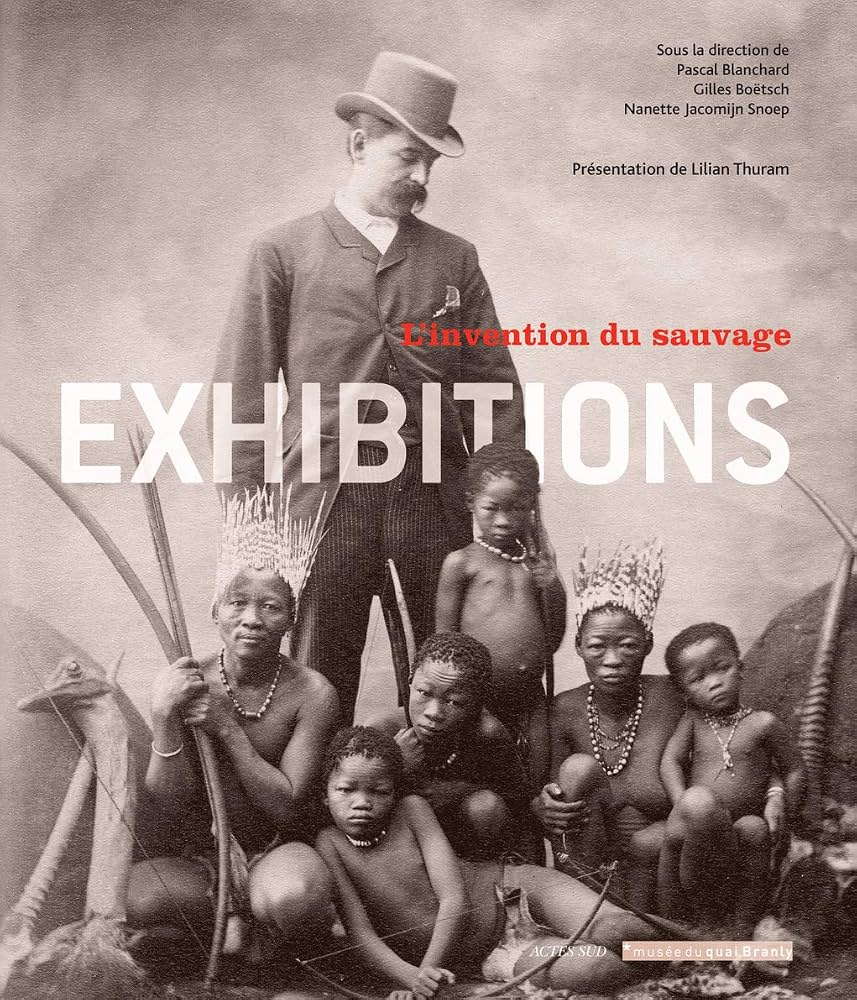
Such work is essential because the photographs that survive can be deceptive.
An old image of an African village constructed in a European park may initially appear almost charming, an innocent curiosity from the age of imperial exploration. Its inhabitants may be seen standing before their dwellings, surrounded by spectators dressed in the fashions of the Belle Époque.
But the photograph rarely tells us what those inhabitants thought, whether they had freely agreed to participate, what promises had been made to them, or whether they ever returned home.
The camera records the spectacle, not necessarily the experience.
It is precisely this missing human perspective that modern historical scholarship must endeavour to recover.
There is also a wider lesson to be drawn from the extraordinary popularity of these exhibitions.
Human beings have always been curious about unfamiliar societies. Curiosity itself is neither shameful nor necessarily prejudiced. Indeed, the desire to discover other cultures has inspired some of humanity’s greatest achievements in exploration, literature, scholarship and diplomacy.
The moral question lies in what happens when curiosity is divorced from respect.
A culture can be studied without being belittled. Its traditions can be presented without turning its people into curiosities. Difference can inspire admiration rather than a presumption of superiority.
The tragedy of the nineteenth-century human zoos was that they so often failed to recognise this distinction.
Europe possessed extraordinary artistic, intellectual and scientific accomplishments. Its achievements in medicine, engineering, philosophy and political thought helped transform the modern world. Yet those achievements did not automatically confer moral wisdom upon every institution or practice undertaken in the name of progress.
Indeed, the history of the human zoos reminds us that scientific language and cultural sophistication can sometimes provide a respectable appearance for profoundly questionable conduct.
Perhaps the most unsettling image from this chapter of European history is not that of the people placed on exhibition, but of the spectators themselves.
They were ordinary citizens: respectable families, educated professionals, fashionable members of society, children accompanied by their parents. Many would have considered themselves humane, cultivated and enlightened.
And yet they could walk through a public garden, observe another human being displayed as an object of curiosity, and return home without perceiving any fundamental contradiction.
That is what makes this history more than an account of colonial arrogance.
It is a reminder that civilisation cannot be measured solely by the splendour of its monuments, the sophistication of its institutions or the brilliance of its intellectual achievements. It must also be judged by the dignity it extends to those who possess neither its power nor its privileges.
The nineteenth century built magnificent museums to celebrate humanity’s accomplishments. In some of their gardens, however, human beings themselves became the exhibits.
And perhaps the most enduring question is not why those people were placed behind the fences, but why so many who stood on the other side believed they belonged there.
HISTORICAL REFERENCES AND FURTHER READING
The principal institutional sources for this feature include the French National Centre for Scientific Research (CNRS), the Musée du quai Branly – Jacques Chirac, the Jardin d’Acclimatation’s own historical account, and Smithsonian Magazine’s research on Carl Hagenbeck.


 Carlos Mundy

 Giovanni R. Ruffini Professor of History Fairfield University, USA



 Sebastian Montclair

 Charles Markeaton-Mundy

 Mark Bellinger