 Clive Uckfield
An extraordinary journey through Ethiopian history, prophecy, a vanished screenplay and the unsettling borderland between fiction and reality
During the turbulent summer of 2020, as the world struggled with a pandemic and an unprecedented period of social and political upheaval, I found myself at the centre of a rather extraordinary sequence of events. What had begun as a work of fiction, inspired by my lifelong fascination with Ethiopia and its last emperor, gradually developed into something altogether more mysterious.
My manuscript, Empire of the White Rastas, was intended as a speculative thriller exploring prophecy, identity, spirituality and the possibility of the return of Emperor Haile Selassie I. Yet, as the story made its way towards publication in New York, events began unfolding around it that seemed, at times, to echo the very mysteries I had invented.
There was a cyberattack on the literary magazine preparing to publish the work, an unexpected opportunity to turn the story into a feature film, a screenplay that was repeatedly promised but never delivered, and a collaborator who eventually disappeared from communication.
I have never claimed that these events were connected by some sinister conspiracy. There may be perfectly ordinary explanations for every one of them. Nevertheless, their extraordinary timing left me with a question that has continued to intrigue me ever since.
Where, precisely, does fiction end and reality begin?
A Childhood Fascination with Africa and an Emperor
My fascination with Africa, biography and history began during childhood. Growing up in England, with family connections to South Africa, I found myself drawn to distant places, extraordinary personalities and the great historical events that had shaped nations and civilisations.
Books offered an escape into worlds far removed from everyday life, and I developed a particular interest in the lives of individuals who had confronted extraordinary circumstances.
Among them, one figure captured my imagination more profoundly than almost any other: His Imperial Majesty Emperor Haile Selassie I of Ethiopia.
His life seemed to contain all the ingredients of an epic historical novel. From his early years and ascent to the imperial throne to his courageous confrontation with Fascist Italy, his exile, restoration and eventual overthrow, the Emperor’s remarkable journey fascinated me.
His appearance before the League of Nations in 1936, appealing to the conscience of the international community following Italy’s invasion of Ethiopia, remains one of the most memorable episodes of twentieth-century diplomatic history.
Yet there was another dimension to his extraordinary legacy. Long after his death, Haile Selassie continued to occupy a unique spiritual position within Rastafari, a movement whose beliefs, symbolism and interpretation of Ethiopian history would eventually become central to my own fictional world.
I was intrigued by the way one historical personality could inspire such different interpretations: emperor, reformer, African statesman, exile, spiritual figure and, to his critics, a ruler whose legacy remains open to debate.
Years later, these interests would provide the historical and imaginative foundations of what became my Rasta Empire Trilogy.
The Birth of an Unusual Story
My journey as a writer began in earnest in 2019, following the death of a close friend and during a period of considerable personal reflection.
Bereavement has a way of encouraging us to examine questions we might otherwise leave unanswered. The passage of time, the meaning of existence, the possibility of spiritual continuity and the relationship between past and present began occupying my thoughts.
It was during a visit to Gibraltar that several seemingly unrelated ideas came together.
I remember sitting in an almost deserted restaurant beneath the Rock, watching merchant ships offshore while Bob Marley’s music played in the background.
There was something particularly evocative about that moment. The sea, the ships, the music and the great limestone Rock towering above me seemed to belong to different worlds, yet somehow formed a coherent picture.
Marley’s songs, with their recurring themes of captivity, redemption, freedom and spiritual awakening, brought my thoughts back to Ethiopia and the remarkable influence of Haile Selassie.
Gradually, the outline of a story began to emerge.
What if an ordinary British journalist, struggling with personal grief and disillusionment, suddenly began receiving messages from a man who had been dead for decades?
And what if that man claimed to be Emperor Haile Selassie himself?
The idea was both absurd and irresistible.
A journalist would naturally question such messages. He might assume that someone was playing an elaborate practical joke, or that he was becoming the victim of a sophisticated deception. Yet what would happen if the messages contained information that appeared impossible for anyone else to know?
What if they demanded that he undertake a mission involving a hidden treasure, a former Ethiopian dictator, an ancient religious relic and the eventual return of the Emperor?
And, perhaps most provocatively, what if the chosen messenger were a white British man with no obvious connection to the Rastafarian movement?
Thus, Empire of the White Rastas began to take shape.
A Story Born in a Fevered Summer
By the summer of 2020, the world had changed almost beyond recognition.
The COVID-19 pandemic had emptied streets, isolated families and forced much of ordinary life behind closed doors. At the same time, the Black Lives Matter movement had brought questions of race, history, power and belonging into homes across the globe.
It was against this extraordinary background that my manuscript began attracting attention.
The title, Empire of the White Rastas, was deliberately provocative. I wanted it to challenge assumptions before a reader had even turned the first page.
Who were these White Rastas? What empire could they possibly claim? And why would an ordinary white British journalist find himself at the centre of a prophecy involving Ethiopia, Haile Selassie and Rastafarian belief?
I conceived the work as a mystery thriller, but I wanted it to be considerably more than a conventional adventure story.
Its inspiration came from history, faith, politics and the extraordinary possibilities of modern communications technology.
The central premise was straightforward: a grieving journalist begins receiving mysterious text messages apparently sent by His Imperial Majesty Emperor Haile Selassie I, decades after the Emperor’s death.
These messages do not simply ask to be believed.
They demand action.
I sometimes described the concept as The Da Vinci Code meeting Rastafarian mysticism, with a universal message of hope.
Yet beneath that cinematic description lay a more personal ambition. I wanted to explore whether someone from outside a particular cultural or religious tradition could become the bearer of its message, whether inherited divisions might be overcome and whether redemption could emerge from confusion, loss and historical injustice.
The story also allowed me to examine the extraordinary influence of modern technology upon belief.
After all, in an age when virtually anyone can receive a message from an unknown source, how do we distinguish genuine revelation from manipulation?
And how easily might a private experience become a worldwide phenomenon through social media?
From Lincolnshire to New York
The manuscript eventually reached Aaduna, an international literary magazine based in New York, known for publishing diverse creative voices.
For me, this was a particularly curious development.
In my fictional story, the narrator concludes his extraordinary account by sending his manuscript to an address in Lincolnshire, with instructions that it should subsequently be forwarded to a literary magazine in New York.
Now, in real life, my own manuscript had followed a remarkably similar journey.
I found the coincidence amusing at first, although subsequent events would make it considerably more intriguing.
As preparations for publication progressed, I began promoting the story through social media.
Encouraging responses arrived from individuals connected with literature, film and the wider cultural world. Some were particularly interested in the multicultural dimensions of the plot, while others were attracted by its mixture of historical mystery, spiritual symbolism and modern technology.
It seemed that a story involving supernatural text messages, ancient secrets and hidden loyalties was particularly well suited to an era in which the boundary between private revelation and public spectacle had become increasingly blurred.
Then something unexpected happened.
According to the information I received, Aaduna suffered a serious cyberattack at a critical moment in the preparations for publication.
The magazine subsequently worked to rebuild and strengthen its digital protections, but the disruption inevitably affected the circumstances surrounding the launch.
I must emphasise that I have no established evidence connecting this attack to my manuscript.
Nevertheless, the timing struck me as extraordinary.
Here I was, writing a story about secret messages, concealed information and shadowy attempts to prevent a revelation, only to discover that the publication carrying my work had encountered a serious digital intrusion.
Perhaps it was nothing more than coincidence.
But coincidence was becoming an increasingly familiar companion.
The Screenplay That Never Arrived
During this period of uncertainty, another unexpected opportunity presented itself.
I was approached by a Zimbabwean-born writer and actor living in the United Kingdom, who expressed an interest in adapting Empire of the White Rastas into a full-length feature film.
Naturally, I was delighted.
The story had always possessed strong cinematic possibilities. Its combination of Ethiopian history, supernatural intrigue, political conspiracy, romance and international locations seemed particularly suited to the screen.
Conversations began, and for several months we exchanged ideas about how the story might be developed.
There was also encouragement from individuals connected with the film industry, together with contacts in the media and on social platforms.
The proposed adaptation was intended to preserve the essential elements of my original narrative: the mysterious messages from the Emperor, the historical background, the journey to Ethiopia, the romance in New York, the murder near Central Park and the ultimate uncertainty over who was really controlling events.
As Christmas approached, I was repeatedly assured that the screenplay was progressing well and would shortly be completed.
I began to anticipate the possibility of seeing my fictional characters brought to life.
Yet Christmas came and went.
The promised screenplay did not arrive.
Further assurances followed, accompanied by explanations for the delay. Arrangements to speak were made and subsequently postponed.
By early February 2021, I understood that film producers were still willing to consider the screenplay, but I remained unable to obtain the document.
Then came another assurance that the work had been finished.
And after that, silence.
Communication ceased.
To this day, the episode remains one of the more perplexing aspects of the entire project.
Of course, there may be a perfectly innocent explanation. Creative partnerships can encounter difficulties, personal circumstances can change, and projects sometimes collapse beneath the weight of expectations.
I have no wish to suggest otherwise.
Yet I could not escape the irony.
I had written a story about mysterious messages from the dead, secret organisations and individuals attempting to prevent the truth from emerging.
And now, one by one, the real-world messages surrounding my project had stopped.
When Reality Begins to Imitate Fiction
As a writer, I have always been fascinated by the way reality provides material for fiction.
What I had not anticipated was the possibility that reality might appear to imitate my fiction.
In Empire of the White Rastas, information is dangerous. Messages arrive from an impossible source. Institutions resist prophecy. A secret service operates in the shadows, and a manuscript survives because it is passed from one keeper to another.
Outside the story, I had witnessed a literary publication disrupted by a cyberattack, a film adaptation repeatedly delayed and a collaborator disappearing from communication.
None of this proves the existence of a conspiracy, and I would never pretend that it does.
Nevertheless, these events created a second narrative around the first.
It was an unresolved narrative in which coincidence, disappointment and imagination became increasingly difficult to separate.
I began asking myself questions that are equally relevant to the reader.
When several unusual events appear to form a pattern, are we discovering meaning or manufacturing it?
If a story seems to anticipate the circumstances of its own publication, is that prophecy, chance or simply the human mind’s instinct to connect otherwise unrelated events?
Perhaps the most fascinating aspect of mystery is not the existence of unanswered questions, but our determination to find answers even when none may be available.
The Journey to the Rasta Empire Trilogy and Its Beautiful Female Heroine
What began as a single short mystery gradually developed into a much larger fictional world.
Empire of the White Rastas was followed by Rasta Jesus and Ethiopia, together forming what I call the Rasta Empire Trilogy, now available as an e-book on AfroRead.
Across these three stories, I have combined supernatural suspense with political allegory, Ethiopian history, romance and espionage.
At the centre of the trilogy lies a recurring question: who has the right to carry another culture’s message?
The imagined return of Emperor Haile Selassie should not be interpreted exclusively as a literal prediction.
For me, it also serves as a metaphor for reconciliation, the restoration of historical memory and the possibility of unity across ethnic, religious and political divisions.
Through the conventions of the thriller, I wanted to explore a serious aspiration: that Ethiopia might one day achieve lasting stability without sacrificing the richness and complexity of its national identity.
I also wanted the female characters to possess genuine strength, intelligence and independence.
One of the most important figures in the story is Liya, a beautiful young Ethiopian secret service agent who becomes central to the dramatic events unfolding in New York.
Liya is not merely a romantic interest for the male protagonist, nor is she simply a convenient guide through an unfamiliar culture.
She is a woman of conviction, courage and considerable intelligence, torn between her professional responsibilities and her developing personal beliefs.
Her decisions alter the entire course of the narrative.
Ultimately, she makes the decisive sacrifice, embodying the conflict between duty, faith and individual conscience.
Her courage and tragic fate provide much of the story’s emotional intensity.
A Personal Calling, an Allegory and a Contested History
As the trilogy developed, I began to regard it as considerably more than a literary exercise.
It became, in many respects, a personal mission.
I wanted to encourage greater interest in Ethiopia’s imperial history, challenge inherited assumptions and explore the possibility that constitutional monarchy might provide a symbol of national continuity.
These are, of course, my personal views, and they form part of the political and creative allegory surrounding the books.
I recognise that Ethiopia’s history is complex and that memories of monarchy, revolution and conflict remain deeply contested.
The legacy of Haile Selassie continues to provoke admiration, criticism and passionate disagreement.
To some, he remains a great African statesman who defended his country’s sovereignty against fascist aggression and became an international symbol of resistance.
To others, his reign must also be examined through the difficult questions of political authority, inequality and the limitations of imperial government.
Within Rastafari, meanwhile, his significance extends far beyond conventional political history.
It is precisely this extraordinary diversity of interpretations that makes him such a compelling figure for fiction.
I do not ask readers to accept a particular political programme or prophecy.
Rather, I invite them to consider the relationship between history, identity, faith and the possibility of national reconciliation.
In my story, David believes that he has been chosen.
Others regard him as deluded, manipulated or potentially dangerous.
The reader must decide whether the mysterious messages reveal a supernatural design, an elaborate political operation or simply the desperate search for meaning of a man struggling with grief.
That uncertainty is deliberate.
It lies at the heart of the trilogy.
The Next Transformation: An AI Film Concept
More recently, the project has entered another fascinating stage of development.
I have been working on a film concept with Ethiopian filmmaker Abenezer Alemayehu, an award-winning filmmaker, architect and graphic designer based in the United States.
Together, we have explored the possibility of using artificial intelligence to create a visually distinctive adaptation inspired by the trilogy.
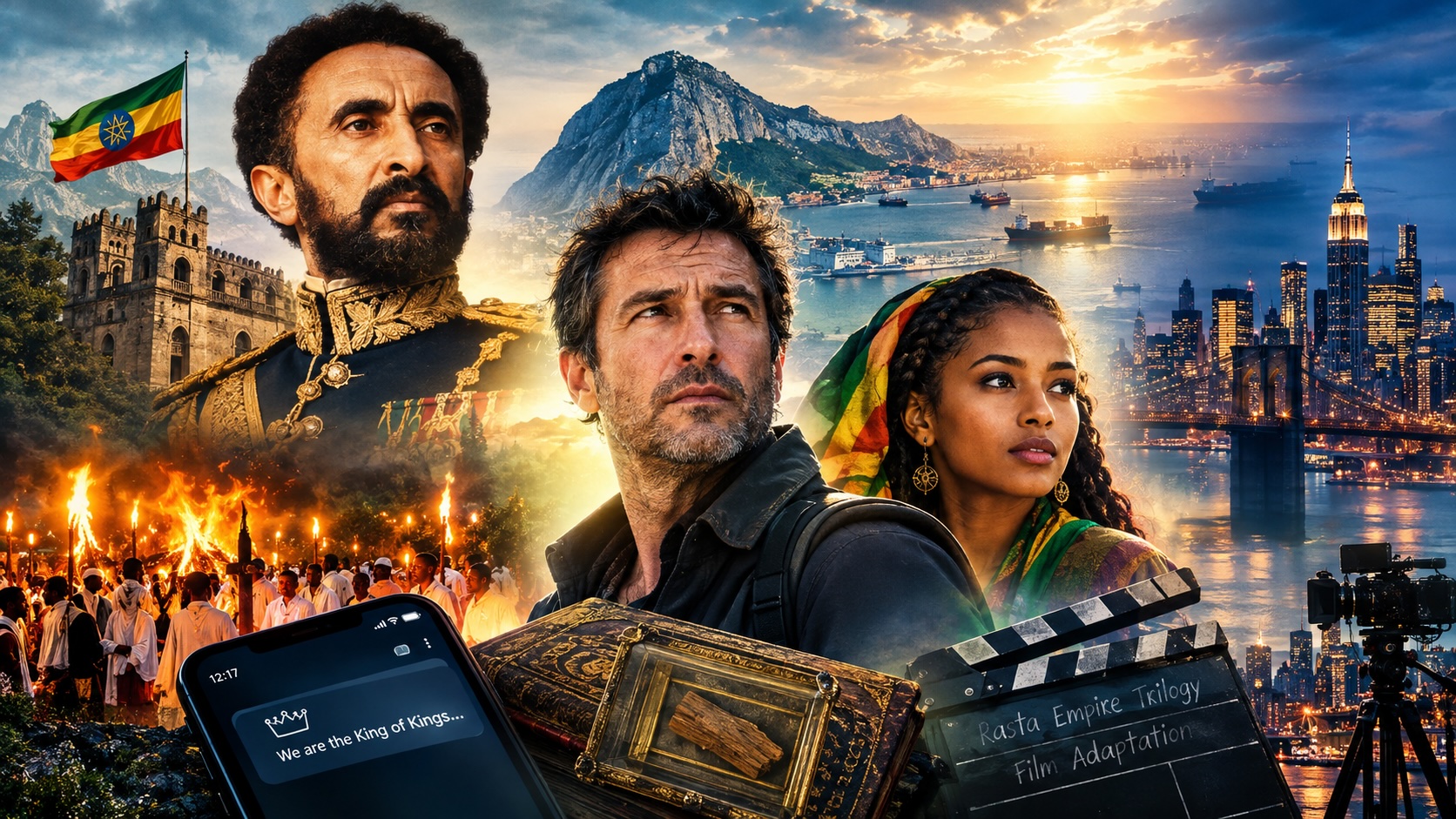
An AI-generated trailer has already been produced, allowing us to experiment with the atmosphere, locations and visual language of the stories.
My ambition is to develop a short feature that presents Ethiopia in all its beauty and mystery, while preserving the essential elements of romance, danger, history and spiritual uncertainty.
I believe the project offers an opportunity not merely to entertain, but also to introduce international audiences to aspects of Ethiopian history and culture that remain insufficiently understood.
Naturally, such an undertaking requires appropriate financial and creative support.
I am therefore interested in discussing sponsorship, investment and production partnerships with individuals or organisations who share the vision behind the project.
Any future collaboration would need to respect the creative integrity of the work, establish clear rights and credits, and ensure that Ethiopian history and culture are presented with sensitivity and care.
Artificial intelligence may be a relatively new instrument of filmmaking, but the underlying question is as old as storytelling itself.
How does a story move from one imagination into another?
Mine began as a manuscript, travelled to a literary magazine, inspired a proposed screenplay and has now started acquiring images, voices and movement through new technology.
Each transformation introduces exciting possibilities.
Yet each also adds another layer between the original experience and the audience attempting to determine what is real.
For me, the return at the heart of the trilogy remains both a mystery and a metaphor: a question about history, identity and whether a divided nation can imagine itself whole again.
The Story Behind the Mystery
Perhaps the best way to understand the unusual journey I have described is to enter the fictional world itself.
The following edited extract from Empire of the White Rastas, originally published in New York, introduces the central mystery.
It is narrated by David, the British journalist who finds himself drawn into an extraordinary sequence of events following the arrival of messages apparently sent by Emperor Haile Selassie.
The historical and spiritual references belong to the fictional narrative and should not be interpreted as independently verified claims.
EMPIRE OF THE WHITE RASTAS
An edited extract from the original story published in New York.
I remember the night the first message came. It was around the time I lost my parents. Midnight had passed and I must have fallen asleep while reading, because the paperback lay open on the floor and my bedside lamp was still burning.
A notification woke me. I reached for my phone, blinking into the light. The message read:
“We are the King of Kings, the Conquering Lion of the Tribe of Judah, descendant of King Solomon and the Queen of Sheba.”
I read it again. Then again. The words did not change.
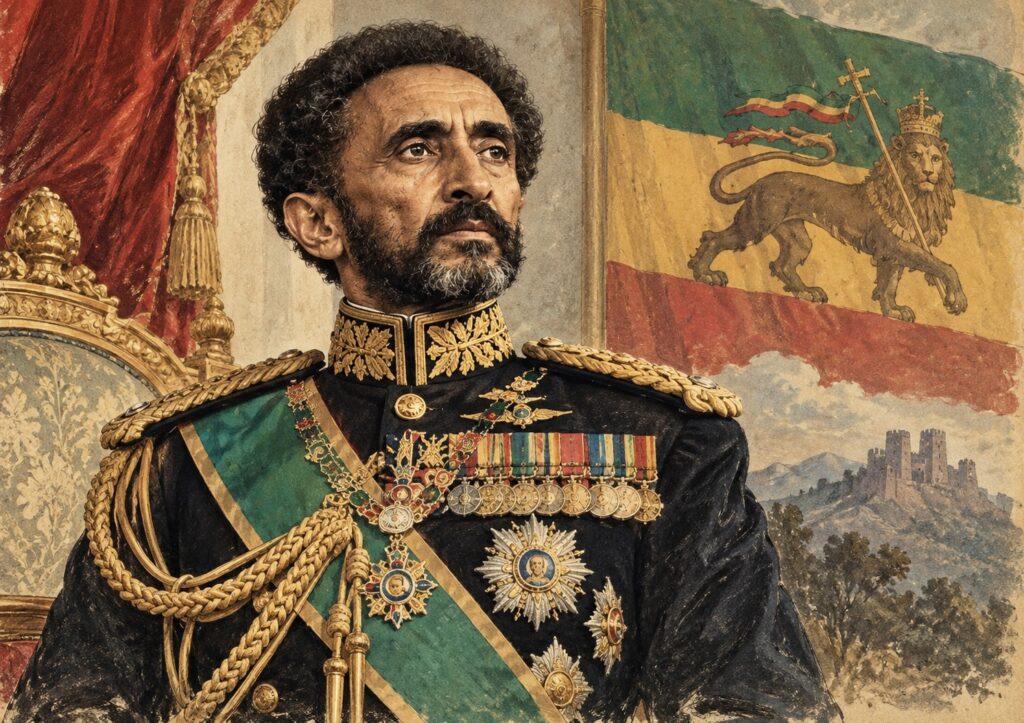
As I reached for the fallen book, it slipped from my hand and opened at a photograph of Haile Selassie, the last Emperor of Ethiopia. He stood with the composed dignity that had once confronted the world’s leaders at the League of Nations.
Before I could collect my thoughts, the phone sounded once more.
The second message was more personal:
“Do not be afraid, David. We are with you, and through your voice the world will prepare for my return.”
I assumed it was a cruel joke. I replied angrily.
The next message contained details that made laughter impossible.
I was told that I had been chosen as a prophet; that forgiveness must be shown to the man responsible for the Emperor’s death; that a hidden treasure had to be restored; and that a Meskel bonfire in New York would become the place of revelation.
I was a journalist, trained to question extraordinary claims. I also knew enough Ethiopian history to understand the significance of the name on my screen.
Yet no training prepares you for a message from a man who died decades before mobile phones existed.
Fear became secrecy; secrecy became drinking, and drinking cost me the relationship that had once anchored my life.
Eventually, my editor insisted I take a sabbatical.
I found myself in Gibraltar, beneath the great Rock, sitting alone in a beach restaurant while the music of Bob Marley played in the background.
The songs spoke of captivity, freedom and redemption.
Somewhere between the sea and the music, the meaning of the messages changed.
Ras. Tafari. Rastafari.
The name had been there all along.
The next instruction took me to Zimbabwe, where I arranged to meet Mengistu Haile Mariam under the cover of a journalistic interview.
I carried a handwritten message in Amharic.
When he read it, the colour left his face.
After a long silence, he returned with an ancient book and spoke a single word:
“Treasure.”
Inside the book was a hidden compartment. It contained no money, documents or jewels, only a sealed glass case holding a small fragment of wood.
I could not understand why such an object should inspire fear until the messages led me towards Ethiopia, and then beyond it.
My attempt to enter public life in Addis Ababa ended with anger and official intervention.
The Emperor’s next message was severe.
I had acted without instruction.
My task was not in Ethiopia, he told me, but in New York, the capital of the modern world.
By the time I boarded the aircraft, social media had given the movement a mocking name: the Empire of the White Rastas.
The insult became an invitation.
Strangers followed the story. Reporters waited.
People wanted a date for the return of a king who had been dead for more than forty years.
On the flight I met Liya, a young Ethiopian woman with an extraordinary knowledge of her country’s history and faith.
She explained Meskel, the celebration of the finding of the True Cross.
As she spoke, I understood what Mengistu’s “treasure” was supposed to be.
The fragment in my bag was not valuable because of gold or ownership.
It was valuable because people might believe it was part of the Cross itself.
When we reached New York, Liya appeared to become my ally.
She guided me through the hotel, calmed me when I learned I had been barred from the city’s Meskel celebration, and brought me a drink.
The next thing I remember is waking with pain crashing through my head.
My luggage had been searched.
The glass case was empty.
I found Liya in the adjoining room.
She confessed that she was working for the Ethiopian secret service.
Her assignment had been to recover the relic and prevent the prophecy from gathering followers.
But something had changed.
She told me that she believed the messages.
More dangerously, she told me that she now believed in me.
Agents were coming.
Liya devised a plan to hide the fragment in Central Park.
From the hotel window I watched her cross into the darkness.
Much later, she returned and looked up towards me.
She nodded once.
It was the last time I saw her alive.
In the lobby, a lift stood jammed open.
Medics crowded around the body.
I recognised Liya’s legs before I saw the blood.
I knew that the same people would come for me.
I disposed of my phone and wrote the whole account by hand on the steps of the New York Public Library.
The Emperor had given me an address in Lincolnshire and one final instruction: send the story there, ask the recipient to forward it to a New York magazine, and tell them to wait for the messages.
They will believe they have silenced me.
They will believe they have prevented his return.
I pray the world will discover otherwise.
Film trailer: Watch the Rasta Empire Trilogy trailer
The Unanswered Question
When I read the conclusion of my fictional story today, I cannot help reflecting upon the curious parallels with the real events that followed its creation.
David’s account ends with a manuscript being sent onwards and a recipient instructed to wait.
My own manuscript travelled from England to New York.
A story involving concealment and the suppression of information encountered delays during publication.
A narrative built around mysterious communications became associated with a collaborator who suddenly ceased communicating.
And the fictional New York literary magazine found its counterpart in a real one.
I am perfectly aware that these coincidences do not establish a supernatural connection or demonstrate the existence of any conspiracy.
Indeed, I believe mystery becomes less compelling when one attempts to impose certainty where none exists.
What interests me is the extraordinary relationship between imagination and experience.
The disappearance of the screenplay from my reach may eventually prove to have an entirely mundane explanation.
It may never be explained at all.
The cyberattack suffered by the magazine may have had absolutely nothing to do with my work.
Nevertheless, these incidents have become inseparable from my memories of the trilogy’s development.
And perhaps that is what makes the experience so intriguing.
Fiction does not need to prove the existence of a conspiracy to explore why people fear one, believe in one or recognise themselves within one.
Fiction, Non-Fiction, or Something in Between?
Looking back upon the entire journey, I have come to regard Empire of the White Rastas as a story fundamentally concerned with transmission.
The transmission of history, belief, grief, guilt and hope.
A supernatural message travels through a mobile telephone network.
An ancient relic passes between countries and hands.
A manuscript crosses the Atlantic.
A story survives because someone chooses to pass it on.
What began as a personal fascination with Emperor Haile Selassie has grown into a trilogy, a proposed film project and a series of experiences that continue to leave me with more questions than answers.
Perhaps the greatest mystery concerns the central prophecy itself.
Will His Imperial Majesty really appear?
And if so, how and in what form?
Could such a return be understood literally, spiritually or symbolically?
Might it represent the restoration of historical memory, the reconciliation of a divided people or something altogether beyond our present understanding?
And what of the missing screenplay?
Have “they” reached the scriptwriter who disappeared from communication?
Or is the truth considerably less dramatic, and altogether more human?
I do not pretend to know the answers.
What I do know is that the story I began writing in 2019 has taken me on a journey I could scarcely have imagined.
It has led me from childhood memories of Africa to the history of Ethiopia, from a quiet restaurant in Gibraltar to a literary magazine in New York, and from the written word towards the extraordinary possibilities of artificial intelligence and filmmaking.
Throughout that journey, one conviction has remained unchanged.
Stories possess the power to cross boundaries, challenge assumptions and encourage us to reconsider what we believe we know about history, identity and ourselves.
I hope that readers of the Rasta Empire Trilogy will discover not merely an entertaining mystery, but also the deeper allegory concealed beneath its surface.
And perhaps, somewhere within its pages, they will find their own interpretation of the Emperor’s extraordinary message.
For the moment, I can offer only one invitation.
Read the story and decide for yourself where the non-fiction ends and the fiction begins — if you dare.
The Film and Book Project
I am interested in discussing responsible sponsorship, investment and production support for the proposed AI-assisted film inspired by the Rasta Empire Trilogy.
My collaboration with Ethiopian filmmaker Abenezer Alemayehu has already demonstrated the visual possibilities of the project through the creation of an AI-generated trailer, and I would welcome the opportunity to develop this concept further with suitable creative and financial partners.
I would also be delighted to receive support in bringing the existing e-book into print as a paperback, allowing the trilogy to reach a wider international readership.
In addition, I am open to discussing the sale of the copyright to organisations possessing the resources, experience and vision to take the project forward through publishing, filmmaking or other creative adaptations.
Anyone interested in exploring these opportunities is welcome to make contact through the magazine or through my professional LinkedIn account under the name Clive Uckfield.
About the Author
Clive Uckfield is the pen name of Paul King, an English civil servant and writer whose longstanding fascination with Africa, Ethiopian history and Emperor Haile Selassie I inspired the creation of the Rasta Empire Trilogy.
Comprising Empire of the White Rastas, Rasta Jesus and Ethiopia, the trilogy combines speculative fiction, historical inspiration, political allegory, romance and contemporary mystery.
His work explores the relationship between faith, identity, historical memory and the possibility of reconciliation, while inviting readers to question the often uncertain boundaries between reality and imagination.
The trilogy is available as an e-book on AfroRead, and a film adaptation is being explored in collaboration with Ethiopian filmmaker Abenezer Alemayehu.
Behind the suspense and supernatural intrigue lies a deeper allegory, one which the author hopes will encourage readers to discover the complete trilogy and reflect upon the enduring legacy of Ethiopia’s imperial history.
For perhaps the greatest mystery of Empire of the White Rastas is not simply whether an emperor might return, but whether the truth behind the story has yet to be fully revealed.


 Elga Wimmer
 Pablo H. Aznar
 Clifford Thurlow
 Antoinette Martin
 Romy Querol
 Charles Markeaton-Mundy
 Ludovico di Valdieri