 Charles Markeaton-Mundy
From the splendour of its royal courts and the courage of its resistance to British colonialism to its remarkable cultural renaissance and growing influence in modern Ghana, the Ashanti Kingdom stands as an enduring testament to African civilisation, dignity and continuity. More than three centuries after its emergence as a formidable West African power, Asanteman remains a living institution, combining the grandeur of its past with an ambitious vision for the future.


There are kingdoms whose greatness belongs to history, their palaces reduced to ruins and their sovereigns remembered only in the pages of ancient chronicles. And then there is the Ashanti Kingdom, or Asanteman, whose remarkable story continues to unfold in the very heart of West Africa.
In the lush, fertile lands of modern Ghana, a royal institution born more than three centuries ago remains a powerful expression of African identity, cultural sophistication and national pride. Its golden regalia, elaborate ceremonies and magnificent traditions are not merely picturesque survivals from a distant age. They represent the visible continuity of a civilisation that has endured warfare, imperial conquest, exile and the extraordinary transformations of the modern world.
The Ashanti story is one of wealth and diplomacy, military organisation and political ingenuity, artistic brilliance and spiritual conviction. Above all, it is a story of resilience: of a people who refused to allow the destruction of their political independence to become the destruction of their identity.
Today, under the leadership of His Majesty Otumfuo Osei Tutu II, the Asantehene, the kingdom has found renewed purpose in education, development, cultural preservation and the promotion of social harmony. Its influence extends well beyond the Ashanti Region, contributing to Ghana’s national life and attracting the attention of an international audience increasingly interested in Africa’s own historical institutions.
For those who imagine that African royalty belongs exclusively to the past, the Ashanti Kingdom offers an eloquent answer. Its monarchy is very much alive.
The Birth of a Great African Empire
The origins of the Ashanti Kingdom lie in the closing years of the seventeenth century, when a number of Akan-speaking communities in the forested interior of what is now Ghana were united under the leadership of Osei Tutu I, assisted by the celebrated priest and statesman Okomfo Anokye.
Their achievement was far more than a military alliance. They established a political and spiritual union capable of transcending the rivalries of individual chiefdoms, creating the foundations of one of the most influential states in precolonial African history.
At the centre of this union stood the Golden Stool, or Sika Dwa Kofi, which tradition holds descended from the heavens through the spiritual powers of Okomfo Anokye. The stool was believed to contain the collective soul of the Ashanti people, representing not simply the authority of a sovereign but the sacred unity of an entire nation.
This distinction is fundamental to understanding Ashanti kingship. The Golden Stool belongs neither to the king nor to any individual dynasty. It represents the people themselves, their ancestors, their spiritual inheritance and the continuity of Asanteman.
From its capital at Kumasi, the kingdom developed into an empire whose authority extended across considerable territories in present-day Ghana and, at different periods, into neighbouring regions.
Its prosperity rested upon fertile agricultural lands, extensive trading networks, highly developed craftsmanship and, most famously, gold.
Yet it would be a mistake to imagine that gold alone accounted for Ashanti greatness. The kingdom possessed a sophisticated system of government, with a monarch advised and constrained by powerful chiefs, queen mothers and councils. Its administration combined central authority with established local institutions, whilst its diplomatic and commercial relationships connected the forest interior to the wider Atlantic economy.
Ashanti prosperity was also intertwined with warfare and the trade in enslaved people, an important and troubling part of the historical record. Acknowledging that reality does not diminish the kingdom’s extraordinary political and artistic achievements; rather, it allows its history to be appreciated in its full complexity.
By the eighteenth and nineteenth centuries, Kumasi had become a major centre of wealth, political power and cultural refinement. European visitors encountered a society whose royal ceremonial life, military organisation and artistic accomplishments challenged the prejudices through which Africa was so frequently portrayed abroad.
A Civilisation of Gold, Art and Intellectual Sophistication


Few African civilisations have produced an artistic language as immediately recognisable as that of the Ashanti.
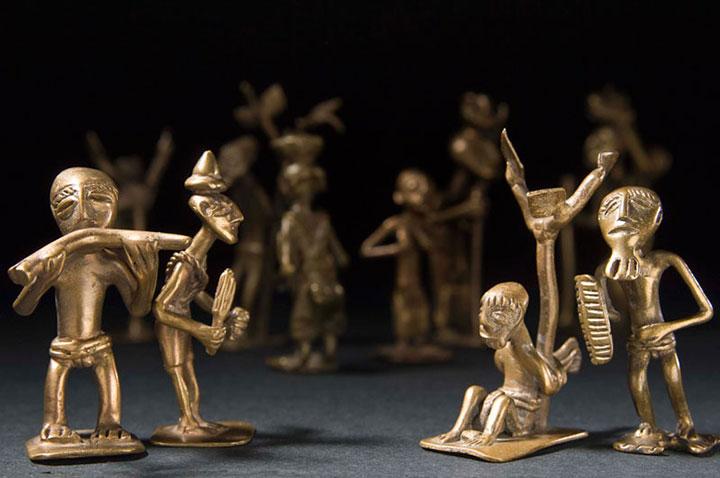
Gold, the metal that helped give the former British colony its name, became an expression of authority, sacred identity and extraordinary craftsmanship. Royal ornaments, ceremonial swords, elaborate jewellery and finely worked objects of gold and brass were not simply displays of wealth. They formed part of an intricate symbolic vocabulary through which political relationships, philosophical beliefs and social responsibilities were communicated.
The celebrated goldweights used in the measurement of gold dust offer a particularly fascinating example of Ashanti intellectual culture. Frequently cast in the forms of animals, human figures and everyday objects, they could embody proverbs, moral lessons and observations about society.
The Ashanti understood that an object could be both useful and beautiful, both material and philosophical.
The same sensibility is evident in Kente, the magnificent woven cloth associated with Akan royalty and now admired throughout the world. Its vibrant colours and elaborate patterns have become symbols of African cultural pride, appearing at state occasions, university ceremonies and international celebrations.
Adinkra symbols, meanwhile, convey ideas about wisdom, courage, destiny, perseverance and the relationship between humanity and the divine. Their enduring popularity demonstrates the remarkable capacity of Ashanti cultural traditions to communicate across generations and national boundaries.
Architecture formed another distinguished element of this civilisation. The surviving Asante Traditional Buildings near Kumasi, with their characteristic decorative reliefs and symbolic motifs, have been recognised by UNESCO as a World Heritage Site. They remain an invaluable testimony to a sophisticated architectural tradition developed from local materials and spiritual beliefs.
What emerges from these artistic achievements is a civilisation in which beauty and meaning were inseparable. The royal court was not merely a seat of government but a centre of artistic patronage, ceremony and intellectual expression.
And, perhaps most remarkably, much of that inheritance remains visible today.
The British Empire and the Kingdom That Refused to Disappear
The nineteenth century brought the Ashanti Kingdom into increasingly direct conflict with British imperial ambitions along the West African coast.
The Anglo-Ashanti Wars, fought over several decades, were not isolated military encounters but part of a wider struggle over trade, territory, sovereignty and the balance of power in West Africa.
For the British Empire, control of the interior promised commercial and strategic advantages. For the Ashanti, resistance was a defence of political independence and a way of life established long before European colonial authority reached the region.
The kingdom’s armies demonstrated formidable organisation and determination, repeatedly challenging British forces and their African allies.
In 1874, British troops entered Kumasi, looted the royal palace and set parts of the capital ablaze. The destruction and removal of royal treasures constituted a devastating assault upon the material and spiritual heritage of the kingdom.
Yet even this catastrophe failed to extinguish Ashanti identity.
In 1896, Asantehene Prempeh I was removed from power and subsequently exiled, eventually to the Seychelles. His removal was intended to break the political authority of the monarchy and consolidate British domination.
The Ashanti response revealed just how deeply their sovereignty was rooted in the collective consciousness of the people.
In 1900, when the British governor, Sir Frederick Hodgson, demanded possession of the Golden Stool, the resulting outrage inspired one of the most celebrated episodes in African resistance to colonialism.
Yaa Asantewaa: The Queen Mother Who Defied an Empire
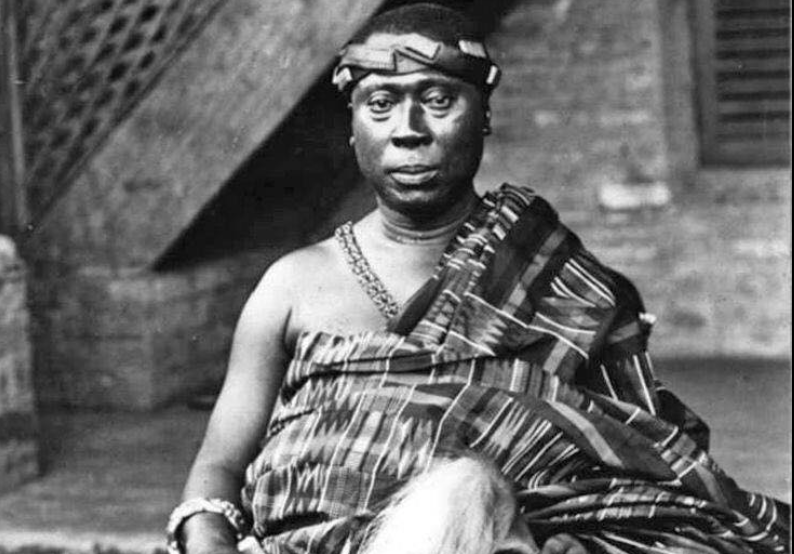
Among the great figures of African history, Yaa Asantewaa occupies a place of exceptional distinction.
As Queen Mother of Ejisu, she became the inspirational leader of the 1900 uprising against British authority, an event remembered as the War of the Golden Stool.
At a moment when the kingdom’s political leadership had been weakened by exile and colonial pressure, Yaa Asantewaa emerged as a formidable advocate of resistance.
Her determination challenged not only the might of the British Empire but also the assumption that military and political leadership necessarily belonged to men.
The uprising was ultimately defeated, and Yaa Asantewaa herself was exiled to the Seychelles, where she died in 1921. Nevertheless, the British failed to seize the sacred Golden Stool, which had been concealed.
The episode became one of the defining symbols of Ashanti resilience.
It also offers an important reminder that women occupied positions of considerable influence within traditional Ashanti political institutions. Queen mothers played an essential role in dynastic succession, governance and the preservation of customary authority.
Yaa Asantewaa’s legacy therefore extends beyond the battlefield. She represents courage, national consciousness and the conviction that the dignity of a people cannot simply be surrendered by imperial decree.
Her name deserves to stand alongside the great figures of resistance in world history.
The Remarkable Survival and Restoration of the Monarchy
The formal incorporation of Ashanti territories into Britain’s Gold Coast possessions in 1902 brought an end to the kingdom’s political independence. It did not, however, bring an end to the institution of kingship.
The monarchy survived because it was embedded in the spiritual, social and cultural structures of Ashanti society.
Chiefs continued to exercise customary responsibilities, royal traditions remained central to communal life, and the Golden Stool retained its sacred significance.
In 1924, Prempeh I was permitted to return from exile. His homecoming was an occasion of profound emotional importance, symbolising the persistence of a royal institution that colonial rule had attempted to subordinate.
In 1935, the restoration of the Ashanti Confederacy under Prempeh II represented a further decisive step in the rehabilitation of traditional authority.
When Ghana achieved independence on 6 March 1957, the Ashanti monarchy entered another chapter of its history. It would no longer be the government of an independent sovereign state, but it remained a respected institution within the new republic, preserving customary authority and cultural identity.
This peaceful accommodation between a modern African republic and an ancient African monarchy is among the most interesting aspects of Ghanaian public life.
Ghana has demonstrated that republican government and traditional kingship need not be mutually exclusive. They can coexist within a constitutional framework, each fulfilling distinct responsibilities.
The Ashanti monarchy today exercises no independent national sovereignty and does not replace Ghana’s elected government. Its influence arises instead from customary institutions, public respect, cultural authority and its capacity to mobilise communities around shared objectives.
That distinction has helped the kingdom remain relevant in a world radically different from the one in which it was founded.
Otumfuo Osei Tutu II: A Modern Monarch with a Vision for the Future


The accession of His Majesty Otumfuo Osei Tutu II to the Golden Stool on 26 April 1999 marked the beginning of a particularly significant period in the modern history of Asanteman.
The sixteenth Asantehene inherited an institution of immense historical prestige, but one confronted by the practical realities of contemporary African society: the need for improved education, better healthcare, economic opportunity, cultural preservation and sustainable development.
His response has been to give the monarchy an increasingly active role in addressing these challenges.
Rather than treating the throne solely as the guardian of ancestral ceremonies, Otumfuo Osei Tutu II has sought to demonstrate how traditional leadership can contribute meaningfully to modern national development.
One of the most important expressions of this philosophy has been his sustained commitment to education.
Through the initiatives that evolved into the Otumfuo Osei Tutu II Foundation, the Asantehene has supported educational opportunity, healthcare, community development and programmes designed to improve the quality of life of Ghanaians.
The Foundation’s origins lie in the Otumfuo Education Fund, established early in his reign. Its initial assistance reached 600 students at Ghana’s three public universities of the period. Over subsequent years, the scope of the royal philanthropic programme expanded considerably.
In 2021, several initiatives were consolidated under the Foundation, bringing education, health, sanitation, cultural heritage and other developmental activities into a more unified structure.
At its twenty-fifth anniversary celebrations in April 2025, the Foundation launched an endowment initiative intended to provide more sustainable long-term financing, with a stated ambition to raise and invest GH₵50 million over five years.
The significance of this work lies not only in the assistance delivered to individual communities but also in the philosophy it represents.
A monarchy once compelled to defend its territories by military force is now directing its energies towards the education and wellbeing of future generations.
It is a striking transformation, and one entirely consistent with the deeper purpose of traditional kingship: the protection and advancement of the people.
Education, Healthcare and the New Meaning of Royal Leadership
The practical achievements associated with the Asantehene’s development initiatives offer an important measure of the monarchy’s contemporary relevance.
The Foundation has supported school infrastructure, student accommodation, educational materials and community water projects. Among the initiatives publicised by the organisation are a 600-bed girls’ dormitory at Sefwi Wiawso Senior High School, accommodation for teachers at St Louis Senior High School and improved access to clean water in selected communities.
The Asantehene’s involvement with Kwame Nkrumah University of Science and Technology, where he serves as Chancellor, further illustrates the relationship between traditional leadership and modern academic advancement.
In April 2026, Ghana’s Education Trust Fund announced a GH₵400 million medical equipment procurement contract for a new KNUST teaching hospital. In reporting the development, the Ghana News Agency noted the Asantehene’s sustained advocacy for the project and his engagement with stakeholders in support of improved medical training and healthcare provision.
Healthcare provides another revealing example of the monarchy’s ability to inspire public participation.
In May 2026, the National Health Insurance Authority in the Ashanti Region conducted its inaugural King’s Month campaign in honour of Otumfuo Osei Tutu II. According to figures reported by the Ghana News Agency, the campaign recorded more than 1.48 million registrations and renewals, including approximately 52,000 new subscribers.
Although organised by the public health authority, the campaign benefited from the participation of traditional leaders and demonstrated how royal prestige can complement the work of modern public institutions.
Such initiatives give substance to the proposition that traditional African monarchies can be agents of social progress.
Their relevance need not depend upon political power. It can rest upon public service, moral authority and the capacity to unite people behind constructive ambitions.
Kumasi: The Royal Capital and a Centre of Ghanaian Enterprise


To appreciate the modern Ashanti Kingdom, one must understand Kumasi.
Long celebrated as the Garden City of West Africa, Kumasi is both the historic capital of Asanteman and one of Ghana’s most important commercial and cultural centres.
Its markets, educational institutions, manufacturing activities and commercial networks connect the Ashanti Region to the rest of Ghana and to neighbouring West African economies.
The celebrated Kejetia market and the wider commercial districts of Kumasi embody the entrepreneurial energy for which the region has long been recognised.
Trading in textiles, agricultural produce, manufactured goods, jewellery and countless other commodities sustains a complex network of merchants, transport operators, artisans and small businesses.
Beyond the city, the Ashanti Region possesses considerable agricultural and mineral resources, including important connections to Ghana’s cocoa and gold industries.
It would be inaccurate to attribute this economic dynamism exclusively to the monarchy. Modern Kumasi’s development reflects the combined contributions of entrepreneurs, workers, universities, local authorities, private investors and the Ghanaian state.
Nevertheless, the royal institution remains an important source of cultural identity and social cohesion within this economic landscape.
For investors and visitors alike, the region offers a particularly compelling combination of commercial vitality, educational resources, historical distinction and cultural confidence.
The future of Kumasi will depend upon improvements in transport, infrastructure, urban planning, environmental management and access to capital. Yet its historical position as a great trading centre gives it a strong foundation upon which to build.
In this respect, the Ashanti Kingdom’s past and Ghana’s economic future are closely connected.
The Return of the Royal Treasures: Restoring a Nation’s Memory
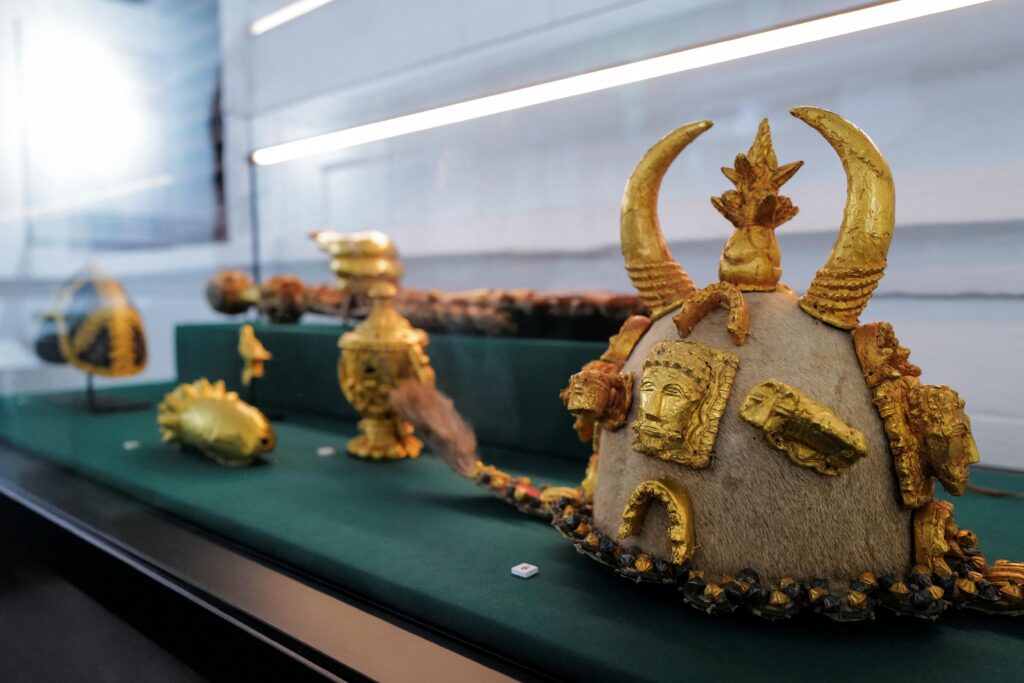
Among the most moving developments of recent years has been the return to Ghana of royal objects removed during the nineteenth-century Anglo-Ashanti conflicts.
For generations, some of the finest examples of Ashanti craftsmanship were held in European and American collections, separated from the communities and ceremonial traditions that had given them meaning.
The restitution debate is therefore about considerably more than ownership of beautiful objects. It concerns historical justice, cultural memory and the right of societies to interpret their own heritage.
In 2024, important royal artefacts associated with the British Museum and the Victoria and Albert Museum returned to Kumasi on loan, whilst objects from the Fowler Museum in California were permanently repatriated.
Their display at the Manhyia Palace Museum coincided with celebrations marking the twenty-fifth anniversary of Otumfuo Osei Tutu II’s reign.
Further returns followed. The Manhyia Palace Museum reported the delivery of 28 additional gold artefacts from AngloGold Ashanti in December 2024, followed by 130 gold and other art objects from South Africa and Britain in November 2025.
These developments have helped restore a measure of cultural wholeness to the royal collections, whilst renewing international interest in Ashanti history.
The distinction between permanent restitution and long-term loans remains important, and discussions about the future of objects still held overseas are far from concluded.
Nevertheless, the momentum is significant.
A kingdom whose treasures were once carried away as symbols of imperial conquest is now welcoming them home as expressions of cultural dignity.
In March 2026, the Manhyia Palace Museum also announced a partnership with UNESCO Ghana associated with the second edition of the Otumfuo Osei Tutu II Art Awards, demonstrating how the preservation of historic artistic traditions can be linked to contemporary creativity.
The return of the royal treasures is therefore not simply an exercise in looking backwards. It is helping create new opportunities for scholarship, museums, tourism, education and artistic collaboration.
A Royal Tradition That Unites Generations
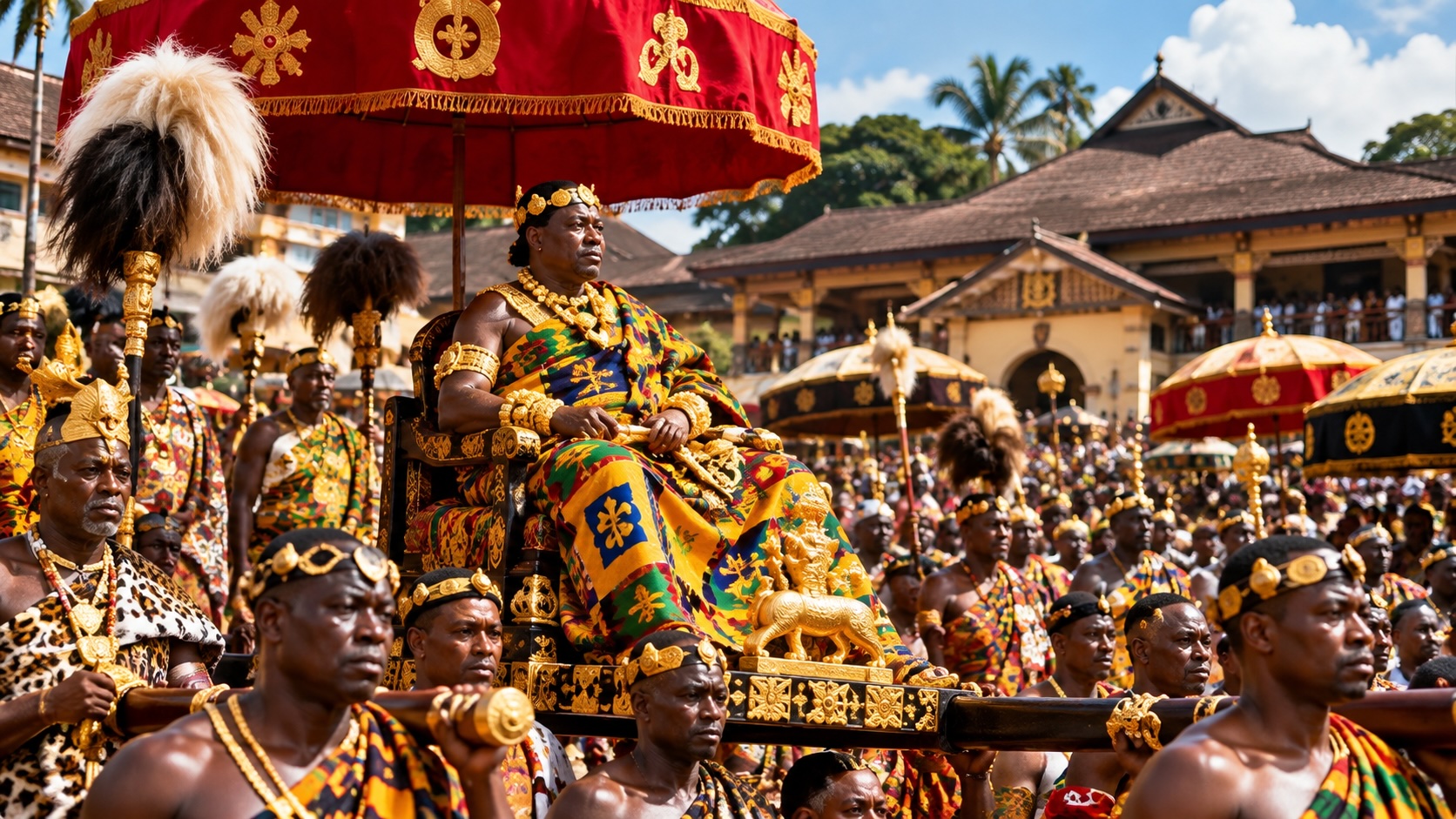
Few spectacles communicate the splendour of Ashanti culture more vividly than the great royal ceremonies held in Kumasi.
The Akwasidae festival, observed according to the traditional Akan calendar, brings together chiefs, queen mothers, elders, musicians, courtiers and members of the public in a magnificent celebration of ancestry, loyalty and continuity.


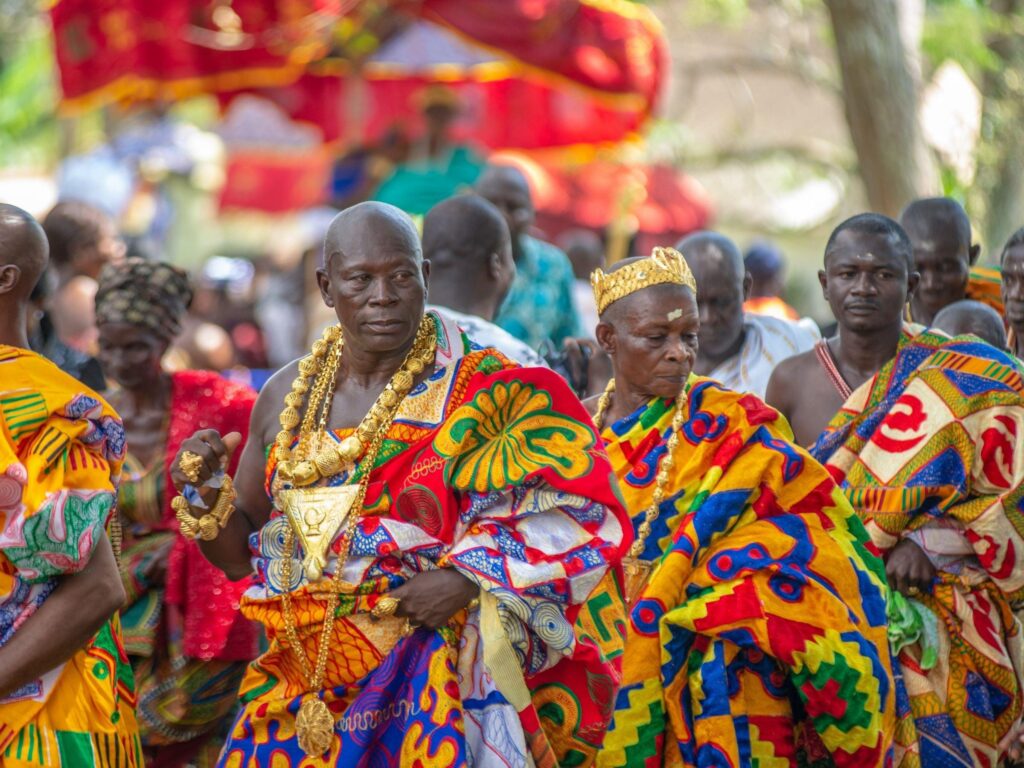
The ceremonial umbrellas, brilliantly coloured Kente cloth, golden ornaments, traditional drums and elaborate courtly processions create a spectacle of exceptional visual richness.
Yet the significance of these occasions reaches far beyond their aesthetic appeal.
They reinforce the bonds between the monarchy and its constituent traditional authorities. They bring generations together, transmit historical knowledge and provide a public expression of the values upon which Asanteman was founded.
For young Ghanaians, such ceremonies offer an encounter with a cultural inheritance that remains relevant despite the accelerating influence of globalisation.
For the African diaspora, they can represent a powerful connection to ancestral identity.
For international visitors, they reveal a side of Africa too often overlooked in conventional accounts of the continent: a world of refined ceremonial traditions, enduring institutions and sophisticated systems of cultural symbolism.
In an age when cultural uniformity increasingly threatens local identities, the Ashanti Kingdom offers an example of how a society can embrace modernity without abandoning its distinctive character.
The Ashanti Kingdom and Ghana’s National Identity
One of the most noteworthy features of contemporary Ghana is the continued importance of traditional authorities within a modern democratic republic.
Ghana is home to numerous historic kingdoms, chiefdoms and cultural communities, each contributing to the country’s rich national inheritance.
The Ashanti monarchy occupies a particularly prominent place within this wider landscape, but its significance is most constructive when understood as part of Ghana’s broader diversity rather than as a rival to other traditions.
The Asantehene’s influence is expressed through customary leadership, mediation, educational patronage, cultural preservation and public engagement.
Traditional authorities can help resolve local disputes, facilitate dialogue and encourage community participation in development initiatives. Their effectiveness depends upon public confidence, institutional accountability and constructive relationships with elected authorities.
In this sense, the monarchy offers Ghana an additional source of social continuity.
Where modern political leadership necessarily changes through elections, traditional institutions can provide a longer historical perspective.
That continuity is not a substitute for democratic government, nor does it place customary authority beyond criticism. Its value lies in the ability to complement national institutions whilst respecting Ghana’s constitutional order.
The Ashanti experience illustrates that modern African nationhood need not require the disappearance of older forms of identity.
On the contrary, a confident republic can draw strength from the cultural institutions that have helped shape its people.
An African Institution with International Significance
The importance of Asanteman extends beyond Ghana’s borders.
Across Africa, societies are increasingly reassessing the historical institutions, artistic traditions and intellectual achievements that colonial narratives frequently marginalised.
The Ashanti Kingdom provides a particularly compelling subject for this reassessment because its history is both extensively documented and visibly alive.
Its political organisation demonstrates the complexity of precolonial African statecraft. Its art reveals extraordinary technical skill and philosophical depth. Its resistance to imperial expansion occupies an important place in the history of African sovereignty.
Its contemporary development initiatives, meanwhile, suggest possibilities for cooperation between customary institutions, universities, philanthropic organisations and modern governments.
There is considerable potential for the kingdom to deepen its international relationships through cultural diplomacy, educational exchanges, museum partnerships and responsible tourism.
The global interest in African art and heritage offers further opportunities.
Kumasi could strengthen its position as a major destination for visitors interested in African history, traditional craftsmanship, royal institutions and contemporary creativity.
International collaboration in conservation and scholarship could also help protect vulnerable historic sites and ensure that the knowledge embodied in Ashanti traditions is passed to future generations.
Such opportunities are not automatic. They require investment, professional management, transparency and careful protection of cultural authenticity.
Yet the foundations are already there.
Few places can offer visitors the opportunity to encounter an ancient royal tradition not as a museum reconstruction but as part of the living fabric of contemporary society.
The Future: From the Golden Stool to a New Generation of African Achievement
If the first great chapter of Ashanti history was written through political unification and imperial expansion, and the second through resistance and survival, the next may be defined by knowledge, innovation and cultural leadership.
The kingdom’s future does not depend upon recovering the territorial power it exercised in the eighteenth or nineteenth centuries. Its greatest opportunity lies in translating the authority of its history into tangible benefits for contemporary society.
Education must remain central to that ambition.
The continued expansion of scholarships, educational infrastructure, research partnerships and opportunities for young people can help ensure that the next generation possesses the skills required by an increasingly competitive global economy.
Technology and entrepreneurship offer further possibilities. Kumasi’s commercial traditions, combined with its universities and youthful population, provide a promising environment for new businesses and creative industries.
Cultural tourism represents another substantial opportunity, particularly if investment in museums, heritage conservation and visitor infrastructure is accompanied by benefits for local communities.
The kingdom’s artistic heritage could also inspire a new generation of designers, architects, jewellers and craftspeople, combining traditional techniques with contemporary markets.
Environmental stewardship will be equally important. The forests, rivers and agricultural landscapes of the Ashanti Region are part of its historical identity, and their protection is essential to sustainable prosperity.
These are challenges that no traditional institution can resolve alone. They require cooperation between government, business, educational establishments, civil society and local communities.
The Asantehene’s role can be to encourage that cooperation, lending the moral and cultural authority of the throne to initiatives that serve the public good.
In this way, Asanteman can continue to contribute not only to Ghana’s development but also to a wider African conversation about the relationship between heritage and progress.
A Kingdom That History Could Not Erase
There is something profoundly moving about the survival of the Ashanti monarchy.
Its kings once governed an empire whose influence extended across much of the forested interior of West Africa. Its warriors resisted the advance of one of the most powerful empires in history. Its capital was attacked, its treasures plundered, its sovereign exiled and its political independence extinguished.
Yet the institution endured.
The Golden Stool survived. The royal succession survived. The ceremonies, the language, the proverbs, the music, the craftsmanship and the collective memory of Asanteman survived.
And when Ghana emerged as an independent republic, the Ashanti Kingdom did not disappear into the footnotes of colonial history. It found a new place within the life of a modern African nation.
Today, the spectacle of the Asantehene seated beneath the magnificent royal umbrellas of Kumasi represents far more than the continuation of an ancient ceremony.
It symbolises the extraordinary endurance of African civilisation.
The kingdom’s contemporary strength is not measured in conquered territories or military victories, but in the education of children, the preservation of heritage, the promotion of healthcare, the encouragement of enterprise and the confidence of a people who know the value of their history.
Its future will undoubtedly bring challenges, as the future of every institution must. Yet the Ashanti Kingdom possesses something that cannot easily be manufactured: centuries of accumulated identity, cultural authority and a powerful sense of continuity.
For Ghana, this inheritance is an important national asset. For Africa, it offers an example of how indigenous institutions can adapt, survive and contribute to modern development without surrendering their essential character.
And for the wider world, it is a reminder that the history of Africa is not merely a history of colonisation and independence. It is also the history of great civilisations, accomplished rulers, extraordinary artistic traditions and societies whose achievements deserve a central place in the story of humanity.
The Ashanti Kingdom has already secured its place in history. Its greatest contemporary achievement may be to demonstrate that a glorious past, far from being a burden, can become the foundation of an equally distinguished future.


 Carlos Mundy
 Giovanni R. Ruffini Professor of History Fairfield University, USA


 Elga Wimmer

 Charles Markeaton-Mundy
 Metaphore Magazine