
 Laura Mitchell
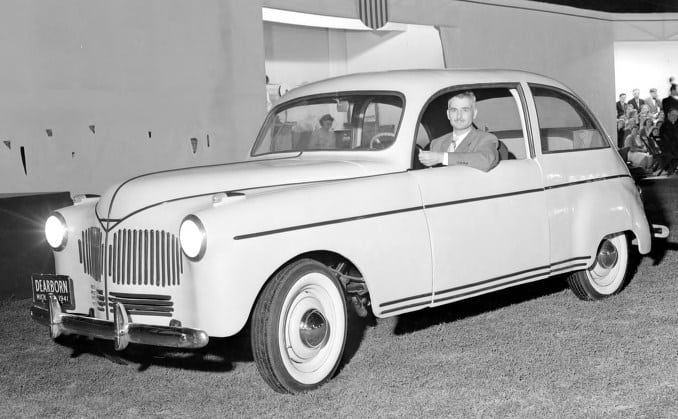
On a summer afternoon in Dearborn, Michigan, on August 13, 1941, a 78-year-old Henry Ford showed his hometown something it had never seen before. The crowd had come out for Dearborn Days, the town’s annual community festival, and at the high point of the celebration Ford unveiled a car whose body wasn’t made of steel. It was made of plastic, and that plastic had been made, at least in part, from things that grow in a field.
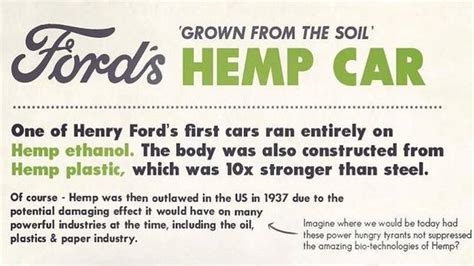
The newspapers called it the “soybean car.” In the decades since, as the legend has been told and retold online, it has picked up another name: the “hemp car.” The truth is somewhere in between, and in some ways it’s more interesting than either.
Henry Ford never stopped being a Michigan farm kid. Even after he’d put America on wheels with the Model T, he kept coming back to one stubborn conviction: the American farm and the American factory ought to be working for each other.
By the 1930s he was putting real money behind that belief. Ford had a soybean laboratory set up in Greenfield Village, where chemists experimented with turning crops into industrial materials. They found that soy-based plastics could be pressed into thick, hard sheets, and they started molding prototype car parts like trunk lids. Pretty soon they were imagining a car body made entirely of the stuff, according to The Henry Ford museum.
The project was first handed to Ford’s styling chief, E.T. “Bob” Gregorie, but Ford didn’t like what came back. So he gave it to Lowell E. Overly, a tool-and-die designer working in the soybean lab, who was backed by the chemist Robert A. Boyer. The car they built had a tubular steel frame wrapped in 14 plastic panels. It weighed about 2,000 pounds, roughly 1,000 pounds lighter than a comparable steel car, the museum notes.
Here’s where the story gets a little murky, and it’s worth being honest about it. No record of the exact recipe survives. Overly himself described the panels as “soybean fiber in a phenolic resin with formaldehyde used in the impregnation.” One article from the time claimed the mix included soybeans, wheat, hemp, flax and ramie, among other ingredients, according to The Henry Ford.
So hemp may well have been in there. But the popular claim that the car was “made of hemp,” with panels of exactly 70 percent cellulose fiber and 30 percent resin that were “ten times stronger than steel,” can’t be checked against the historical record.
The same goes for that famous photograph of Ford swinging an ax at a car. It’s real, but it doesn’t show the 1941 car. It was taken in 1940, and it shows Ford’s personal car fitted with a soy-plastic trunk lid. As the museum tells it, the ax would bounce right off, sometimes flying about 15 feet into the air, though a rubber boot had been fitted over the blade, according to The Henry Ford. It was great showmanship, and the photo ran in newspapers across the country.
The other half of the legend is that Ford’s car was meant to run on fuel made from hemp. There’s no solid evidence the 1941 car ever did. What is well documented is Ford’s long interest in ethanol. Back in 1925, he told The New York Times that ethanol was “the fuel of the future,” as Purdue University recalled. He thought crop-based fuel could help farmers and keep engines running smoothly at the same time, Agweek reported.
Put the two ideas side by side and you get a vision that sounds remarkably modern: a car built from crops, powered by crops, and, at the end of its life, made of materials that could go back to the land.
Ford had practical reasons, too. Metal was getting scarce as the country edged toward war, and he hoped this new material could replace it. He even claimed the plastic panels made the car safer, saying it could roll over without being crushed, according to the museum.
The plastic car never made it to a showroom. After Dearborn Days it went on display at the Michigan State Fairgrounds. A second one was being built when World War II broke out, and all civilian car production stopped. By the time the war ended, the plastic car had, in the museum’s words, “fallen through the cracks.” According to Overly, the original was eventually destroyed by Gregorie, The Henry Ford reports.
After the war, cheap oil and a booming petrochemical industry made steel, synthetic plastics and gasoline the obvious choices. Hemp had its own problems. It’s a close cousin of marijuana, and after the Marihuana Tax Act of 1937 it was caught up in the same restrictions, which made it very hard to treat as an ordinary farm crop for most of the century that followed.
Picking up where Ford left off
Fast-forward about 75 years to Florida, where a tech veteran named Bruce Michael Dietzen decided to take Ford’s idea seriously.
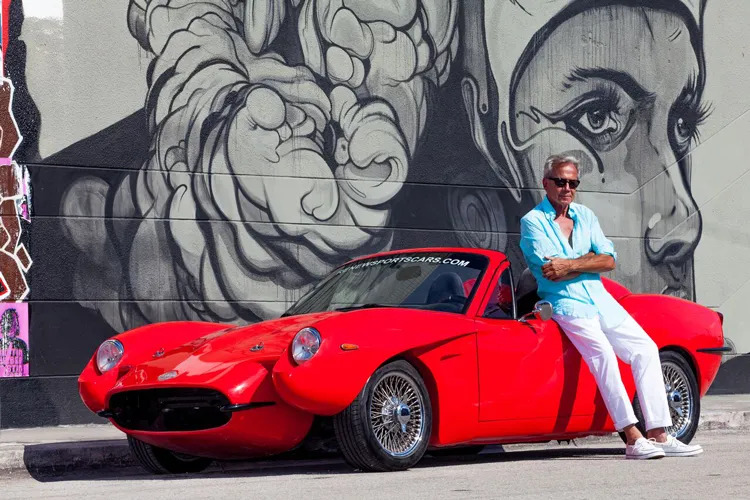
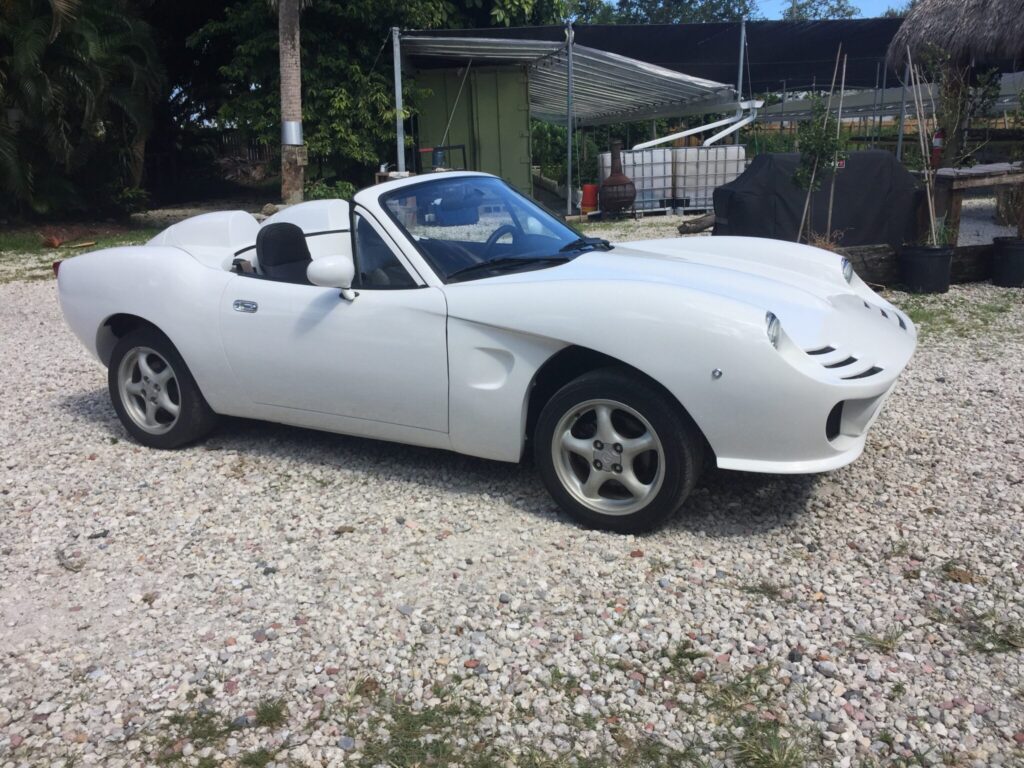
Dietzen built the Renew Sports Car, which people quickly started calling the “Cannabis Car.” It’s basically a reimagined first-generation Mazda Miata with a brand-new body made of woven hemp. At the time, growing hemp was illegal in Florida, so he had to buy his hemp from China. About 100 pounds of it goes into each body, The Drive reported in 2016. The prototype cost him around $200,000 to get running, and the prototype ran on biofuel made from agricultural waste, according to The Drive.
Dietzen finished the prototype in 2017. The body is about 65 percent woven hemp and 35 percent bio-epoxy, a material he calls Carbon Negative Fiber. He has said the venture cost him around $200,000 in direct expenses, plus about as much again in income he gave up while he worked on it, autoevolution reported. Like Ford with his ax, he likes a good demonstration. He’ll pound on the body with his fist to show how tough it is, RCN Magazine noted.
His sales pitch is bold. He calls the car “three times greener than today’s electric vehicles,” as The Drive quoted him. The reasoning is that hemp pulls carbon dioxide out of the air as it grows and keeps it locked in the finished material. Those environmental claims come from Dietzen himself, and they don’t count the carbon that went into building the original Miata.
The road has been bumpy for Dietzen, too. The Renew is no longer in production, and only one other car besides his own was ever built. Dietzen says he was “about seven years ahead of [his] time,” and he has since turned to bringing his hemp fabric to electric vehicle makers, autoevolution reported.
Both men ran into the same wall. Brilliant prototypes are one thing; car-industry economics are another. Safety testing, regulatory approval and the huge cost of scaling up have swallowed better-funded ideas than these. And hemp still carries some old baggage, even though industrial hemp contains only trace amounts of THC.
But the climate has changed, in every sense. The 2018 Farm Bill made industrial hemp legal to grow in the United States, opening the door to a crop that grows fast, needs relatively little water, and can be turned into textiles, building materials, plastics and more. Carmakers are under heavy pressure to cut emissions and use fewer petroleum-based plastics, and natural-fiber composites are getting serious attention as lighter, renewable options for panels and interior parts. Lighter cars use less fuel, and lighter electric cars get more range out of every charge.
None of this means the next car you buy will be grown on a farm in Kentucky. But it does mean that an idea an old man showed off at a small-town festival in 1941 no longer looks like a curiosity. It looks more like a road America almost took, and might still find its way back to.
Henry Ford wanted to bring the farm and the factory together. More than 80 years later, people like Bruce Dietzen are still trying to finish the job.


 Metaphore Magazine



 Carlos Mundy

 Laura Mitchell
 Mayte Hidalgo