
 Laura Mitchell
Spain is going back to the ballot box.
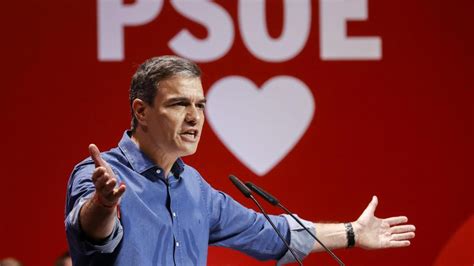
On 5 October 2026, Prime Minister Pedro Sánchez announced that a snap general election would be held on 29 November, bringing forward a contest that had not been expected until 2027. The announcement followed the parliamentary defeat of his Government’s emergency housing measures and comes after years of political fragmentation, dependence upon smaller regional parties and an increasingly damaging succession of judicial investigations and corruption scandals surrounding figures close to the Prime Minister.
The election therefore arrives at an extraordinary moment in modern Spanish politics.
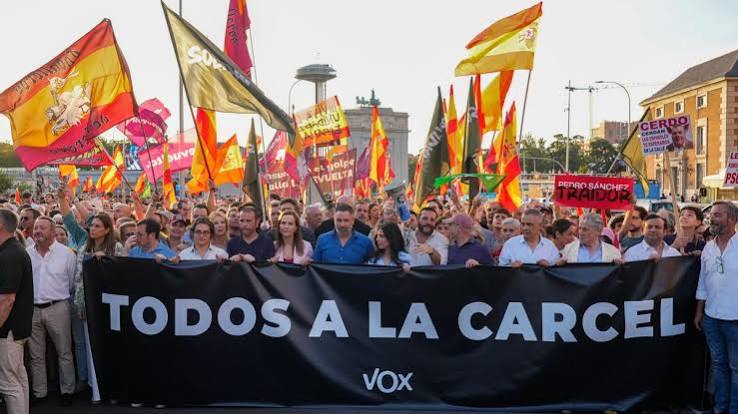
The question facing Spain is not simply whether Pedro Sánchez should remain Prime Minister. There is another, quite separate question that has become impossible to ignore: where does political responsibility end and potential legal responsibility begin?
Those two questions must not be confused.
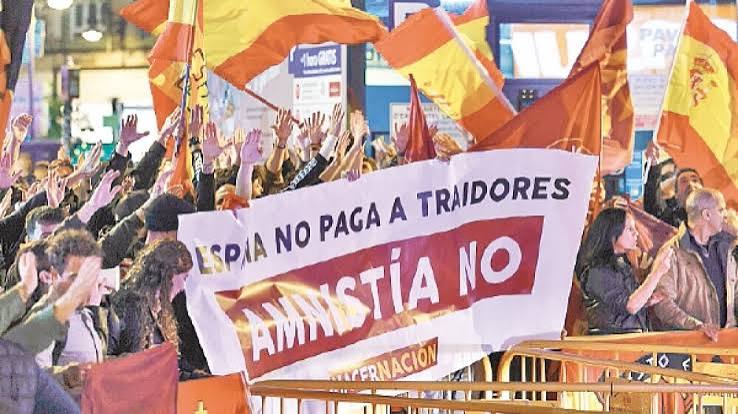
Losing an election is not a criminal conviction. Political conduct, however objectionable opponents may consider it, is not automatically criminal conduct. Nor does the wrongdoing of relatives, ministers or party officials establish the criminal responsibility of a prime minister. In a constitutional democracy, criminal liability is individual and must be established by evidence before an independent court.
That principle must apply to Sánchez just as rigorously as it applies to everyone else.
But the opposite principle is equally important: holding the office of Prime Minister cannot provide immunity from legitimate scrutiny. No democratic leader should be considered too politically important, too institutionally powerful or too electorally successful to be investigated if credible evidence of criminal conduct should emerge.
And the circumstances surrounding Sánchez have changed dramatically.
When criticism of his administration first intensified, many of the accusations surrounding the Socialist Government remained allegations. That is no longer universally the case.
In June 2026, Spain’s Supreme Court sentenced José Luis Ábalos — Sánchez’s former Transport Minister and one-time Secretary of Organisation of the Socialist Party — to more than 24 years in prison for corruption offences arising from the procurement of face masks during the pandemic. His former adviser Koldo García also received a lengthy prison sentence.
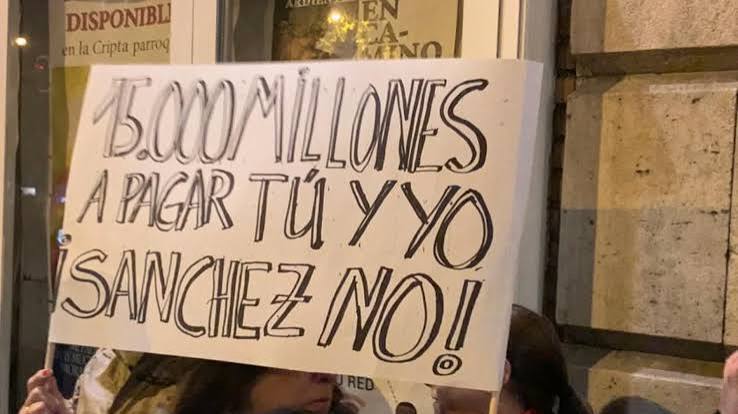
This was no longer political rhetoric or an opposition accusation. It was a judgment delivered by Spain’s highest criminal court.
The significance is difficult to exaggerate. Ábalos was not some obscure provincial official operating at the distant fringes of the Socialist Party. He had occupied one of the most important positions in Sánchez’s Government and had been one of the most powerful organisational figures within the PSOE.
Then came another blow.
In July 2026, David Sánchez, the Prime Minister’s brother, was convicted of administrative misconduct concerning his appointment to a cultural post by the provincial government of Badajoz. He was disqualified from holding public office for nine years. The judgment may be appealed, and that fact must be emphasised, but the case has inevitably intensified questions about patronage and the proximity of political power to public appointments.
More serious politically still is the position of the Prime Minister’s wife.
Begoña Gómez has been the subject of a lengthy judicial investigation concerning allegations that she exploited her position in connection with professional activities. She denies wrongdoing, and the proceedings have themselves become bitterly politicised, with Sánchez and the PSOE arguing that the case forms part of a campaign by political opponents against his Government.
Nevertheless, the proceedings have moved beyond preliminary investigation.
In September 2026, Judge Juan Carlos Peinado ordered Gómez to stand trial before a jury for alleged influence peddling and misuse of public funds. The trial date has yet to be fixed. Gómez remains entitled to the presumption of innocence, and the existence of a trial is emphatically not proof of guilt.
Yet Spain now finds itself in the remarkable position of entering a general election while the Prime Minister’s wife awaits trial, his brother has been convicted at first instance, and one of his former most powerful ministers has received a substantial prison sentence for corruption.
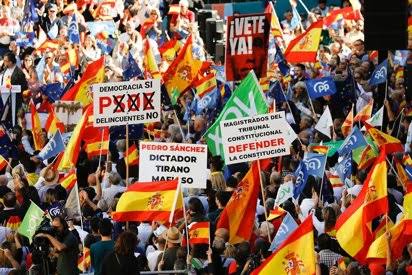
That does not make Pedro Sánchez guilty of anything.
It does, however, make scrutiny of his Government unavoidable.
There is another figure whose trajectory has intensified the political damage: Santos Cerdán, who succeeded Ábalos as Secretary of Organisation of the PSOE and became one of Sánchez’s closest political lieutenants. Investigations have examined alleged kickbacks and the relationship between political influence and public contracts. In July, investigators sought banking information concerning members of Cerdán’s family after the Guardia Civil’s Central Operational Unit reported what it regarded as more than €323,000 in potentially irregular benefits involving Cerdán and relatives between 2015 and 2024. These remain allegations requiring judicial determination.
Even Sánchez himself acknowledged before Congress in June that the corruption affair involving former senior PSOE officials was real, while firmly rejecting the suggestion that it demonstrated generalised corruption within his Government.
That distinction matters.
Indeed, one of the weaknesses of the political debate surrounding Sánchez has been the tendency on both sides to collapse very different propositions into one another. His opponents sometimes treat proximity to corruption as proof of personal criminality. His defenders sometimes appear to treat the absence of charges against Sánchez personally as though it disposes of the wider question of political responsibility.
Neither proposition is satisfactory.
As matters stand, Pedro Sánchez himself has not been charged in these corruption proceedings. That fact must be stated unequivocally.
But it does not follow that Spaniards should cease asking difficult questions.
How did individuals occupying positions of enormous political confidence acquire such prominence within the governing party? What systems of supervision operated around ministers and senior party officials? When did the Prime Minister become aware of allegations concerning people close to him? Were warning signs overlooked? Were institutions sufficiently protected from political influence? And, above all, should evidence ever emerge implicating Sánchez personally, would Spain’s institutions be sufficiently independent to pursue it without fear or favour?
These are legitimate democratic questions.
The controversy surrounding Sánchez also extends beyond corruption.
His handling of Catalonia transformed Spanish politics. His Government pardoned nine Catalan separatist leaders convicted over the illegal 2017 independence process and subsequently promoted an amnesty law covering offences connected with the Catalan independence movement.
For Sánchez’s critics, the amnesty represented an extraordinary political bargain made because he required Catalan nationalist votes to remain in office. For its supporters, it represented an attempt to bring an exceptionally destructive constitutional confrontation back into the sphere of democratic politics.
The legal picture is more complicated than either slogan suggests.
Spain’s Constitutional Court upheld the essential constitutionality of the amnesty law in its landmark 2025 judgment, while finding aspects of its scope unconstitutional on equality grounds. Subsequent Constitutional Court decisions in 2025 and 2026 broadly reaffirmed the constitutionality of the measure while resolving or qualifying particular provisions.
One may therefore regard the amnesty as politically cynical, constitutionally dangerous or historically necessary. But it is no longer accurate simply to describe the entire measure as having been declared unconstitutional.
The distinction between political condemnation and criminal liability must again be maintained.
There are, nevertheless, legitimate reasons for concern about the health of Spain’s institutional system. The long-running political struggle over appointments to the General Council of the Judiciary, the increasingly hostile relationship between political parties and judges, and the tendency of both left and right to portray adverse judicial decisions as politically motivated have contributed to a damaging erosion of public confidence.
Spain cannot afford a political culture in which judges are considered independent only when they reach the conclusion preferred by one’s own side.
The same principle applies to Sánchez.
If investigations involving his associates produce evidence against him, that evidence should be investigated. If they do not, his opponents cannot simply substitute suspicion for proof.
His Government’s record during the COVID-19 pandemic provides another example of why precision matters.
The Constitutional Court did indeed rule that important elements of the Government’s pandemic emergency arrangements were unconstitutional. In 2021 it struck down provisions relating to the first state of alarm and subsequently declared unconstitutional parts of the second emergency framework, including elements concerning delegated authority and the six-month parliamentary extension.
Those were serious constitutional judgments against measures adopted by Sánchez’s Government.
But an unconstitutional government measure does not automatically constitute a criminal offence by the Prime Minister. Constitutional responsibility, political responsibility and criminal responsibility are different things. A mature democracy must be capable of distinguishing among them.
And that distinction leads directly to the election of 29 November.
Sánchez is asking Spaniards for another mandate after more than eight years at the centre of government. His supporters will point to employment, social reforms, economic growth, Spain’s role within Europe and his Government’s defence of a progressive social agenda. Sánchez himself has framed the coming election as a choice over the country’s social and economic direction.
His opponents will point to corruption cases, institutional confrontation, concessions to Catalan separatists, parliamentary instability, the housing crisis and what they regard as an increasingly personalised exercise of political power.
Those arguments belong in an election.
Criminal accusations belong somewhere else: in a courtroom.
This distinction has become especially important because the word corruption is now used so casually in European politics that it risks losing its meaning. There is a profound difference between saying that corruption occurred within a government, saying that a prime minister bears political responsibility for failing to prevent it, and saying that the prime minister personally committed a criminal offence.
The first proposition has acquired substantial judicial support in relation to individuals who served under Sánchez.
The second is a matter of political judgment upon which Spaniards may reach very different conclusions.
The third requires evidence.
That evidence should be pursued wherever it leads.
If investigators uncover credible evidence that Pedro Sánchez personally participated in, facilitated, concealed or knowingly benefited from criminal activity, his office must offer him no protection whatsoever from the ordinary operation of Spanish law. A prime minister must be subject to precisely the same criminal law as the citizen he governs.
Equally, if no such evidence exists, he must not be prosecuted merely because those around him have been accused or convicted.
That would not be justice. It would be politics conducted through the criminal courts.
There is, however, a broader question of accountability that cannot be resolved by waiting for prosecutors.
Pedro Sánchez chose his ministers. He led his party. He constructed the political machinery that has governed Spain since 2018. He cannot reasonably claim political credit for everything his administrations achieved while insisting that the failures of powerful individuals operating within that same political structure have nothing to do with his leadership.
Political responsibility is not criminal guilt.
But neither is it meaningless.
The conviction of a former senior minister, the conviction at first instance of the Prime Minister’s brother, the forthcoming trial of his wife and the continuing investigations surrounding other senior Socialist figures have created an atmosphere unlike that surrounding any ordinary Spanish general election.
And now the electorate will have its say.
On 29 November, Spaniards will decide who should govern them. They will judge Sánchez’s record alongside the alternatives offered by the opposition. That is democracy performing its essential function.
But elections cannot determine innocence or guilt.
A government may win an election and still be investigated. A prime minister may lose an election and still be innocent of criminal wrongdoing. Popular sovereignty and the rule of law are complementary principles precisely because neither can substitute for the other.
Spain therefore needs both.
It needs an election conducted without intimidation or hysteria. It needs judges capable of investigating the powerful without political interference. It needs prosecutors willing to follow evidence rather than headlines. And it needs politicians prepared to accept that public office carries responsibilities extending beyond the minimum requirement of avoiding criminal conviction.
The proper principle is consequently more important than any single politician:
Investigate the evidence. Follow it wherever it leads. Prosecute anyone against whom a legally sufficient case exists — whether minister, businessman, party official, relative of the Prime Minister or, if the evidence ultimately warrants it, the Prime Minister himself.
But conviction must come from a court, not from a newspaper headline, an opposition speech or an electoral campaign.
Pedro Sánchez will face Spain’s voters on 29 November.
If there is a criminal case for him to answer, he should face Spanish justice as well.
The two judgments must remain separate.
That is not a concession to Pedro Sánchez.
It is the very essence of the rule of law.


 Carlos Mundy
 Giovanni R. Ruffini Professor of History Fairfield University, USA


 Metaphore Magazine


 Laura Mitchell
 Mayte Hidalgo