
 Elga Wimmer
For decades, an extraordinary Cubist case for two violins lay forgotten in Venezuela. Now exhibited in Toledo, the object has undergone an extensive forensic investigation of its signature, materials, pigments and century-old paper fragments. The evidence points towards Pablo Picasso and one of the most revolutionary periods of his career. One final institutional step remains: formal recognition by the Picasso Committee.
For decades, nobody knew it was there.
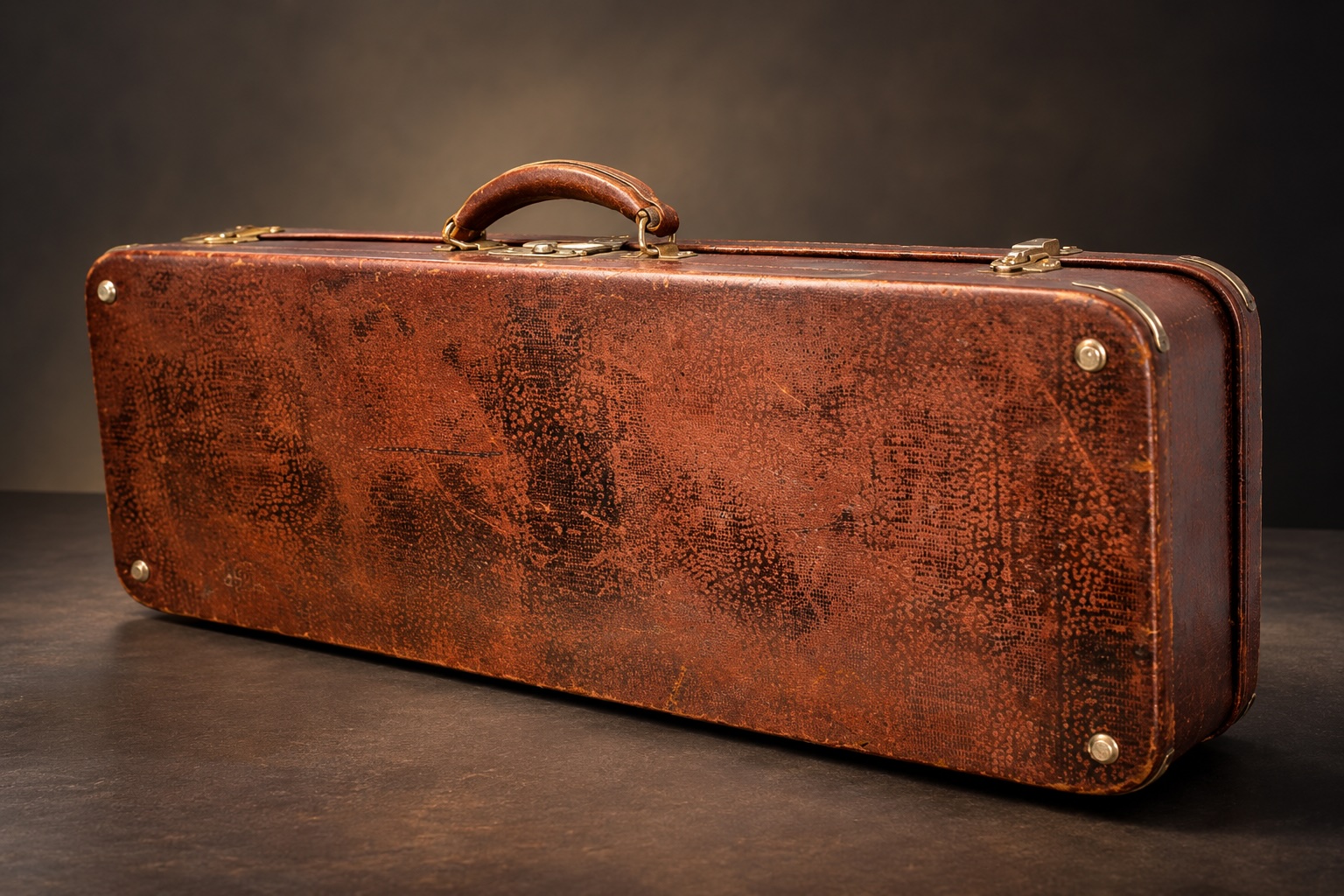
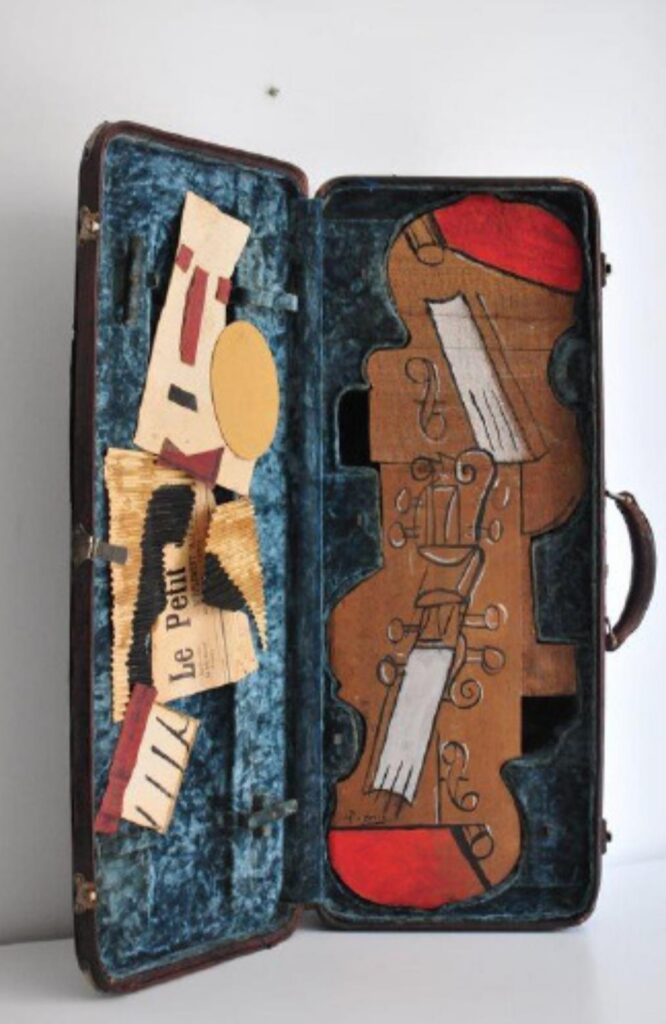
Inside a forgotten trunk in an apartment in Caracas lay an old case made to carry two violins. Closed, it was an unremarkable object of another age: brown, worn, portable, utilitarian. Nothing about its exterior proclaimed that it might conceal a work connected with one of the greatest revolutions in twentieth-century art.
Then the case was opened.
Inside was another world.
Newspaper. Corrugated cardboard. Fragments of books. Painted pieces of wood. A violinist assembled from the detritus of ordinary life. Two violins reduced and reconstructed into Cubist forms. Black, white and brilliant passages of red. And towards the bottom of the composition, on one of those strange wooden instruments, a name capable of changing everything:
Picasso.
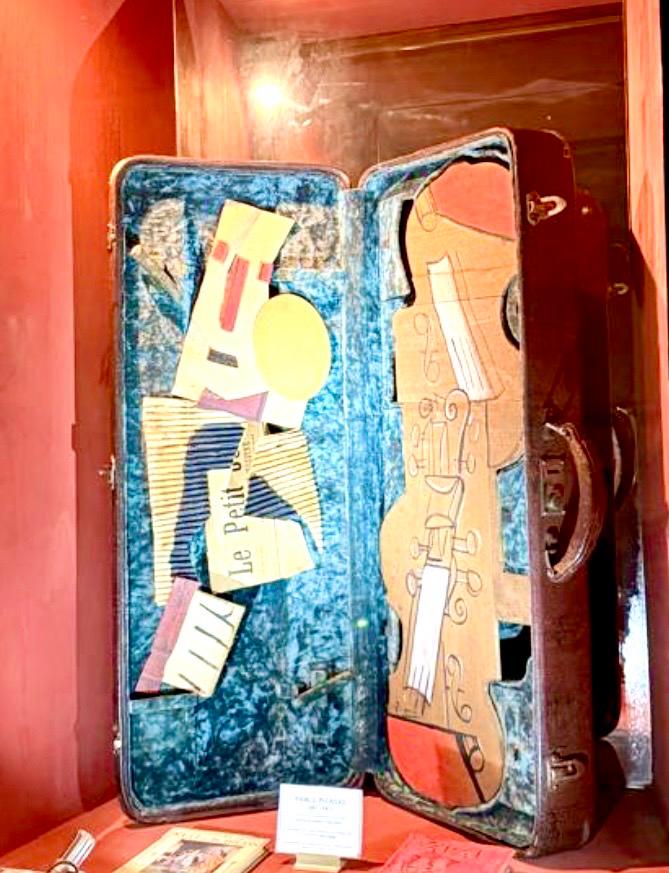
The object is known today as Estuche para dos violines — Case for Two Violins. Having passed through a succession of Spanish cultural institutions since its emergence from obscurity, it is now on public view at Museo Cromática in Toledo, an institution devoted to the encounter between painting and music. The museum presents it as a work by Pablo Picasso, a violin case transformed through collage during the years surrounding the birth of Synthetic Cubism. Toledo’s municipal authorities likewise announced the exhibition as Picasso, el violín mágico.
It is difficult to imagine a more appropriate setting. Here is an object in which music does not merely provide a subject for painting: the two have physically become one.
But the most extraordinary part of its story may be the simple reason why a work bearing Picasso’s signature could have remained outside the recognised history of Picasso for so long.
It was forgotten.
The work that disappeared without disappearing
There is a tendency, when a previously unknown work associated with a major artist suddenly emerges, to imagine intrigue: a disputed attribution, a concealed collection, a wartime disappearance, perhaps an elaborate art-world scandal.
The history of Case for Two Violins is at once less dramatic and considerably more romantic.
The present owner, the Venezuelan artist Marcos Salazar Ruiz, inherited the object from his father, who, according to the Fundación Antonio Pérez, acquired it in approximately 1954–55. At some point the case ceased to be regarded as something demanding attention. It was placed in a trunk in the storage area of an apartment in Caracas and remained there, beyond the sight of curators, scholars, dealers and the institutions that construct the accepted histories of great artists. Fundación Antonio Pérez
This distinction is crucial. The object did not vanish because it had been rejected by Picasso scholarship. It was absent from Picasso scholarship because, for decades, it was simply not there to be studied.
Salazar eventually rescued it from the trunk and brought it to Spain. Its re-emergence began a remarkable institutional journey. It was exhibited for a year at the Museo del Real Conservatorio Superior de Música de Madrid, subsequently at the Centro Cultural San Clemente in Toledo and then at the Fundación Antonio Pérez’s Museo de Obra Gráfica in San Clemente. Today it is at Museo Cromática.
Thus began the transformation of a forgotten family possession into an object of serious investigation.
And the deeper investigators looked, the more intriguing the case became.
A signature put on trial
A signature reading “Picasso” is seductive. It is not proof.
The owners of works associated with artists of Picasso’s stature know this only too well. A name can be copied; signatures can be added; convincing pastiches can be manufactured. The question therefore had to move beyond whether the inscription looked like Picasso.
In January 2017, the Santiago-based specialist firm VeriArt completed an extraordinary 136-page examination of Case for Two Violins. Its remit extended far beyond handwriting. The investigation encompassed the signature, physical and chemical examination of the constituent materials, microscopic study, pigments, wood, cardboard, printed matter and an extensive historical and aesthetic analysis. Reporte Experticia N° 353 – Pic…
The signature analysis is striking.
Rather than comparing the inscription with one or two convenient examples, the investigators worked from a reference universe of 350 accepted Picasso signatures. From that body they identified five recurring graphic phenomena that they regarded as sufficiently stable to form part of Picasso’s individual writing identity.
They examined the construction of the letters, their relative proportions, the relationship between the two ss, the peculiar formation of the final o, the spacing between P, i and c, and the relationship of the letters to the baseline.
The signature on the violin case corresponded with all five.
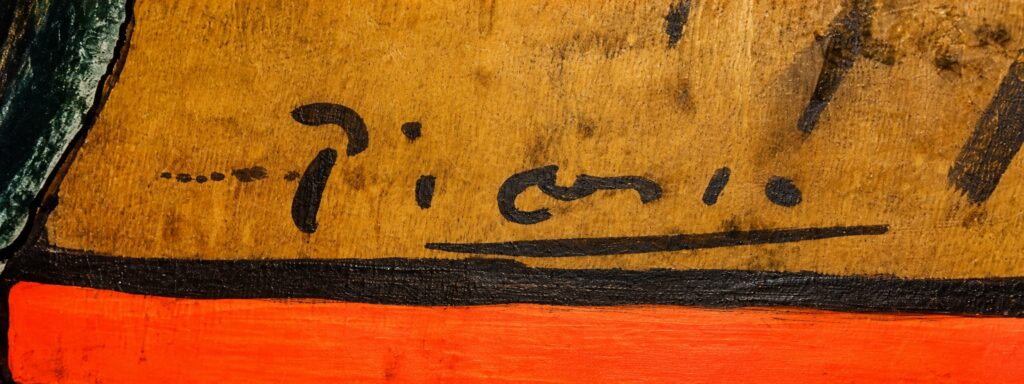
The report consequently found morphological correspondence between the questioned signature and Picasso’s authentic signatures sufficient to establish what it termed a technical presumption of authorship. Reporte Experticia N° 353 – Pic…
But this was only the beginning.
For if someone had simply placed Picasso’s name upon an unrelated old object, the object itself might eventually betray the deception.
Instead, the materials began telling their own story.
A time capsule made of scraps
One of the great paradoxes of Cubism is that Picasso and Georges Braque helped revolutionise Western art using things that most people would have thrown away.
Newspapers. Wallpaper. Cardboard. Packaging. Printed lettering. Scraps of ordinary paper.
In 1912 Braque introduced pasted paper into his Cubist compositions, inaugurating what became known as papier collé. Picasso immediately recognised the possibilities of the discovery. MoMA identifies Braque’s experiments that year with newspaper, wallpaper and other papers as the origin of the technique; the Metropolitan Museum records Picasso following Braque’s example in September 1912. The Museum of Modern Art
The revolution was conceptual as much as aesthetic.
A piece of newspaper no longer had to be painted to resemble newspaper. The newspaper itself could enter the picture. Representation and reality began to collide.
That is precisely what happens inside the violin case.
On its left-hand side, the musician is not conventionally painted. He is constructed. Paper, cardboard, printed material and a few graphic interventions coalesce into a human figure. On the other side, the violins are not simply images painted onto a flat ground: wooden forms occupy actual space.
The humble materials matter enormously.
The VeriArt investigation identified spruce and poplar in the wooden components, materials considered compatible with woods found in Picasso’s sculptural practice. It identified corrugated cardboard, another material entirely at home in the experimental vocabulary of Cubist construction. The white, red and black pigments could not independently provide a date — a limitation the report explicitly acknowledges — but the investigators found them compatible with materials available to and used within Picasso’s Cubist milieu. Reporte Experticia N° 353 – Pic…
Then there were the pieces of printed paper.
They proved to be far more than decoration.
One fragment was traced to the French newspaper Le Petit Journal of 14 January 1893. Another came from Historias de Ruiz de Alarcón, published by the Barcelona house Araluce in 1914. Fragments were also identified from Zizi. Historia de un gorrión de París, although the precise edition could not be established conclusively.
The newspaper fragment was subjected to comparison with an authentic copy. The investigators concluded that the paper and printing characteristics corresponded and that the fragment incorporated into the collage was indeed material dating from 1893. The Ruiz de Alarcón fragment was compared with the first edition of 1914. Reporte Experticia N° 353 – Pic…
That 1914 fragment is particularly important.
It gives the object a terminus post quem: the completed collage cannot pre-date material physically incorporated into it.
The report ultimately concluded that the printed materials were chronologically consistent with a work made around 1914–15 and that its style, technique and materials corresponded to the period of Synthetic Cubism. Reporte Experticia N° 353 – Pic…
And 1914 is not an arbitrary date in Picasso’s career.
It takes us directly into the laboratory Picasso shared with Georges Braque.
Two men reinventing art
It is almost impossible to understand Case for Two Violins without understanding Picasso’s extraordinary relationship with Braque.
Their collaboration during the development of Cubism was one of the great creative partnerships in the history of modern art. They looked at one another’s work, responded to one another’s discoveries and pushed each other further. For a period their artistic dialogue became so intimate that distinguishing invention from response can sometimes seem almost beside the point.
Braque’s contribution is especially relevant here because music was central to his Cubist vocabulary. Violins, guitars, clarinets and mandolins recur throughout his work. MoMA notes both the importance of musical instruments in Braque’s art and his close collaboration with Picasso in the development of Cubism. The Museum of Modern Art
And then came collage.
Braque’s Guitar of 1913, for example, combines printed and painted paper, charcoal, pencil and gouache. MoMA describes the invention of collage by Braque and Picasso in 1912 as a radical shift in Western art: actual fragments of the material world entered the artwork and challenged the assumption that art had to represent reality rather than incorporate it. The Museum of Modern Art
Picasso’s Man with a Hat and a Violin of 1912 is perhaps still more revealing in relation to the Toledo object. Picasso used cut newspaper and charcoal to construct the image of a man holding a violin. Pieces of Le Journal cease to function principally as newspaper and instead become components of a figure and an instrument. The Metropolitan Museum of Art
A century later, open Case for Two Violins and the intellectual kinship is difficult to ignore.
There is the musician.
There is the violin.
There is the printed word.
There is the transformation of ordinary matter into representation.
Yet the violin case goes further still, because its very container participates in the game.
The case is the clue
The most fascinating element of Case for Two Violins may ultimately be neither the signature nor the individual materials.
It may be the case itself.
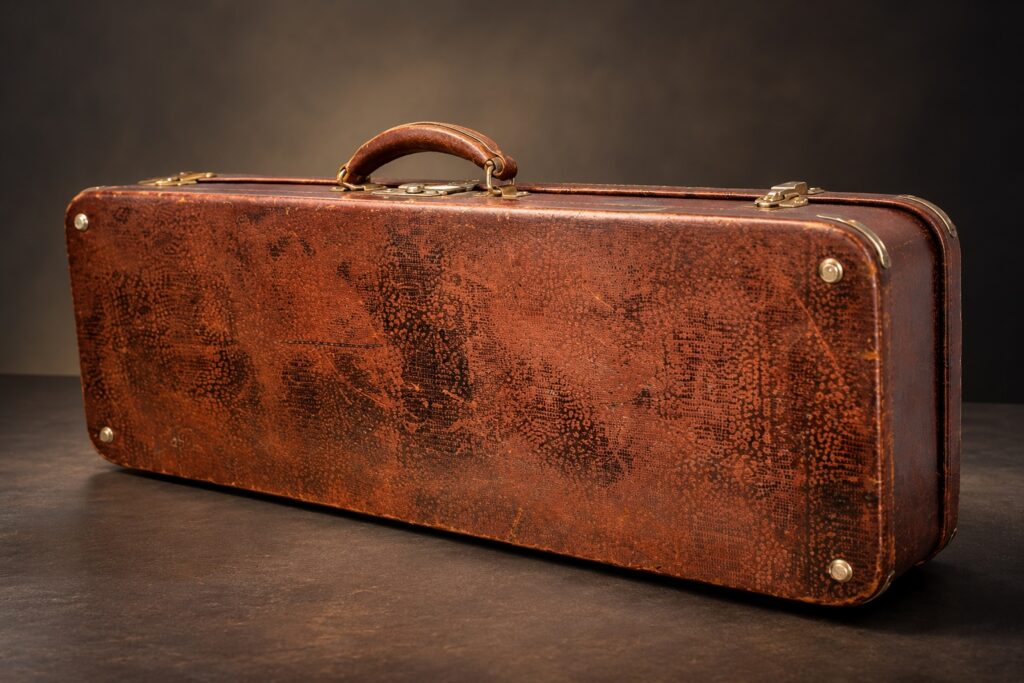
This is not simply a collage placed inside an old violin case. The case determines the meaning of the work.
Closed, it is an object designed to contain musical instruments.
Opened, it contains representations of those instruments.
Reality has been turned inside out.
The container becomes the support; the support becomes part of the image; the image becomes three-dimensional; and the real object whose purpose was to transport violins becomes a work in which violins are reconstructed from wood, line and colour.
It is difficult to imagine a more characteristically Cubist joke.
The VeriArt study perceptively describes the opening of the case in theatrical terms: almost as though a curtain has been drawn aside to reveal a musician and his instrument. The spectator is confronted with an ambiguous territory between two and three dimensions — painting, collage, construction and object occupying the same physical space.
The report goes so far as to suggest that the work might be understood as a kind of ready-made ante litteram. The phrase requires caution: this is not a Duchampian readymade in the later Dada sense. Yet the conceptual anticipation is intriguing. An everyday manufactured object has been deprived of its ordinary function, altered and recontextualised until its identity becomes unstable.
Is it still a violin case?
Is it a painting?
Is it sculpture?
Is it collage?
The most interesting answer is that it is all of them.
And this places the object squarely within one of Picasso’s most radical periods, when he was already demolishing the boundaries between painting and sculpture through his revolutionary constructions.
A secret dialogue with Braque?
There is an even more tantalising detail buried among the scraps of paper.
The investigators noticed that the words “Le Petit” appear in the composition alongside material taken from Zizi. Read together, they can suggest Le Petit Zizi. The report then draws attention to Braque’s Petit Oiseau of 1913 and wonders whether there might be an intentional dialogue between the two works.
It is an interpretation, not forensic proof, and should be treated as such.
But it is exactly the sort of possibility that makes the object worthy of deeper scholarly attention.
Picasso and Braque were not artists working independently in adjacent rooms of art history. During these crucial years they were engaged in an intense creative conversation. Ideas passed between them. Materials migrated from everyday life into their work. Musical instruments became vehicles for dismantling and reconstructing visual reality.
The violin case seems to speak the same language.
And its chronology places it at the end of that extraordinary period.
In 1914 the conversation was violently interrupted. Europe went to war. Braque entered military service, and the intense partnership that had produced Cubism in the preceding years was broken. MoMA dates the separation of their paths to Braque’s enlistment at the outbreak of the First World War. The Museum of Modern Art
If the dating proposed by the forensic and contextual investigation is correct, Case for Two Violins belongs to that extraordinary threshold: the culmination of one artistic revolution and the destruction of the European world in which it had been created.
That gives the object an unexpected poignancy.
What the investigation actually concluded
With a discovery of this importance, precision matters.
The scientific investigation did not claim that one miraculous test had produced the word PICASSO in flashing lights. Authentication does not work like that.
Instead, evidence accumulated.
The signature exhibited the identified morphological characteristics of Picasso’s hand.
The woods were compatible.
The corrugated cardboard was compatible.
The pigments presented no chronological contradiction and were consistent with materials of the period.
The printed fragments were genuine old materials, including the 1893 Le Petit Journal and the 1914 Historias de Ruiz de Alarcón.
The artistic construction corresponded in technique, material and visual language with Synthetic Cubism.
And the proposed date corresponded with Picasso’s production around 1914–15.
The report’s final conclusion is therefore important precisely because it is measured. Drawing upon these different forensic and aesthetic disciplines, it states that the synthetic collage made within the case for two violins possesses characteristics of authenticity. Reporte Experticia N° 353 – Pic…
That is an unusually substantial body of evidence for an object that spent decades beyond the reach of Picasso scholarship.
One step, however, remains.
The final blessing
The work still awaits formal recognition by the Picasso Committee.
That should not be confused with a controversy over the object. The circumstances are rather more unusual.
For much of its modern existence, there was simply no work before the Picasso establishment to recognise. It was not circulating through Parisian galleries or appearing at auction. It was not hanging anonymously in a provincial collection awaiting a curator’s rediscovery.
It was in a trunk.
By the time it emerged, generations of Picasso scholarship had already constructed the familiar corpus of the artist’s work without it.
Formal recognition would therefore represent not the end of an argument so much as the completion of an extraordinary process of recovery: from forgotten object, to rediscovery, to forensic investigation, to public exhibition and, potentially, into the accepted catalogue of one of the most thoroughly studied artists in history.
The distinction is important.
There is no need to manufacture a controversy when the reality is considerably more interesting.
From Caracas to Toledo
The public history of the work since its rediscovery has gradually gathered momentum.
In 2021 the Diputación de Toledo exhibited it at the Centro Cultural San Clemente, noting that it had passed the VeriArt expert examination. It subsequently travelled to the Fundación Antonio Pérez, which exhibited it in 2022 and recorded both its inheritance by Marcos Salazar and its extraordinary history in the Caracas trunk. Diputación de Toledo
Today, the circle has tightened further.
At Museo Cromática in Toledo, an institution conceived around the union of music and visual art, the violin case has found a setting that seems almost uncannily made for it. The museum describes the object as a Picasso and emphasises precisely the conjunction of music, painting and collage that makes it so unusual. Museo Cromática
Visitors can now stand before something that for decades existed in darkness.
And perhaps that physical encounter matters.
Photographs communicate the basic construction of the piece, but they cannot entirely reproduce its strangeness. This is an artwork whose identity depends upon an act of revelation. A violin case ordinarily promises an instrument inside. This one opens onto a Cubist world in which the musician and his instruments have been dismantled and remade from the physical remnants of everyday life.
The very experience of discovering it echoes the history of its rediscovery.
A case is opened.
A trunk is opened.
A mystery is opened.
And gradually, the evidence comes to light.
The Picasso history forgot
There is a temptation to believe that nothing genuinely important can remain undiscovered about an artist such as Picasso.
His life has been dissected almost day by day. His studios were photographed. His lovers, friendships, rivalries and dealers have been chronicled exhaustively. His paintings and sculptures command some of the highest prices in the international market. Museums and archives across the world have devoted decades to documenting his output.
But art history is not omniscient.
It depends upon objects remaining visible.
A work that passes from studio to dealer, from dealer to collector, from collector to auction house and finally to museum leaves a documentary wake behind it. Exhibitions generate catalogues. Sales generate invoices. Scholars generate references. Each appearance reinforces the work’s place within the accepted history of an artist.
Put the same object into a trunk for several decades and the mechanism stops.
That may ultimately be the simplest explanation for the strange absence of Case for Two Violins.
It was not necessarily lost in the romantic sense of the word.
It was merely forgotten.
And sometimes being forgotten is enough.
What has emerged from that darkness is an object demanding serious attention: a work bearing a signature whose morphology has been compared with hundreds of accepted Picasso signatures; incorporating materials subjected to microscopic and chemical examination; containing printed fragments independently traced to publications of 1893 and 1914; employing the language of papier collé, construction and musical imagery at precisely the moment Picasso and Braque were transforming those things into a new conception of art.
None of those elements should be exaggerated. They do not need to be.
Taken together, they make the story remarkable enough.
More than a century after its apparent creation, Case for Two Violins has travelled from obscurity into the public gaze. Its materials have been examined. Its signature has been subjected to forensic comparison. Its scraps of newspaper and books have yielded their dates. Its strange marriage of music, collage, sculpture and found object leads directly back to the revolutionary conversation between Picasso and Braque.
And now it hangs in Toledo, awaiting the final institutional recognition that would complete its return to art history.
There is something almost too perfect about the metaphor.
Picasso and Braque took fragments of the ordinary world — newspapers, wallpaper, cardboard, scraps and discarded things — and showed that looking differently could transform them into art.
More than a hundred years later, the same principle seems to have been applied to the work itself.
For decades, it was simply an old violin case lying forgotten inside a trunk in Venezuela.
Someone finally opened it.
And inside was Picasso.


 Elga Wimmer
 Pablo H. Aznar
 Clifford Thurlow
 Antoinette Martin
 Romy Querol
 Merritt Becker
 Carlos Mundy

 Laura Mitchell
 Mayte Hidalgo